Thin Section Bearings: What to Specify Before You Buy


Thin Section Bearings: What to Specify Before You Buy
Inner and outer diameters are not enough.
To specify thin section bearings correctly, you must define the cross-section consistency, internal clearance class (such as C3 or C4), preload level, contact angle, and cage material. Ignoring these parameters leads to premature vibration, thermal failure, and costly downtime in automation systems.
I learned this the hard way in a humid industrial zone in Dong Nai Province, Vietnam. I was handling procurement for an automation facility, tasked with sourcing replacements for robotic joint assemblies. The request seemed simple: match the inner and outer dimensions of the failed units. I focused entirely on the ID and OD, assuming the geometry was the only critical factor. The new units arrived, looked identical, and were installed. For the first few hundred hours, everything ran smoothly. Then, the joints began to vibrate. The noise grew into a distinct rattle, forcing a full line stoppage. The downtime cost far exceeded the price difference between the cheap replacements and the correct specifications. The issue was not the size; it was the internal clearance and preload. The original design required a specific preload to maintain rigidity under dynamic loads, but the replacements had standard clearance that allowed excessive play once the lubricant warmed up. That experience shifted my focus from mere dimensions to the internal geometry that dictates performance. [NEED_CITE: impact of preload on bearing stiffness and service life]
When you look at a thin section bearing, the wall thickness is minimal relative to the diameter. This structural reality means that external mounting conditions and internal specifications have a magnified effect on performance. You cannot treat them like standard deep-groove bearings. The following sections break down the exact parameters you need to verify before placing an order for thin section bearings.
Why Basic Dimensions Aren’t Enough?
Most buyers start their search with a part number or a set of millimeter measurements for the bore and outside diameter. While these are necessary for fit, they do not guarantee function. In thin section bearings, the cross-section is constant and slender. This makes the bearing highly sensitive to shaft and housing tolerances, as well as internal geometric variations.
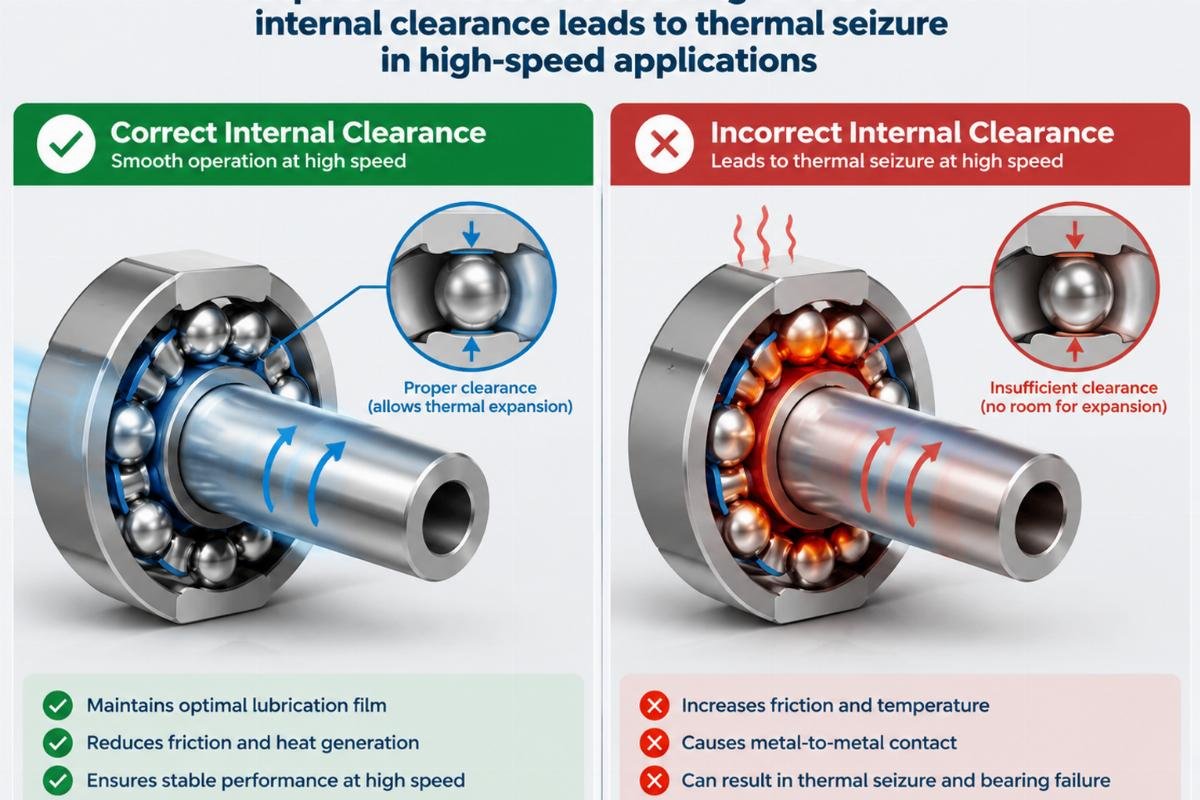
Consider the case of a high-speed spindle application in a precision machining center. The operator replaced worn bearings with units that matched the ID and OD perfectly. However, the new bearings had a different internal radial clearance. Under high-speed rotation, the inner ring expanded thermally. Because the clearance was too tight, the balls were crushed between the races, generating excessive heat. The spindle seized within hours. Had the buyer specified the correct ISO clearance class, such as C3, which accounts for thermal expansion, the bearing would have accommodated the growth without binding. [NEED_CITE: ISO standards for bearing internal clearance classes]
The key difference lies in the internal geometry. Two bearings with the same outer dimensions can have different raceway curvatures, ball sizes, and number of balls. These factors determine load distribution and fatigue life. When you specify thin section bearings, you are not just buying a ring with holes; you are buying a precise mechanical interface. If the cross-section tolerance is not held tightly, the bearing may not seat correctly in the housing, leading to elliptical deformation and premature failure.
What Clearances and Preloads Should You Specify?
Clearance and preload are often confused, but they serve different purposes. Clearance is the space between the balls and the raceways when the bearing is unloaded. Preload is an axial load applied to eliminate this clearance and create stiffness. Getting this balance wrong is a common cause of failure in automation.
Many engineers assume that tighter preload is always better for precision. This is a dangerous misconception. Excessive preload increases friction, which generates heat. In high-speed joints, this heat can degrade the lubricant and soften the steel, leading to catastrophic failure. Conversely, insufficient preload allows the balls to skid rather than roll, causing wear patterns known as false brinelling.
| Parameter | Incorrect Specification | Correct Specification Strategy |
|---|---|---|
| Internal Clearance | Standard (C0) for all applications | Match to speed and temperature; use C3 or C4 for high-speed or high-temp environments [NEED_CITE: ABMA guidelines on clearance selection] |
| Preload Level | Maximum possible for rigidity | Calculate based on load and speed; use light preload for high-speed, medium for general precision |
| Thermal Consideration | Ignored | Account for differential expansion between shaft and housing materials |
A European wind farm operator faced this issue with yaw drive mechanisms. The initial specification called for heavy preload to resist wind loads. However, the ambient temperature fluctuations caused the housing to expand and contract. The heavy preload, combined with thermal expansion, led to overheating during peak sun hours. By switching to a specified light preload with a C3 clearance, the system accommodated thermal changes while maintaining sufficient rigidity for operational loads. The service life extended noticeably, reducing maintenance frequency.
When you specify thin section bearings, always define the operating temperature range and speed. This allows the supplier to recommend the appropriate clearance class. Do not leave this to chance.

How Do Contact Angles and Cage Materials Impact Applications?
The contact angle determines how a bearing handles axial versus radial loads. In thin section bearings, which are often used in robotic arms and rotary tables, the load direction can change dynamically. A standard radial contact bearing may not handle significant axial loads, leading to edge loading and rapid wear.
For applications with combined loads, an angular contact design is often necessary. The contact angle, typically 15 or 25 degrees, allows the bearing to support axial forces more effectively. Specifying the wrong contact angle can result in uneven load distribution across the balls, reducing the overall load capacity of the assembly.
Cage material is another critical factor that is frequently overlooked. The cage holds the balls in place and guides them through the load zone. Common materials include polyamide (nylon) and brass. Polyamide cages are lightweight and offer good sliding properties, making them suitable for high-speed applications where centrifugal forces are a concern. However, they have temperature limits and may not be suitable for harsh chemical environments. Brass cages are more robust and can handle higher temperatures and heavier loads, but they add weight and may limit maximum speed due to higher inertia.
In a space-constrained automation project for a packaging line, weight reduction was a primary goal. The engineer initially specified brass cages for durability. However, the added mass increased the inertia of the rotating assembly, requiring larger motors and driving up energy costs. By switching to high-performance polyamide cages, the weight was reduced significantly while maintaining adequate strength for the application. This change allowed for downsizing the drive components, resulting in a more efficient system. [NEED_CITE: effect of cage material on bearing speed limit and weight]
When you specify thin section bearings, consider the load direction and environmental conditions. Choose the contact angle that matches your load profile and the cage material that fits your speed and temperature requirements.

What Quality Checks Are Essential Before Ordering?
The market for thin section bearings is flooded with counterfeit and substandard products. A bearing that looks correct on the outside may have poor surface finish, incorrect hardness, or contaminated steel inside. These defects are not visible until the bearing fails, often after a short period of operation.
To avoid this, you must verify traceability and certification. Genuine bearings from reputable manufacturers like SKF, FAG, NSK, NTN, TIMKEN, KOYO, NACHI, and IKO come with complete documentation. This includes material certificates, heat treatment records, and dimensional inspection reports. Without these documents, you have no proof of quality.
I once sourced a batch of bearings for a mining crusher rebuild. The supplier offered a price that was significantly lower than the market average. The bearings looked fine, but there was no traceability documentation. After installation, the bearings failed within weeks due to spalling caused by poor steel cleanliness. The cost of the replacement bearings and the downtime far exceeded the initial savings. Since then, I insist on full traceability for every order.
When you specify thin section bearings, ask for the following:
- Original manufacturer’s certificate of conformity.
- Material test reports verifying steel grade and cleanliness.
- Dimensional inspection data for critical parameters.
- Proof of authorized distribution chain.
Sourcing from a supplier who offers one-stop solutions for genuine brands ensures that you receive authentic products with complete traceability. This reduces the risk of counterfeit failures and provides peace of mind for critical applications. Technical selection support is also valuable here, as experienced suppliers can help verify that your specifications match the application requirements.

Conclusion
Specifying thin section bearings requires precision beyond basic dimensions.
Focus on cross-section consistency, internal clearance, preload, contact angle, and cage material to ensure reliability. Verify traceability and certifications to avoid counterfeit risks. Proper specification prevents premature failure and minimizes downtime in demanding automation and industrial applications.
Need a quote for the bearings in this article?
Send your part numbers and get price, stock and lead time within 4 hours.

Written by
authorEditor covering global sourcing, supplier verification, and industrial product knowledge. Content is compiled from manufacturer specifications, industry standards, and hands-on experience with international B2B buyers. Every article is fact-checked before publishing to help procurement professionals make informed decisions.
View all posts

