Gen 1 vs Gen 2 vs Gen 3 Wheel Hub Bearing Wholesale Supplier

Gen 1 vs Gen 2 vs Gen 3 Wheel Hub Bearing Wholesale Supplier
Newer is not always better.
Selecting the right hub bearing generation is not about upgrading to the newest, but matching structural designs to specific load, speed, and space constraints to prevent premature failure. For distributors and aftermarket suppliers, the core decision logic rests on three pillars: load capacity requirements, installation complexity, and environmental sealing needs. Gen 1 offers superior serviceability in extreme off-road conditions; Gen 2 reduces assembly time for passenger cars through flange integration; and Gen 3 provides compact, high-load solutions with integrated ABS sensors for modern commercial vehicles. Misalignment between these structural features and actual operating conditions is the primary driver of warranty claims.
I still remember the silence in the boardroom in Monterrey when a fleet manager slid a worn-out inner ring across the table. It was from a batch of heavy-duty trucks I had supplied months earlier. The bearings were technically correct by part number, but they were Gen 1 units installed in a muddy, high-shock mining environment without proper preload adjustment. The inner race had spun, scoring the shaft and destroying the hub. That loss was not due to material defect, but a mismatch between the bearing generation and the application’s harsh reality. Since then, I have stopped looking at hub bearings as simple replacement parts. I view them as structural components where the generation type dictates the entire maintenance lifecycle. [NEED_CITE: common failure modes in wheel end assemblies per ISO 15243]
Understanding these differences is critical for any Gen 1 vs Gen 2 vs Gen 3 Wheel Hub Bearing Wholesale Supplier aiming to reduce returns and build trust with technical buyers.
What Are the Structural Differences Between Gen 1, 2, and 3?
The evolution from Gen 1 to Gen 3 is not merely a change in size, but a fundamental shift in how the bearing integrates with the vehicle’s suspension and braking systems.
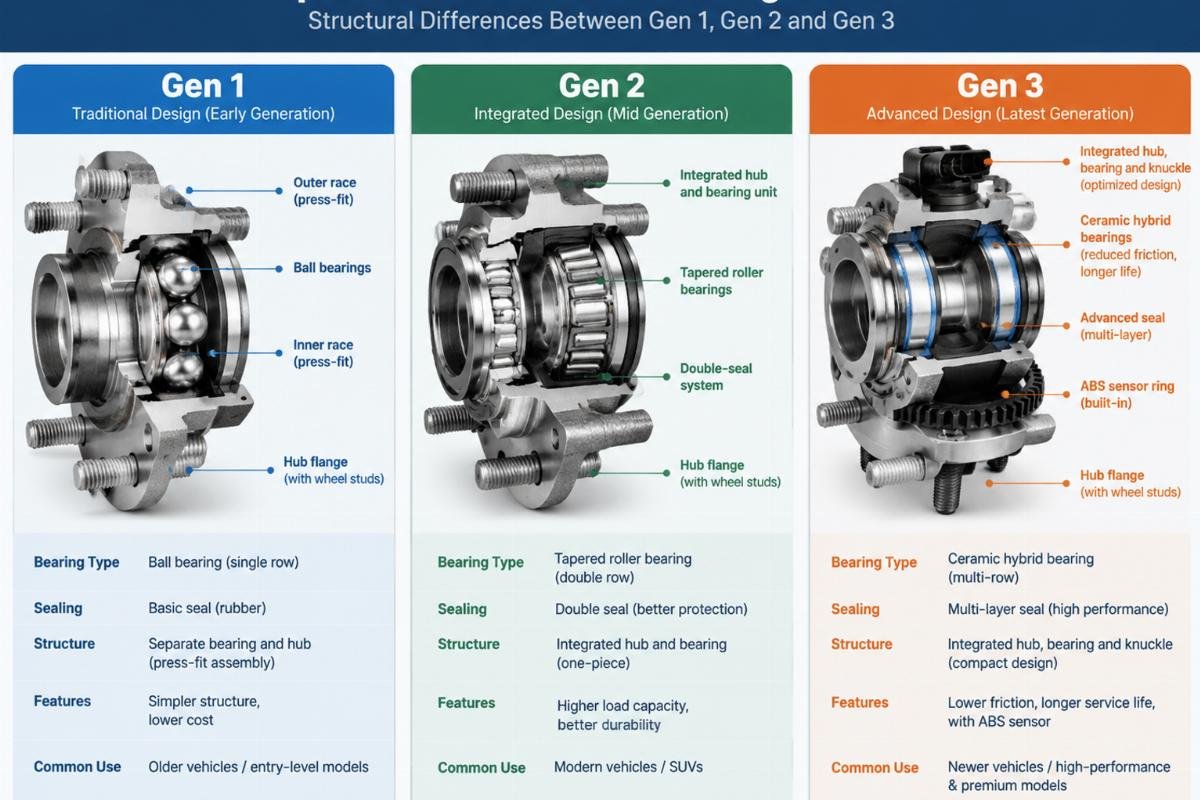
Gen 1 bearings are the traditional tapered roller or ball bearing sets. They consist of an inner ring, outer ring, rolling elements, and a cage. Crucially, they are non-integrated. This means the hub, brake rotor, and steering knuckle are separate components that must be assembled around the bearing. The bearing itself does not have a flange. Installation requires precise press-fitting of the inner and outer races into the hub and knuckle respectively. This design allows for individual component replacement, which is why it remains popular in heavy-duty off-road applications where field repairability is valued over assembly speed.
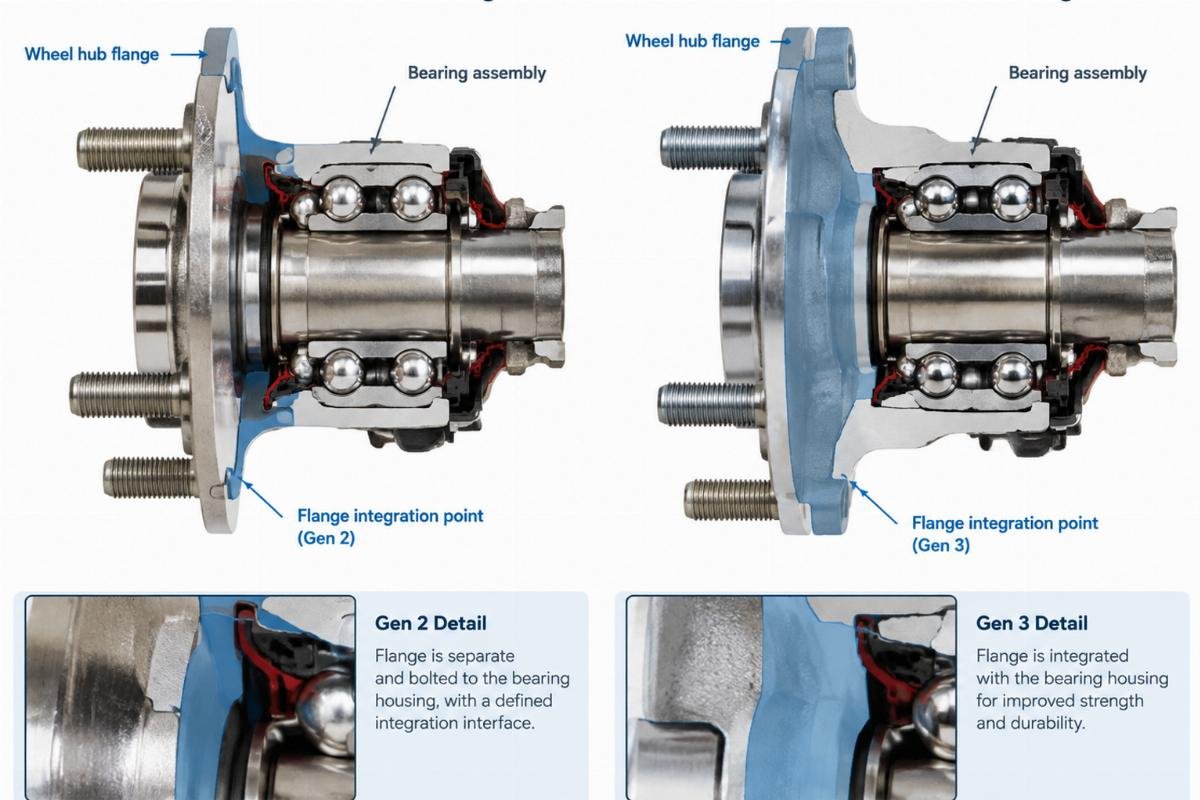
Gen 2 bearings introduced the first level of integration. The outer ring is extended to form a flange that bolts directly to the steering knuckle or axle housing. This eliminates the need to press-fit the outer race, reducing installation error and time. However, the inner ring is still pressed onto the shaft or spindle. Gen 2 units often come pre-greased and sealed, making them maintenance-free for the life of the component. This generation struck a balance between cost and ease of assembly, becoming the standard for many passenger car platforms in the late 1990s and early 2000s.
Gen 3 bearings represent full integration. Both the inner and outer rings feature flanges. The inner flange bolts to the drive shaft or spindle, while the outer flange bolts to the knuckle. This design completely eliminates press-fitting during installation, relying solely on bolted connections. Gen 3 units are typically more compact, allowing for larger brake rotors or improved suspension geometry. They also frequently integrate ABS sensor rings or active tone wheels directly into the seal or inner ring structure. [NEED_CITE: SAE J2908 standards for wheel bearing assembly interfaces]
| Feature | Gen 1 | Gen 2 | Gen 3 |
|---|---|---|---|
| Flange Integration | None | Outer Ring Only | Inner and Outer Rings |
| Installation Method | Press-fit (Inner & Outer) | Press-fit (Inner), Bolt-on (Outer) | Bolt-on (Inner & Outer) |
| Serviceability | High (Component Replacement) | Low (Unit Replacement) | Low (Unit Replacement) |
| ABS Integration | External Sensor | Often Integrated | Fully Integrated |
| Typical Application | Heavy Duty, Off-Road, Older Models | Passenger Cars, Light Trucks | Modern Passenger, Commercial Vehicles |
For a Gen 1 vs Gen 2 vs Gen 3 Wheel Hub Bearing Wholesale Supplier, stocking the correct generation is vital. A customer attempting to install a Gen 3 unit on a hub designed for Gen 1 will face immediate fitment issues, not because the bearing is defective, but because the mounting interface is fundamentally different.
How Do Load Capacities and Speed Ratings Compare?
Load capacity is not solely determined by the physical size of the bearing but by its internal geometry and contact angles. Gen 1 tapered roller bearings, for instance, excel in handling combined radial and axial loads due to their line contact design. This makes them exceptionally robust for heavy-duty applications where shock loads are common, such as in mining or construction equipment. However, their performance is highly dependent on correct preload adjustment during installation. Too loose, and they wobble; too tight, and they overheat. [NEED_CITE: dynamic load rating calculation methods per ISO 281]
Gen 2 and Gen 3 bearings typically use ball or tapered roller elements but are optimized for higher speeds and lower friction. The integration of the flange in Gen 2 and Gen 3 designs can sometimes limit the maximum load capacity compared to a similarly sized Gen 1 unit because the structural material is distributed differently. However, advancements in steel cleanliness and heat treatment have allowed Gen 3 units to achieve comparable or superior load ratings in a more compact package. This is crucial for modern vehicles where unsprung weight reduction is a key design goal.
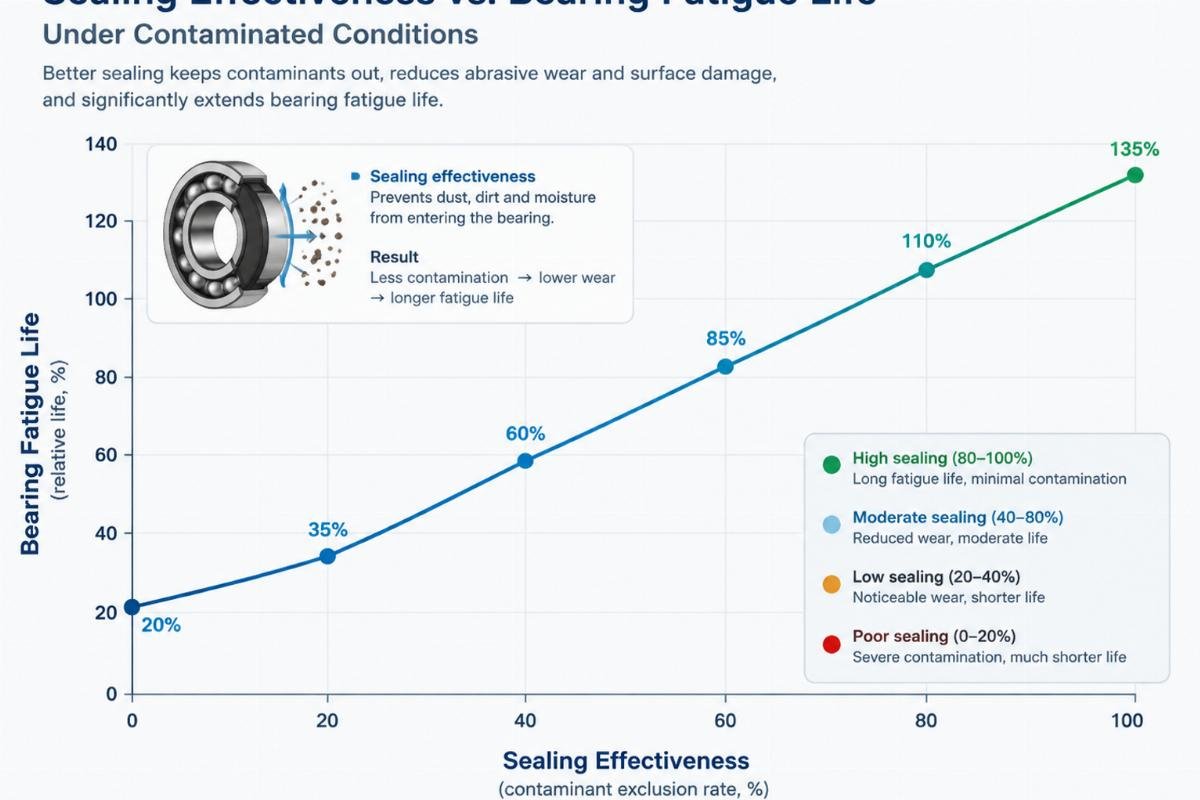
In high-speed passenger car applications, Gen 3 bearings often outperform Gen 1 due to better sealing and lubrication retention. The sealed nature of Gen 2 and Gen 3 units prevents contamination, which is a major cause of premature failure in high-speed rotations. In contrast, Gen 1 units, if not sealed properly or if the seal wears, are vulnerable to water and dirt ingress, leading to rapid degradation of the rolling elements.
A European wind farm operator once reported that switching from standard open bearings to sealed, integrated hub units (similar in concept to Gen 3 automotive bearings) for their auxiliary generator shafts reduced contamination-related failures significantly. While not automotive, the principle holds: integration enhances sealing integrity, which directly impacts load-carrying capability over time by maintaining lubricant quality. [NEED_CITE: effect of contamination on bearing fatigue life]
When advising clients, I emphasize that load rating sheets alone do not tell the whole story. The operating environment matters. A Gen 1 bearing might have a higher static load rating on paper, but in a wet, muddy environment, a Gen 3 sealed unit will likely last longer because it keeps the contaminants out. This nuance is what separates a order-taker from a trusted Gen 1 vs Gen 2 vs Gen 3 Wheel Hub Bearing Wholesale Supplier.
What Are the Installation and Maintenance Realities?
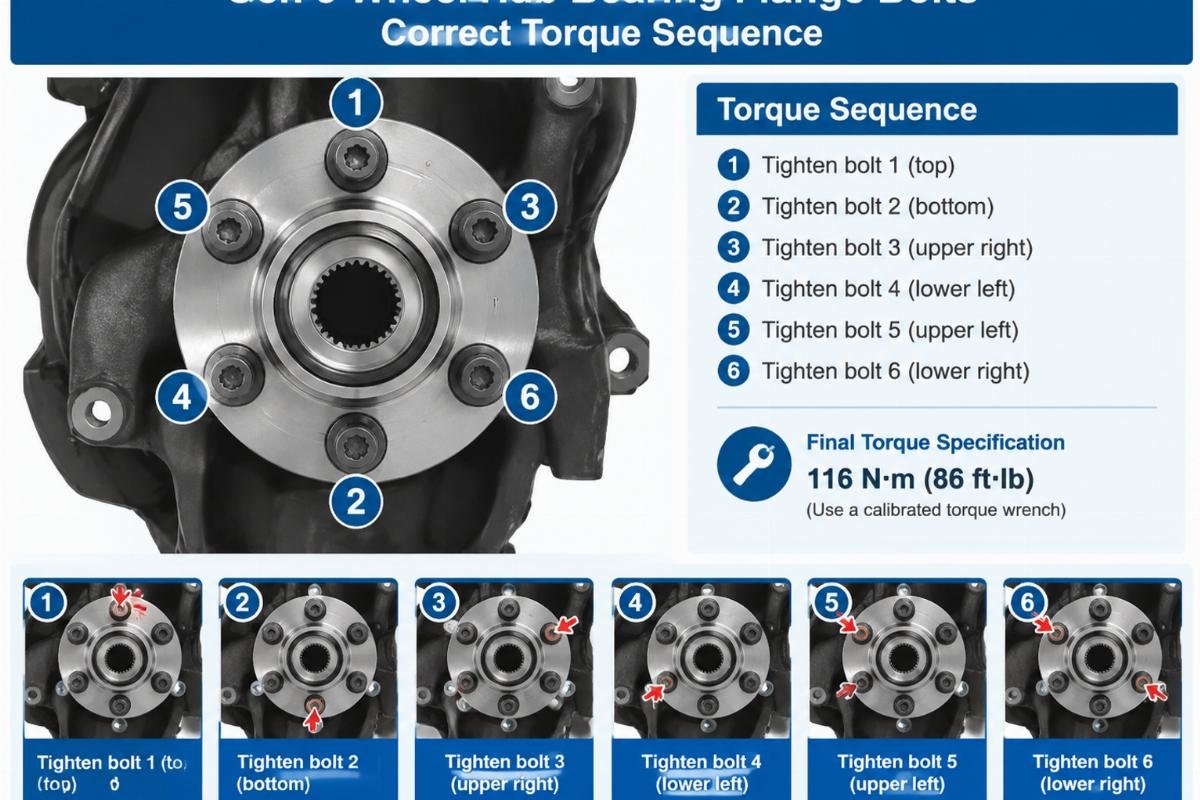
Installation errors are a leading cause of premature bearing failure, particularly for Gen 2 and Gen 3 units. Because these generations rely on bolted flanges, improper torque application can distort the bearing races, leading to internal preload changes and early fatigue. [NEED_CITE: recommended torque specifications for wheel hub flange bolts]
Gen 1 installations are labor-intensive and require specialized tools for pressing races. The advantage here is adjustability. In heavy-duty off-road scenarios, a mechanic can disassemble, clean, repack, and readjust a Gen 1 bearing. This serviceability is a key reason why Gen 1 remains dominant in certain agricultural and mining sectors. If a bearing fails in a remote location, replacing a single race is far easier than sourcing an entire integrated hub assembly.
Gen 2 and Gen 3 units are designed as “replace-only” components. Once sealed, they cannot be serviced. If the bearing fails, the entire unit must be replaced. This increases the parts cost but drastically reduces labor time. For high-volume repair shops dealing with passenger cars, this trade-off is economically favorable. However, it requires distributors to stock complete assemblies rather than just rolling elements, increasing inventory complexity.
A common mistake I see is the use of impact guns to tighten Gen 3 flange bolts. This uneven torque can warp the thin flange sections, causing the bearing to run out of true. Always recommend using a torque wrench and following the manufacturer’s star-pattern tightening sequence. Additionally, Gen 3 units with integrated ABS sensors require careful handling. Dropping the unit or striking the sensor area can damage the internal magnetic encoder, leading to ABS faults even if the bearing itself is mechanically sound.
How to Match the Right Generation to Your Application?
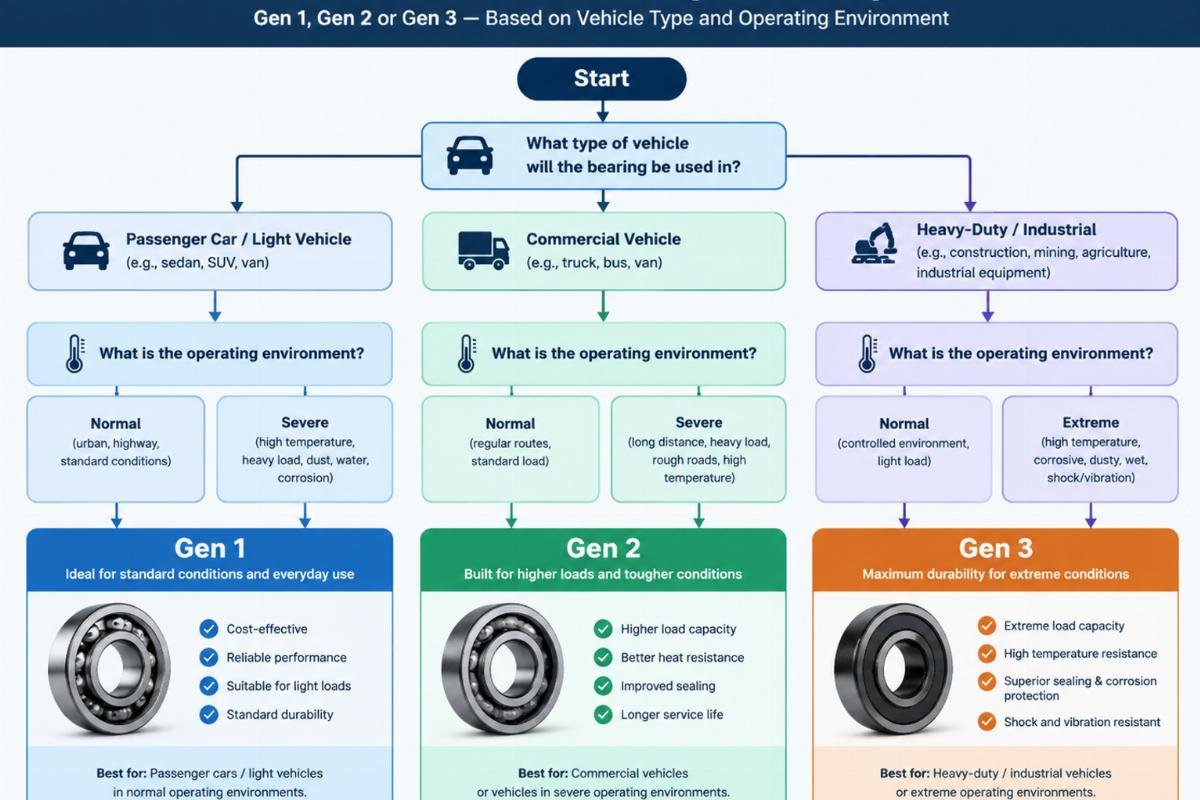
Selection logic should start with the vehicle type and operating environment, not just the part number.
For heavy-duty fleets operating in muddy, unpaved conditions, Gen 1 is often the superior choice. Its robustness and serviceability allow for maintenance in the field. The ability to repack grease and replace worn races extends the overall life of the hub assembly, even if individual maintenance intervals are shorter. In these scenarios, the “sealed for life” promise of Gen 3 is less valuable because the seals may be compromised by extreme debris, and the unit cannot be repaired.
For passenger car aftermarket and light commercial vehicles, Gen 2 and Gen 3 are the standard. The focus here is on installation speed and reliability. Gen 2 is a good middle ground for older platforms, while Gen 3 is essential for newer vehicles with integrated ABS and stability control systems. Distributors serving these markets must ensure they have cross-reference data that accurately maps OEM part numbers to the correct generation. A mismatch here leads to immediate returns.
For commercial vehicle upgrades, especially those involving ABS integration, Gen 3 is the only viable option. However, attention must be paid to the sensor type. Some Gen 3 units use passive tone rings, while others use active magnetic encoders. Mixing these up will result in system failures. Technical support is crucial here. A Gen 1 vs Gen 2 vs Gen 3 Wheel Hub Bearing Wholesale Supplier must provide clear documentation on sensor compatibility, not just dimensional data.
We maintain a multi-brand inventory including SKF, FAG, TIMKEN, NSK, and NTN, allowing us to offer cross-brand equivalents when specific OEM parts are unavailable. Our technical team assists in verifying generation types and sensor specifications to ensure the selected bearing matches the vehicle’s engineering requirements. This approach minimizes warranty claims and builds long-term partnerships with distributors who value accuracy over mere availability.
Conclusion
Match the structure to the stress.
Choosing between Gen 1, Gen 2, and Gen 3 is not about chasing the latest technology but about aligning the bearing’s structural characteristics with the specific demands of load, speed, and maintenance accessibility. Gen 1 offers rugged serviceability for harsh environments, while Gen 2 and Gen 3 provide efficiency and integration for modern automotive applications. Understanding these distinctions allows distributors to guide their customers toward solutions that minimize failure and maximize uptime.
Need a quote for the bearings in this article?
Send your part numbers and get price, stock and lead time within 4 hours.

Written by
authorEditor covering global sourcing, supplier verification, and industrial product knowledge. Content is compiled from manufacturer specifications, industry standards, and hands-on experience with international B2B buyers. Every article is fact-checked before publishing to help procurement professionals make informed decisions.
View all posts

