Miniature Bearings Sizes & Tolerances: Wholesale Supplier Guide


Miniature Bearings Sizes & Tolerances: Wholesale Supplier Guide
Smaller is not always cheaper, and matching outer dimensions does not guarantee interchangeability.
Selecting the correct miniature bearings sizes and tolerances requires exact matching of metric or inch series dimensions and ABEC tolerance grades to prevent high-speed vibration and premature failure. A mismatch in inner diameter deviation or radial clearance, even by a few microns, leads to catastrophic performance drops in precision equipment.
I still recall the humidity of the Apapa port in Lagos, where a container destined for a local dental clinic sat under customs hold. The packing list vaguely described the contents as “small bearings,” failing to distinguish between metric 682ZZ and inch R-series specifications. Without clear markings for the 2mm inner diameter or the specific tolerance band, the shipment languished. When finally released and installed, the dental handpieces vibrated violently at high RPMs. The standard tolerance bearings could not handle the rotational speed, resulting in a total write-off of the batch. That incident shifted my focus entirely to the microscopic details of micro bearing procurement. In the world of miniature bearings sizes and tolerances, an error of one micron is not a minor discrepancy; it is a functional failure.
Understanding these technical nuances is critical for buyers who need to avoid costly mismatches. The following sections break down the essential specifications and selection criteria.
What Are the Standard Size Series for Miniature Bearings?
Metric and inch series follow distinct dimensional standards that are not directly convertible.
Miniature bearings generally fall into two primary categorization systems: the metric series (such as the 68 and 62 series) and the inch series (often designated with an R prefix). While they may appear similar to the untrained eye, their internal geometry and load-carrying capabilities differ significantly. The metric system uses millimeters for all dimensions, adhering to ISO standards, while the inch series uses fractional or decimal inches, following ABMA specifications. [NEED_CITE: ISO 15 and ABMA standard dimension tables for miniature bearings]
A common mistake occurs when buyers assume that a bearing with a 6mm outer diameter in the metric series is identical to one with a similar measurement in the inch series. They are not. The ball size, raceway curvature, and cage design are optimized for their respective measurement systems. Substituting one for the other often results in improper fitment within the housing or on the shaft, leading to increased friction and heat generation.
| Feature | Metric Series (e.g., 68x) | Inch Series (e.g., R-x) |
|---|---|---|
| Dimension Unit | Millimeters (mm) | Inches (in) |
| Standard Body | ISO | ABMA/ANSI |
| Common IDs | 1mm, 2mm, 3mm, 4mm, 5mm | 1/16″, 3/32″, 1/8″, 5/32″ |
| Interchangeability | Not interchangeable with inch series | Not interchangeable with metric series |
| Availability | Global standard for most new OEM designs | Common in legacy US-designed equipment |
For a European medical device manufacturer, switching from an inch-based prototype to a metric production line without verifying the housing bore can cause assembly line stoppages. We once assisted a client whose automated assembly robots kept rejecting bearings because the slight difference in outer diameter tolerance between the two systems caused jamming in the feeder tubes. By cross-referencing the miniature bearings sizes and tolerances against the original equipment manufacturer’s drawings, we identified the mismatch and supplied the correct metric equivalents, restoring production flow.

Buyers must verify the original design specification before placing orders. If the equipment was designed in the United States decades ago, it likely uses inch series. Newer global designs typically favor metric. Confusing the two is a frequent source of procurement errors.
How Do Tolerance Grades Impact High-Speed Performance?
Higher ABEC ratings do not always mean better performance for every application, but they are critical for high-speed stability.
Tolerance grades define the allowable deviation in dimensions such as bore diameter, outer diameter, and width. For miniature bearings, the Annular Bearing Engineers Committee (ABEC) scale is the most common reference, ranging from ABEC 1 to ABEC 9. Higher numbers indicate tighter tolerances and greater precision. [NEED_CITE: ABMA Standard 20 for radial ball bearings tolerance classes]
In high-speed applications, such as dental handpieces, spindle motors, or gyroscopes, vibration is the enemy. Standard tolerance bearings (ABEC 1 or 3) may have slight irregularities in the raceway surface or ball roundness. At low speeds, these imperfections are negligible. However, as rotational speed increases, these tiny deviations amplify, causing chatter, noise, and excessive heat. This vibration accelerates fatigue in the bearing steel, leading to premature spalling and failure.
Consider a case involving a high-speed textile spindle manufacturer. They initially sourced standard tolerance bearings to cut costs. The machines ran smoothly at moderate speeds but exhibited severe chatter when operated at maximum RPM. The vibration amplitude exceeded acceptable limits, causing thread breakage and quality defects. After switching to ABEC 7 precision grade bearings, the vibration levels dropped noticeably, and the lifespan of the spindles extended substantially. The initial higher cost of the precision bearings was offset by the reduction in scrap rate and maintenance downtime.
| ABEC Grade | Precision Level | Typical Application | Vibration Control |
|---|---|---|---|
| ABEC 1 | Standard | General purpose, low speed | Basic |
| ABEC 3 | Normal | Electric motors, appliances | Moderate |
| ABEC 5 | Precision | Machine tools, automotive | Good |
| ABEC 7 | High Precision | Dental handpieces, high-speed spindles | Excellent |
| ABEC 9 | Ultra Precision | Aerospace, instrumentation | Superior |
It is important to note that tighter tolerances require more precise manufacturing processes, which increases cost. Therefore, selecting the appropriate grade depends on the operational requirements. For a simple conveyor roller, ABEC 1 is sufficient. For a precision instrument rotating at tens of thousands of RPM, ABEC 7 or higher is mandatory. Understanding miniature bearings sizes and tolerances helps buyers avoid over-specifying for low-demand applications or under-specifying for critical high-speed tasks.

When sourcing, request certification that verifies the tolerance grade. Genuine manufacturers provide test reports detailing the actual measured deviations. This documentation is essential for quality assurance and traceability.
Metric vs. Inch: Why Are They Not Interchangeable?
Even if outer dimensions appear similar, metric and inch bearings have different internal geometries and load ratings.
The belief that a metric bearing can replace an inch bearing if the outer diameter fits is a dangerous misconception. While the outer dimensions might be close enough to slide into a housing, the internal components are designed differently. The ball diameter, number of balls, and contact angles are calculated based on the specific measurement system. Using a metric bearing in an inch-designed application can lead to uneven load distribution.
For instance, an inch series R-632 bearing has specific load capacity characteristics that differ from a metric 682 bearing, even if their overall envelopes are comparable. The raceway grooves in the inch series are cut to accommodate inch-sized balls, which may not seat correctly with metric balls. This misalignment causes point loading, where stress concentrates on small areas of the raceway rather than being distributed evenly. Over time, this leads to rapid wear and catastrophic failure.
A buyer in the Middle East once attempted to substitute metric bearings for inch series in older mining equipment control panels. The bearings fit physically, but within weeks, several units failed due to overheating. The root cause was the mismatch in internal clearance and ball size, which generated excessive friction. By providing the correct inch series replacements and explaining the technical differences, we helped the client avoid further equipment damage.
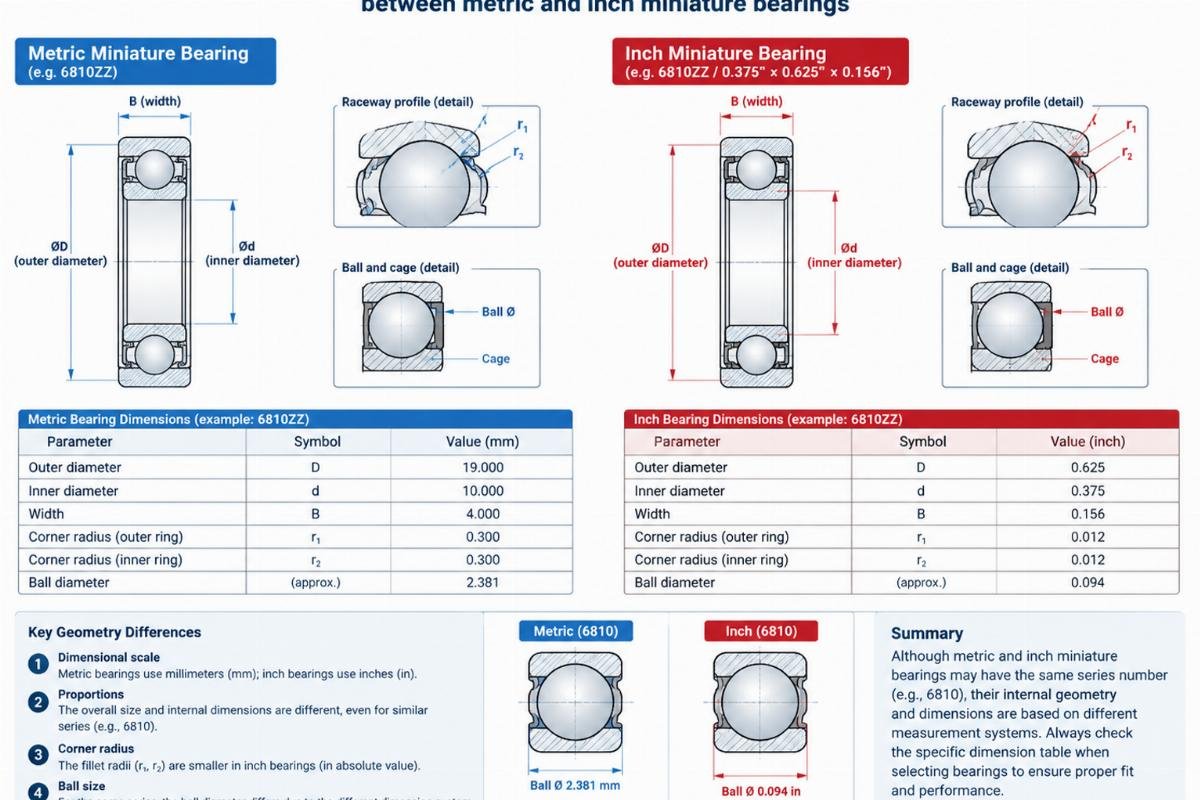
To avoid such issues, always consult the original equipment manual or measure the existing bearing precisely using micrometers. Do not rely on visual inspection alone. If the original part number is unclear, cross-reference it with authoritative catalogs from brands like NSK, NTN, or SKF. Our team provides cross-brand equivalence consultation to ensure that the selected miniature bearings sizes and tolerances match the original design intent exactly.
How to Verify Quality and Avoid Customs Issues?
Precise documentation and traceability are as critical as the physical specifications of the bearing.
Customs authorities worldwide are increasingly strict about imported industrial components. Vague descriptions on packing lists, such as “bearings” or “parts,” often lead to delays, inspections, and additional fees. For miniature bearings, the description must include the specific type, series, dimensions, and material. For example, instead of “small ball bearing,” use “Deep Groove Ball Bearing, Metric 682ZZ, Steel, ABEC 3.”
Traceability documentation is another key factor. Genuine bearings come with certificates of origin and material test reports. These documents prove that the products are authentic and meet international standards. Counterfeit or substandard bearings often lack this paperwork or provide forged documents that do not withstand scrutiny. In one instance, a shipment to South America was held up because the packing list did not specify the tolerance grade. The customs officers required clarification to determine the correct tariff code. Providing detailed technical data sheets and original manufacturer certificates resolved the issue quickly.
| Document Type | Purpose | Importance |
|---|---|---|
| Commercial Invoice | Value declaration for customs | Mandatory |
| Packing List | Detailed item description and quantity | Mandatory |
| Certificate of Origin | Proof of manufacturing country | Often required for tariffs |
| Material Test Report | Verification of steel quality and hardness | Critical for quality assurance |
| Tolerance Certification | Proof of ABEC grade compliance | Essential for precision applications |
Ensuring that all documents align with the physical goods prevents costly rework and delays. Buyers should work with suppliers who offer complete traceability documentation and can provide mixed-brand consolidation with accurate labeling. This level of detail supports smooth global shipping and ensures that the miniature bearings sizes and tolerances specified are delivered without administrative hurdles.

By prioritizing accurate documentation and verified quality, buyers can streamline their supply chain and reduce the risk of operational disruptions.
Conclusion
Precision in specification prevents failure in operation.
Selecting the right miniature bearings involves more than just matching outer dimensions. It requires a deep understanding of metric versus inch series, the impact of ABEC tolerance grades on high-speed performance, and the importance of precise documentation. Errors in these areas lead to vibration, premature failure, and customs delays. By focusing on verified specifications and traceable sources, buyers can ensure reliability and efficiency in their precision equipment.
Need a quote for the bearings in this article?
Send your part numbers and get price, stock and lead time within 4 hours.

Written by
authorEditor covering global sourcing, supplier verification, and industrial product knowledge. Content is compiled from manufacturer specifications, industry standards, and hands-on experience with international B2B buyers. Every article is fact-checked before publishing to help procurement professionals make informed decisions.
View all posts

