Obsolete Bearing Part Numbers: Source Discontinued Models from Global Supplier


Obsolete Bearing Part Numbers: Source Discontinued Models from Global Supplier
Most discontinued bearings are not actually unavailable; they are just hidden behind rigid brand loyalty.
Sourcing obsolete part numbers safely requires shifting from single-brand reliance to cross-brand equivalent matching and verified global spot inventory. This approach ensures authenticity, prevents equipment downtime, and avoids the high failure rates associated with refurbished counterfeit parts. By leveraging dimensional tolerance verification and traceability documentation, MRO managers can secure genuine replacements even when original manufacturers have ceased production.
I still remember the panic of a 3 AM call from an injection molding plant in Dongguan. The main spindle had seized, halting a critical production run. The required FAG bearing model had been discontinued years prior. The procurement team, desperate to restart the line, bought a batch from a local stall at a rock-bottom price. It seemed like a win until the machine burned out again three days later. Upon disassembly, we found the “new” bearings were poorly refurbished fakes with worn raceways masked by fresh grease. That incident shifted my entire perspective. I realized that finding a discontinued bearing is not about finding the lowest price or the exact same box; it is about finding a dimensionally precise, authentic alternative that keeps the machine running. [NEED_CITE: common failure modes in refurbished bearings per ISO 15243]
Why Do Bearings Become Discontinued and What Are the Risks?
Manufacturers frequently update their portfolios, phasing out older designs to streamline production or introduce new materials. For end-users, this creates a supply gap. The risk is not just the lack of availability, but the surge in counterfeit goods that fill the void. When a part number is marked as discontinued, unauthorized sellers often repackage used or low-quality domestic bearings as genuine stock.
The primary danger lies in material integrity. Genuine bearings from brands like SKF, FAG, or NSK undergo strict quality controls regarding steel purity and heat treatment. Counterfeit or improperly refurbished units lack these controls, leading to premature fatigue and catastrophic failure. [NEED_CITE: impact of steel cleanliness on bearing fatigue life] A failed bearing in a mining conveyor or a marine winch does not just cost the price of the part; it incurs massive demurrage charges or production losses.

Sourcing from a reliable discontinued bearings sourcing partner means bypassing these risks. Instead of gambling on unknown market stock, buyers should seek suppliers who maintain verified spot inventory or have established channels for genuine old-stock retrieval. The goal is to secure a component that meets the original engineering specifications, regardless of its current production status.
How to Verify Authenticity When Sourcing Obsolete Stock?
Authenticity is proven through documentation, not just packaging.
When dealing with obsolete items, the standard box-and-label check is insufficient because counterfeiters often replicate packaging with high fidelity. Verification must rely on traceability documents and physical inspection parameters.
First, request the original certificate of conformity or material test reports. While some very old stock may lack digital records, reputable suppliers can provide batch-level traceability linking the item to its manufacturing origin. Second, inspect the bearing itself. Genuine products have precise laser etching or stamping that is clean and uniform. Refurbished fakes often show signs of re-polishing or inconsistent font depths. [NEED_CITE: visual inspection guidelines for bearing authentication]
A US-based distributor once shared how they avoided a costly mistake by demanding full traceability for a batch of discontinued TIMKEN tapered roller bearings. The supplier provided the original mill certificates, confirming the steel grade and heat treatment batch. Without this paper trail, the buyer would have had no way to distinguish the genuine old stock from a high-quality fake.

For those learning how to source obsolete bearing part numbers, the key is to treat documentation as part of the product. A supplier who cannot provide verifiable proof of origin should be avoided, regardless of their price advantage. This diligence protects your operation from the hidden costs of premature failure.
Cross-Brand Equivalents: A Practical Matrix for Obsolete Replacements
Dimensional equivalence often provides a more immediate solution than waiting for obsolete stock.
Many engineers assume that if a specific SKF or FAG part number is discontinued, the machine must wait for a custom order or a risky surplus find. In reality, international standards ensure that bearings with the same boundary dimensions (bore, outside diameter, width) are often interchangeable across brands. This is where cross-referencing becomes a powerful tool.
| Dimension Parameter | Verification Method | Risk Level if Ignored |
|---|---|---|
| Bore Diameter | Micrometer measurement | High (Shaft fit issue) |
| Outside Diameter | Caliper check | High (Housing fit issue) |
| Width | Precision gauge | Medium (Clearance issue) |
| Internal Clearance | C2/C3/C4 standard check | High (Thermal expansion mismatch) |
| Precision Class | P0/P4/P5 rating verification | Medium (Vibration/Noise) |
[NEED_CITE: ISO dimensional standards for rolling bearings]
Consider a mining operation facing a gearbox overhaul. The original specified bearings were no longer produced. By analyzing the dimensional requirements and load ratings, we identified equivalent models from other premium brands like NSK or NTN that were still in active production. These alternatives met the same ISO precision classes and load capacities. The result was a significant reduction in procurement lead time and cost, without compromising performance.
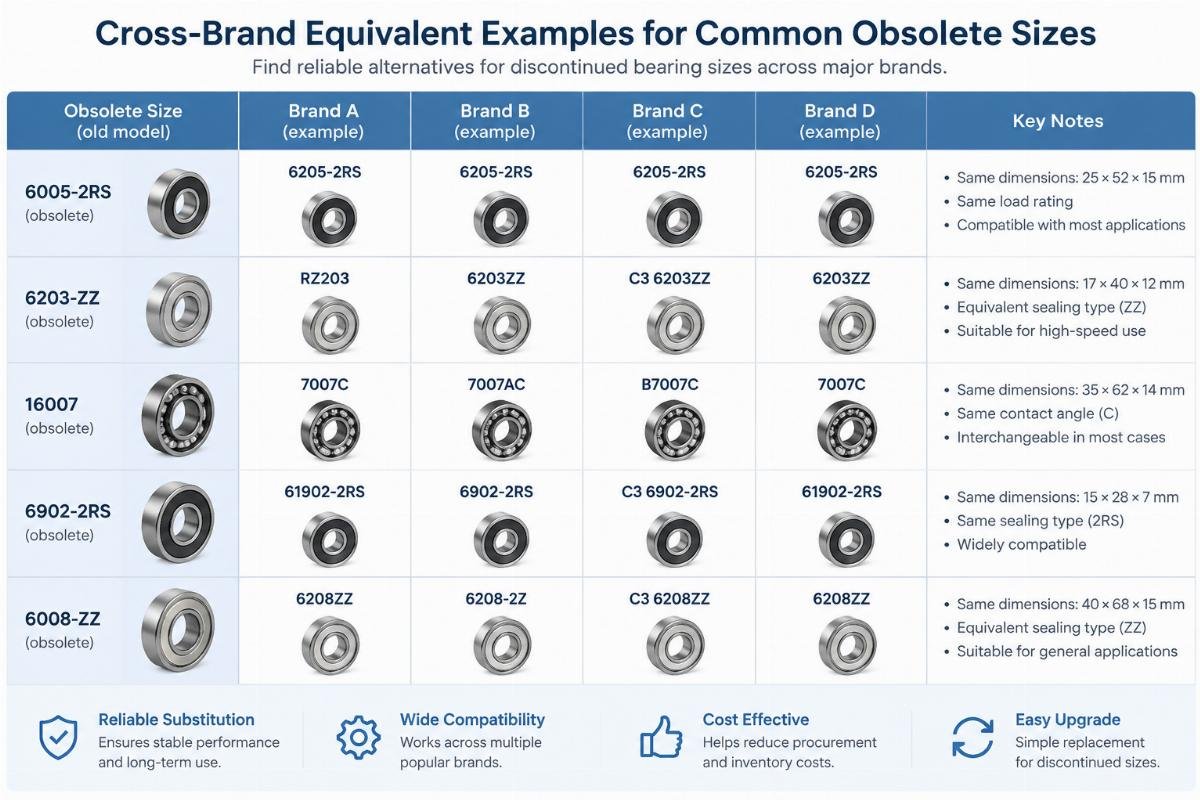
This strategy is central to effective discontinued bearings sourcing. It shifts the focus from a specific part number to the functional requirements of the application. By understanding that a discontinued FAG unit can often be replaced by a currently produced NSK equivalent with identical dimensions, buyers can unlock a much larger pool of available, genuine inventory. This approach requires technical consultation to ensure that internal clearances and cage materials are also compatible, but it eliminates the dependency on scarce obsolete stock.
Single-Unit Emergency vs. Bulk Consolidation: Which Sourcing Strategy Fits?
Urgency dictates the channel, but volume dictates the cost structure.
Sourcing strategies must align with the operational need. For emergency repairs, such as a marine winch failure causing vessel demurrage, speed is the only metric that matters. In these cases, accessing global spot inventory is critical. A supplier with a vast warehouse of mixed-brand stock can ship a single unit immediately, avoiding the weeks-long lead times of official channels.
Conversely, for planned overhauls or stocking programs, bulk consolidation offers better value. Regional distributors in markets like Southeast Asia or Latin America often need to fill containers with mixed SKUs to serve local workshops. Here, the ability to consolidate various brands and sizes into one shipment reduces logistics costs significantly. [NEED_CITE: global trade logistics efficiency for mixed cargo]
A European wind farm operator faced a similar dilemma. They needed a mix of standard and special bearings for a scheduled maintenance window. By consolidating their order with a global supplier, they secured genuine products from multiple brands in one shipment, ensuring all parts arrived simultaneously. This prevented the delay of having to coordinate multiple deliveries from different official sources.

Understanding how to source obsolete bearing part numbers involves recognizing when to pay a premium for speed and when to leverage volume for cost savings. For MRO managers, maintaining a relationship with a supplier who offers both single-unit emergency dispatch and bulk consolidation flexibility is essential. This dual capability ensures that whether it is a midnight breakdown or a quarterly restock, the right parts are available without unnecessary delay or expense.
Conclusion
Stop chasing ghost part numbers and start solving mechanical problems.
Sourcing discontinued bearings is less about finding the exact original box and more about securing a genuine, dimensionally accurate replacement. By embracing cross-brand equivalents and verifying authenticity through traceability, you can keep aging equipment running safely. Whether you need a single urgent unit or a consolidated bulk order, the right partner provides access to global spot inventory and technical expertise. This approach minimizes downtime and protects your operation from the risks of counterfeit parts. Mastering discontinued bearings sourcing ensures your supply chain remains resilient, even when manufacturers move on.
Need a quote for the bearings in this article?
Send your part numbers and get price, stock and lead time within 4 hours.

Written by
authorEditor covering global sourcing, supplier verification, and industrial product knowledge. Content is compiled from manufacturer specifications, industry standards, and hands-on experience with international B2B buyers. Every article is fact-checked before publishing to help procurement professionals make informed decisions.
View all posts

