Bearing Sample Orders: Cost, Timeline & Tests from Wholesale Supplier


Bearing Sample Orders: Cost, Timeline & Tests from Wholesale Supplier
Sample orders are not mini production runs.
Bearing sample orders require explicit alignment on testing standards, packaging specifications, and hidden validation costs to prevent costly rejections. The primary risk is not the unit price, but the mismatch between application-specific requirements like vibration grades and clearance classes, and the generic stock provided without third-party verification.
I learned this the hard way in Chicago. A local MRO distributor requested deep groove ball bearings for a critical pump repair. I treated the request like a scaled-down bulk order, shipping standard cartons with no special protection. I did not calculate the cost of individual wooden pallets or third-party vibration testing fees, nor did I confirm the specific clearance tolerance required for their high-speed application. The client rejected the entire batch upon arrival, citing excessive noise and a lack of traceability documentation. The loss covered several times the value of the bearings themselves, mostly in international express freight. That incident reshaped my approach. Now, every bearing sample order begins with a detailed technical alignment, not just a commercial quote. [NEED_CITE: common causes of bearing sample rejection in industrial procurement]
This guide breaks down the real logistics of securing valid samples. It covers the true cost structure, realistic timelines, and the non-negotiable testing parameters that separate a useful prototype from a rejected shipment.
What Are the True Costs of Bearing Samples?
The unit price is often the smallest component of the total sample cost.
Most buyers focus on the per-unit price of the bearing itself. However, bearing sample orders involve significant ancillary expenses that do not scale linearly with volume. When ordering a full container, packaging and logistics are amortized across thousands of units. For a sample, these fixed costs become dominant.
Custom crating is a major factor. Standard export cartons may suffice for bulk shipments where pallets are stacked and secured. For single-unit or small-batch samples, especially heavy spherical roller bearings or large tapered roller bearings, individual wooden crates or reinforced pallets are necessary to prevent damage during fragmented freight handling. The cost of such custom packaging can exceed the value of the bearing. [NEED_CITE: impact of packaging on bearing integrity during less-than-container-load shipping]
Third-party testing fees also add up. If your application requires verified noise levels or specific vibration data, you cannot rely on standard factory certificates. Engaging an independent lab to perform vibration analysis according to ISO standards incurs a fixed fee per test, regardless of sample size. This fee is often hidden until the invoice arrives.
| Cost Component | Bulk Order Allocation | Sample Order Reality |
|---|---|---|
| Unit Price | Dominant cost driver | Minor portion of total |
| Packaging | Amortized over volume | High fixed cost per unit |
| Testing | Batch-level certification | Per-sample lab fees |
| Freight | Container rate efficiency | Premium express/courier rates |
| Documentation | Standard batch certs | Individual traceability reports |
A European wind farm operator once requested cylindrical roller bearings for a gearbox trial. They assumed the sample cost would mirror their bulk pricing. The final invoice included charges for individual anti-corrosion wrapping, a dedicated vibration test report from an accredited lab, and air freight surcharges for hazardous material declarations due to preservative oils. The total cost was substantially higher than the initial estimate, but it prevented a catastrophic failure in the field. [NEED_CITE: importance of preservative oil handling in air freight]

Understanding these components allows for accurate budgeting. It also highlights why flexible MOQ structures and consolidated sourcing solutions are vital. By grouping multiple sample requests into a single logistical event, buyers can mitigate some of these fixed costs.
How Long Does the Sample Timeline Actually Take?
Sample lead times are driven by QC alignment, not just inventory availability.
Buyers often expect sample dispatch within days if the item is in stock. This assumption ignores the time required for technical validation. A bearing sitting on a shelf is not ready for shipment until it meets the specific criteria of the sample request.
The first delay usually occurs during clearance tolerance confirmation. Standard stock may carry a default clearance class, but high-precision applications require specific classes like C3 or C4. Verifying these dimensions takes time, especially if the bearings need to be measured individually rather than relying on batch averages. [NEED_CITE: ISO standards for bearing radial internal clearance measurement]
Noise level reporting is another bottleneck. Generating a valid noise report requires running the bearing on a specialized test rig under controlled conditions. This process cannot be rushed. For automotive aftermarket suppliers evaluating tapered roller bearings, the absence of a noise report can lead to immediate rejection. Waiting for this document adds days to the timeline.
Specialized freight further extends the schedule. Unlike bulk cargo moved via sea freight, samples often move via air courier. However, certain bearings with specific lubricants or magnetic properties may require additional screening or documentation, causing customs delays.
A Middle East steel mill needed spherical roller bearings for a conveyor upgrade. They required urgent samples to test fitment before a shutdown. While the bearings were in stock, the requirement for a detailed dimensional tolerance report and a specific noise grade verification added nearly a week to the process. The delay was frustrating, but it ensured the samples matched the engineering specs, avoiding a costly fitment error during the maintenance window.

Realistic planning accounts for these technical steps. Rushing the QC phase to meet an arbitrary dispatch date often results in sending unverified parts, which defeats the purpose of sampling.
What Must Be Tested Before Approval?
Validation requires verifying noise, vibration, clearance, and traceability.
Sending a bearing without data is risky. Acceptance should depend on verifiable metrics, not just visual inspection. The core parameters for bearing sample orders include vibration, clearance, and documentation.
Vibration testing is critical for rotating equipment. Standards range from Z1V1 to Z4V4, indicating different levels of acceptable vibration velocity and displacement. For high-speed spindles or precision machine tools, lower vibration grades are non-negotiable. Without a test report confirming the grade, the bearing is a guess. [NEED_CITE: ABMA/ABEC precision grades and vibration limits]
Clearance classes determine how the bearing fits and performs under thermal load. Classes range from C2 to C5. Using a standard clearance bearing in a high-temperature environment can lead to seizure, while excessive clearance in a precision application causes instability. Confirming the actual measured clearance against the specified class is essential.
Traceability documentation proves authenticity. In markets flooded with counterfeits, a certificate of origin and material traceability chain are vital. This is especially true for premium brands like SKF, FAG, or NSK. Missing docs raise immediate red flags for compliance officers and quality managers.
An auto aftermarket supplier once received tapered roller bearings that looked perfect visually. However, the dimensional tolerances did not match the OEM specifications, and the traceability documents were missing. The parts were rejected because they could not be verified as genuine, posing a liability risk for their end customers.

Testing transforms a physical part into a validated component. It provides the data needed to make an informed decision about bulk procurement.
How to Avoid Sample Rejection?
Align on testing standards and packaging specs upfront.
Rejection usually stems from mismatched expectations, not product defects. Preventing this requires proactive communication before the order is placed.
First, define the testing standard. Do not assume “standard quality” is sufficient. Specify the required vibration grade, noise level, and clearance class. If third-party verification is needed, state this explicitly. This ensures the supplier prepares the correct testing protocols. [NEED_CITE: best practices for defining technical specifications in procurement]
Second, clarify packaging requirements. Will the samples be shipped via courier or freight? Do they need individual wooden crates, or is standard carton acceptable? For mixed-brand sample consolidation, ensure each brand’s packaging meets its specific preservation needs. Incorrect packaging leads to corrosion or damage, resulting in automatic rejection.
Third, verify documentation needs. Determine if material certificates, origin proofs, or specific test reports are required for customs or internal quality approval. Request these documents before shipment to avoid delays at destination.
A Latin American distributor requested deep groove ball bearings from multiple brands. By specifying the need for individual vibration reports and reinforced packaging for air freight upfront, they avoided the pitfalls that had plagued previous purchases. The samples arrived intact, with full documentation, allowing for rapid evaluation and subsequent bulk orders.
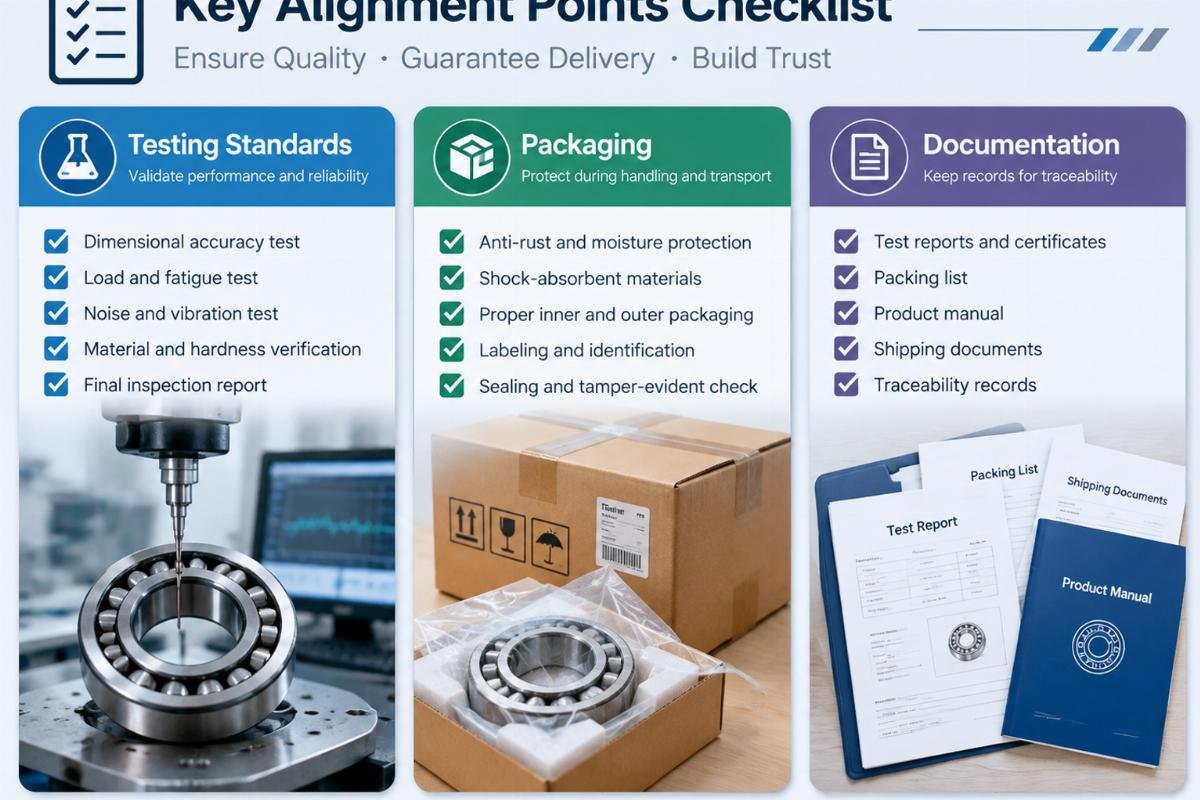
Proactive alignment turns the sample process into a reliable validation step. It minimizes waste and accelerates the path to full-scale procurement.
Conclusion
Bearing sample orders demand precision in logistics and validation.
Treating samples as miniature bulk orders leads to hidden costs and rejections. Success lies in aligning on testing standards, understanding the true cost structure, and allowing time for proper QC. By focusing on these details, buyers can secure valid data for confident purchasing decisions.
Need a quote for the bearings in this article?
Send your part numbers and get price, stock and lead time within 4 hours.

Written by
authorEditor covering global sourcing, supplier verification, and industrial product knowledge. Content is compiled from manufacturer specifications, industry standards, and hands-on experience with international B2B buyers. Every article is fact-checked before publishing to help procurement professionals make informed decisions.
View all posts