VCI Bearing Packaging for Export: Rust Prevention Wholesale Supplier

VCI Bearing Packaging for Export: Rust Prevention Wholesale Supplier
Heavy grease does not stop rust; it traps moisture.
The only reliable method to prevent bearing corrosion during high-humidity ocean freight is proper VCI packaging that creates a sealed micro-environment, surpassing traditional oil coating alone. This approach ensures product integrity for global distributors and OEMs by actively neutralizing corrosive agents rather than merely blocking them.
I still remember the sinking feeling when we opened a container in Santos. The deep groove bearings inside were meant for a major industrial client in Latin America. We had coated them heavily with standard anti-rust oil, assuming the thick layer would survive the thirty-to-forty-day transit through tropical humidity. It did not. The raceways were covered in reddish-brown rust spots. The oil had degraded and trapped condensation against the metal surface, accelerating the very damage it was supposed to prevent. That loss was significant, but the lesson was permanent. Since then, I have focused entirely on vapor phase corrosion inhibition. In high-salinity, high-humidity maritime environments, physical barriers like plastic wrap or oil films are insufficient because they fail to address the molecular presence of water vapor. [NEED_CITE: mechanism of VCI vs traditional barrier methods]
Understanding why traditional methods fail is the first step toward selecting the right solution. For buyers managing mixed-brand inventories or urgent MRO spare parts, the choice of packaging material directly impacts claim rates and customer trust.
Why does traditional oiling fail in ocean freight?
Oil degrades and traps condensation, whereas VCI provides active molecular protection.
Many procurement managers believe that applying a heavier coat of grease or oil will better protect bearings during long sea voyages. This is a dangerous misconception. Traditional oils act as a physical barrier, but they are permeable to water vapor over time. More critically, when temperature fluctuates during transit—common in containers moving from cold warehouses to hot equatorial ports—condensation forms. If this moisture gets trapped under a layer of oil, it creates an ideal environment for electrochemical corrosion. The oil prevents the water from evaporating, holding it against the steel surface.
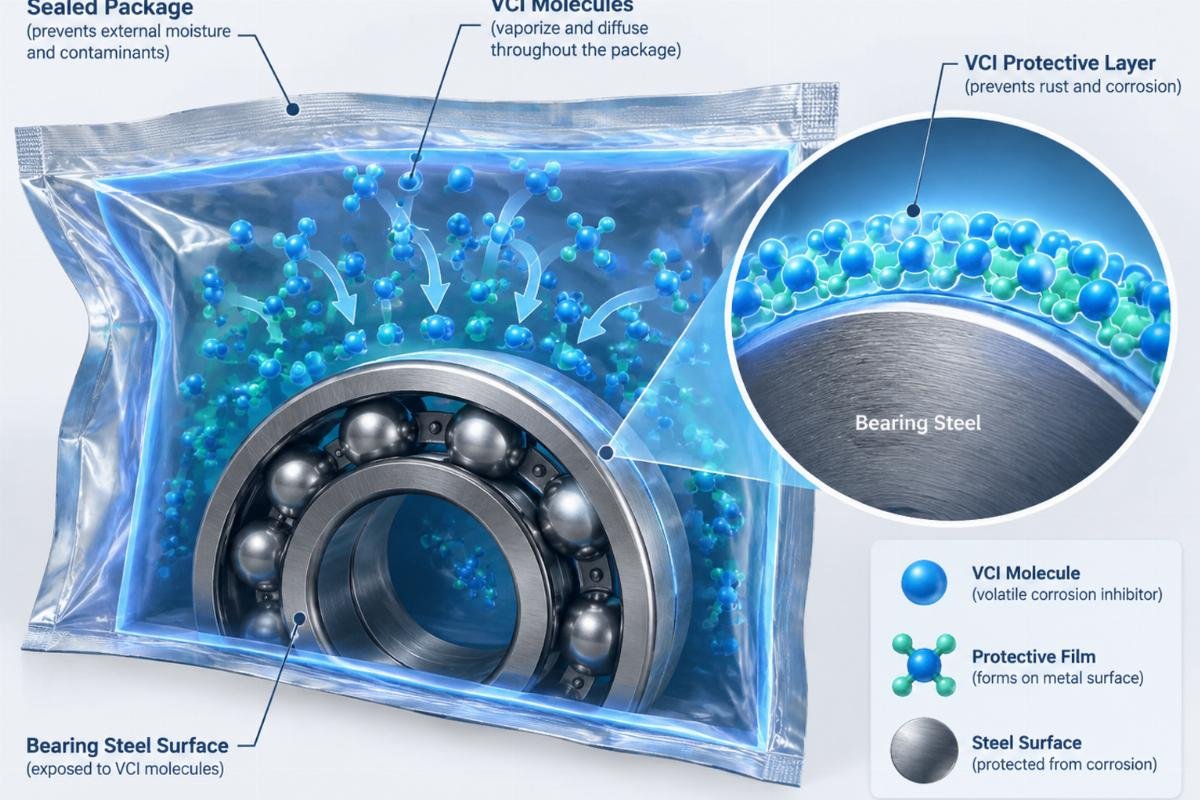
In contrast, Volatile Corrosion Inhibitors (VCI) work differently. They do not just sit on the surface; they sublime, releasing vapor molecules that fill the entire enclosed space. These molecules adsorb onto the metal surface, forming a monomolecular protective layer that interrupts the electrochemical reaction required for rust to form. [NEED_CITE: electrochemical corrosion interruption by VCI vapors] This means protection reaches every nook and cranny, including the internal rolling elements of a sealed bearing, which oil cannot easily penetrate without disassembly.
Consider a recent shipment of spherical roller bearings destined for a port in Southeast Asia during the monsoon season. The transit time was short, only seven to fourteen days, but the ambient humidity was extreme. Using standard plastic wrapping would have resulted in flash rust within days due to trapped air moisture. By switching to VCI-impregnated paper and ensuring a tight seal, the bearings arrived in pristine condition. The key difference was not the duration of the trip, but the active chemical protection inside the package.
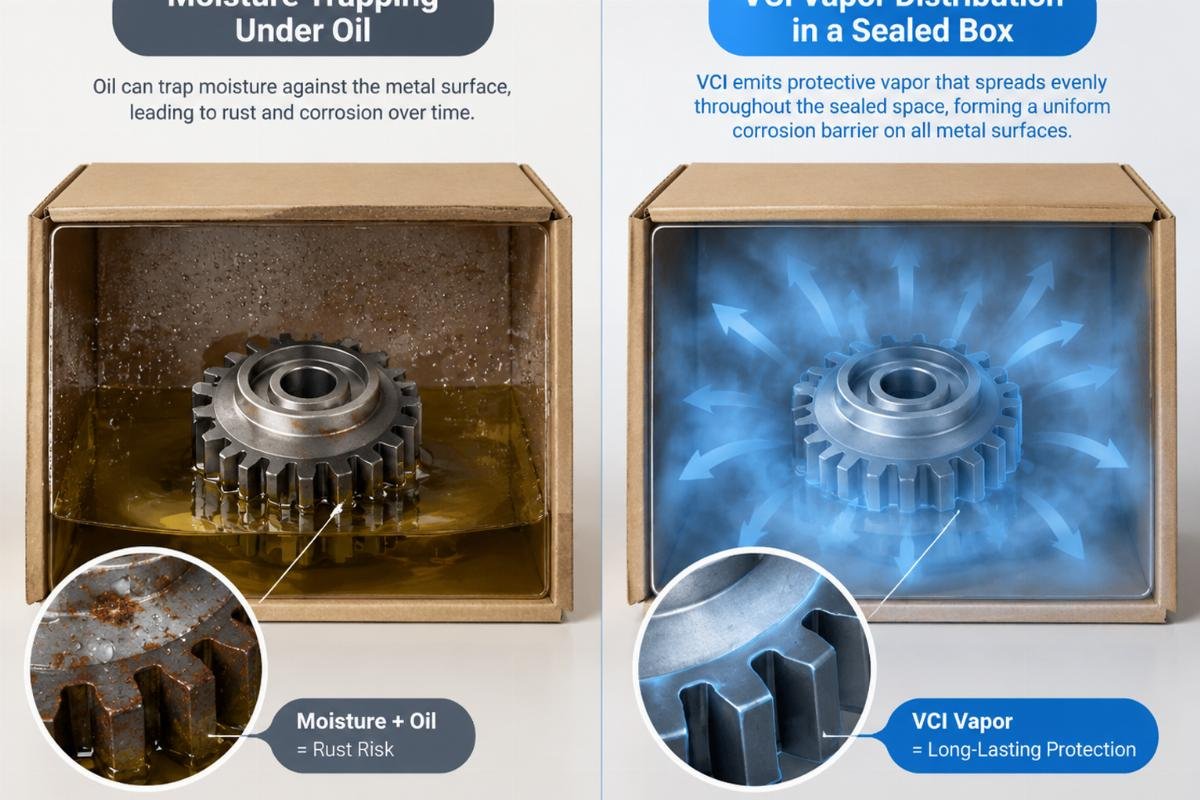
For a VCI bearing packaging for export rust prevention wholesale supplier, understanding this chemical distinction is vital. It allows us to advise clients not just on what to buy, but on how to pack. The failure of oil is not due to poor quality, but due to its passive nature in an active corrosive environment.
How to select the right VCI material for bearings?
Match VCI paper for multi-metal compatibility or VCI film for heavy loads based on transit duration.
Not all VCI materials are created equal, and using the wrong type can be as ineffective as using no protection at all. The selection depends on three factors: the bearing type, the presence of other metals in the packaging, and the expected transit conditions. A common mistake is assuming any blue or pink plastic film is VCI. Many non-VCI plastics simply trap condensation, accelerating internal corrosion. [NEED_CITE: risks of non-VCI plastic encapsulation in humid environments]
When dealing with mixed-brand batches, such as those often requested by distributors in the Middle East, the complexity increases. A single container might hold five to ten tons of various sizes, from small needle bearings to large tapered roller units. Some components may include copper cages or brass seals. Standard VCI formulations designed solely for ferrous metals can sometimes corrode non-ferrous components. Therefore, selecting a multi-metal VCI paper is crucial for these mixed loads.
| Packaging Type | Best Use Case | Metal Compatibility | Transit Duration Suitability |
|---|---|---|---|
| VCI Paper | Mixed sizes, complex shapes | Multi-metal (Ferrous & Non-ferrous) | Medium to Long |
| VCI Film | Heavy loads, uniform shapes | Primarily Ferrous | Long |
| VCI Bags | Small batch, urgent MRO | Multi-metal | Short to Medium |
For a client sourcing angular contact ball bearings for machine tools, we recommended VCI film due to the uniform shape and heavy weight of the palletized goods. However, for another client shipping a mixed container of insert bearings and thrust bearings to Africa, we used customized VCI paper wrapping. The paper conforms better to irregular shapes and allows for breathability while still emitting protective vapors.
As a VCI bearing packaging for export rust prevention wholesale supplier, we analyze the specific shipping route. A thirty-day journey to Brazil requires different emission rates than a seven-day trip to Vietnam. The volume-to-area ratio of the sealed space must be calculated to ensure sufficient vapor concentration. [NEED_CITE: VCI emission rates and sealed space volume ratios]
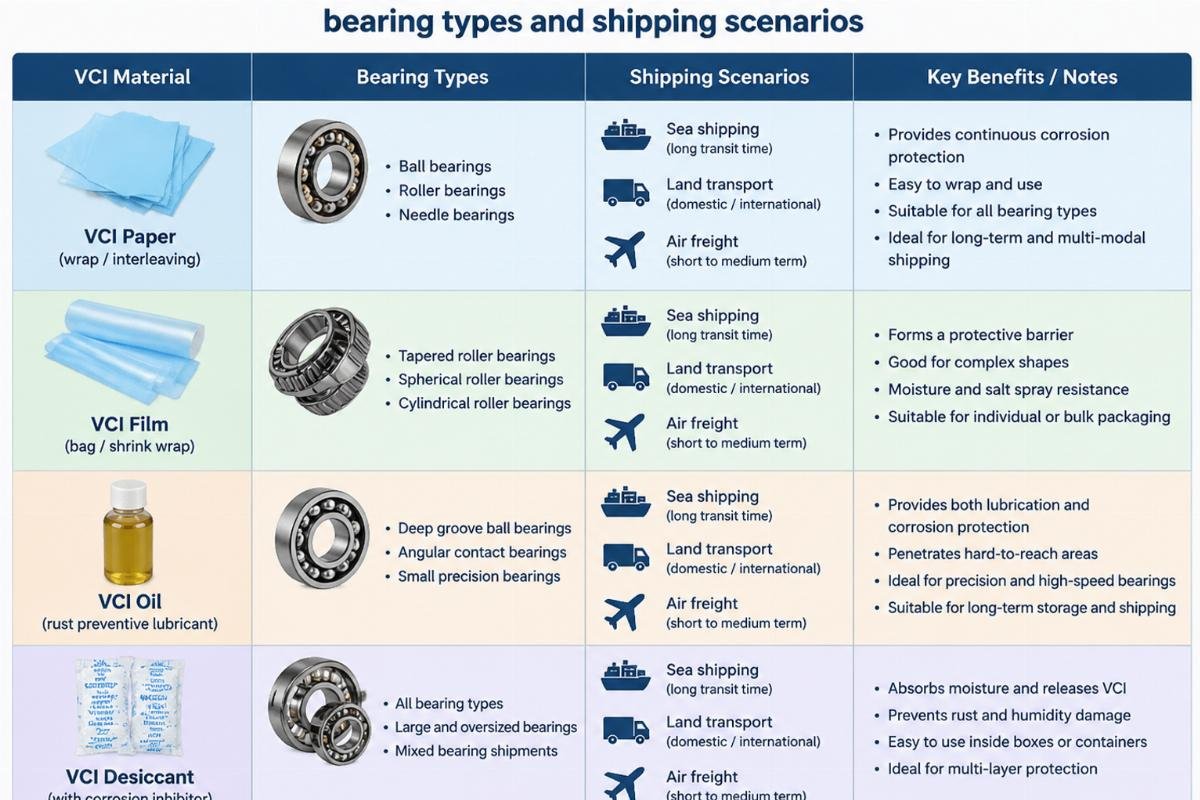
Selecting the correct material prevents the costly error of over-packaging or under-protecting. It ensures that the protection lasts exactly as long as needed, no more and no less.
What are the critical steps for sealing VCI packaging?
Eliminate air gaps and ensure complete sealing to activate the vapor phase.
Even the best VCI material will fail if the packaging is not sealed correctly. The effectiveness of vapor phase inhibitors relies on maintaining a saturated micro-environment. If air can exchange freely with the outside humid atmosphere, the VCI molecules dissipate, and moist air enters. This is why the sealing process is just as important as the material selection.
The first step is to ensure the bearings are clean and dry before packaging. Any residual moisture or contaminants will interfere with the VCI layer formation. Next, the VCI material must completely surround the product. For individual boxes, this means wrapping each unit tightly. For pallets, it involves using large VCI shrouds or bags that cover the entire load.
A critical error we often see is leaving gaps around the edges of the VCI bag. When heat-sealing, the seal must be continuous and strong. Any pinhole or weak spot becomes a entry point for humidity. In one case involving urgent MRO spare parts for a wind farm operator, rapid vacuum sealing was employed. This removed the majority of the air, reducing the volume that needed to be saturated with VCI vapor and minimizing the risk of condensation during the high-rainfall transit. [NEED_CITE: benefits of vacuum sealing in conjunction with VCI]
- Clean and dry all bearing surfaces thoroughly.
- Wrap individual units or groups in VCI paper or place in VCI bags.
- Ensure no direct contact between dissimilar metals if using single-metal VCI.
- Seal the package completely, eliminating all air gaps.
- Place desiccants if extended storage is expected before shipping.
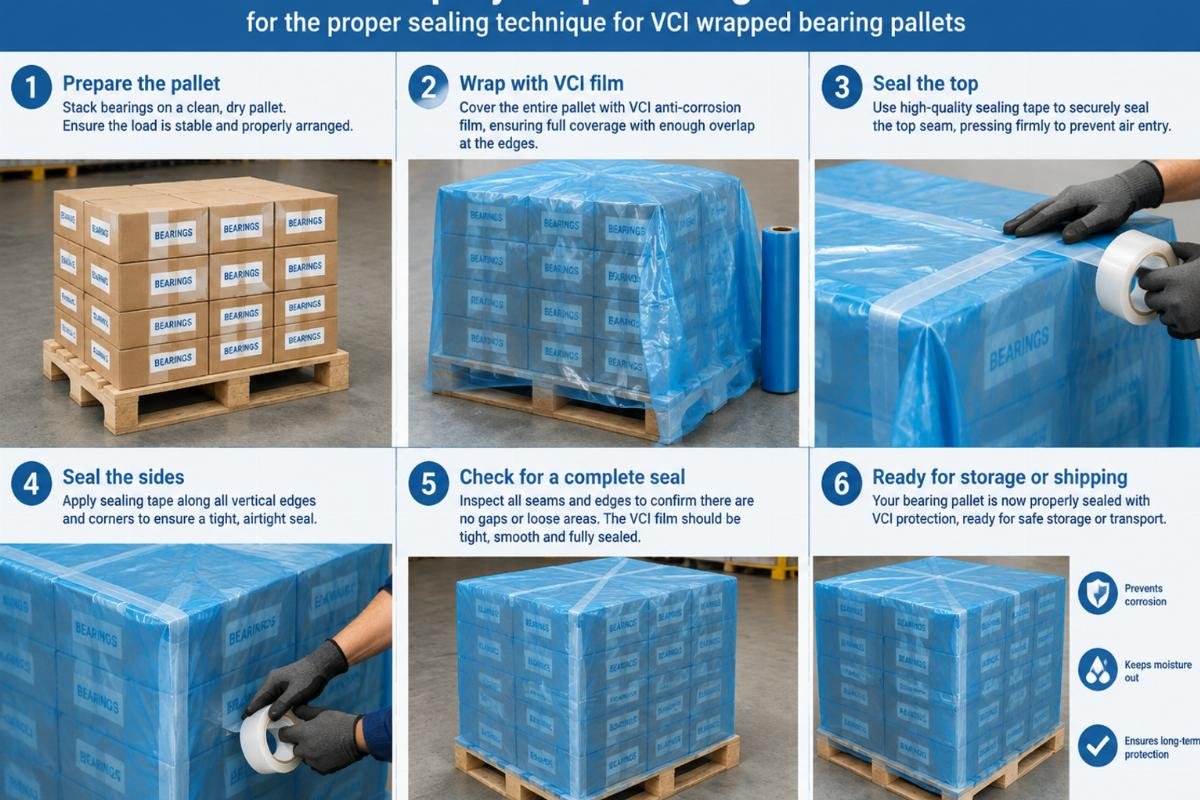
Proper sealing transforms the package into a self-contained protective unit. Without this step, the VCI cannot build up the necessary concentration to protect the steel. As a VCI bearing packaging for export rust prevention wholesale supplier, we emphasize that the labor invested in sealing pays for itself by preventing claims.
How to verify packaging quality before shipping?
Conduct salt spray tests and check VCI residual amounts.
Trust but verify. Before committing to a large shipment, especially for new routes or challenging climates, it is essential to validate the packaging performance. Relying solely on supplier claims is risky. Instead, use standardized testing methods to confirm efficacy.
Salt spray testing is a common industry standard for evaluating corrosion resistance. By subjecting packaged bearings to accelerated corrosive conditions, you can simulate months of ocean freight in a matter of days. [NEED_CITE: ASTM B117 salt spray test standards for packaging] If the bearings show signs of rust after the test, the packaging protocol needs adjustment. This could mean changing the VCI type, increasing the amount of material, or improving the seal.
Additionally, checking the VCI residual amount ensures that the material has not expired or lost its potency. VCI chemicals have a shelf life, and improper storage can degrade their effectiveness. Simple test strips can detect the presence of VCI vapors inside a sealed package, confirming that the protective environment is active.
A European wind farm operator once requested verification for a batch of cylindrical roller bearings intended for offshore installation. We conducted pre-shipment salt spray tests on sample packages. The results confirmed that our VCI film maintained protection even under extreme saline conditions. This data provided the client with the confidence to proceed with the order, knowing the bearings would survive the harsh marine environment.
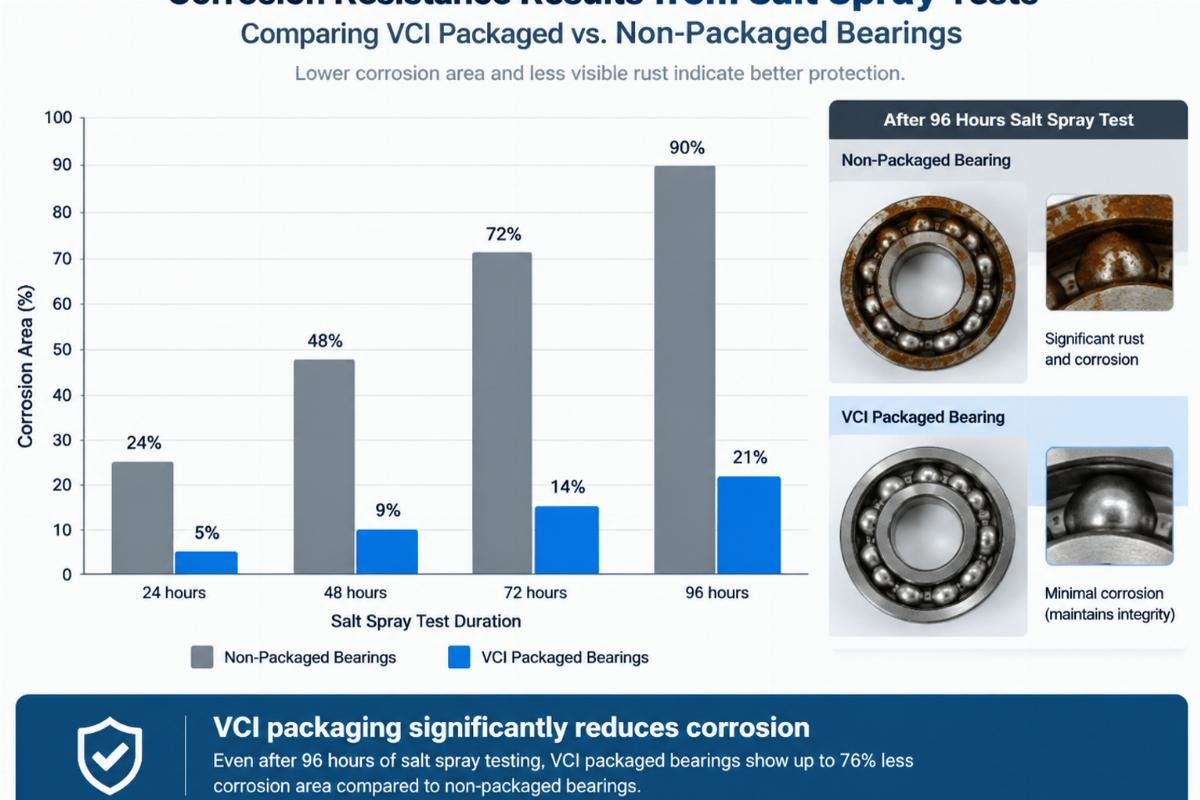
Verification removes guesswork from the procurement process. It provides objective evidence that the packaging will perform as required. For a VCI bearing packaging for export rust prevention wholesale supplier, this commitment to verification builds long-term trust with global partners.
Conclusion
Proper VCI packaging is not an expense; it is insurance for your product’s integrity.
Traditional oiling fails because it traps moisture, while VCI actively neutralizes corrosion through vapor phase protection. Selecting the right material, sealing it correctly, and verifying its performance ensures that bearings arrive in perfect condition, regardless of the transit route. By focusing on these technical details, distributors and OEMs can eliminate rust claims and maintain their reputation for quality.
Need a quote for the bearings in this article?
Send your part numbers and get price, stock and lead time within 4 hours.

Written by
authorEditor covering global sourcing, supplier verification, and industrial product knowledge. Content is compiled from manufacturer specifications, industry standards, and hands-on experience with international B2B buyers. Every article is fact-checked before publishing to help procurement professionals make informed decisions.
View all posts