Inch vs Metric Bearings: How to Tell Them Apart


Inch vs Metric Bearings: How to Tell Them Apart
A two-millimeter gap in inner diameter is not a manufacturing defect; it is a fundamental mismatch between imperial and metric systems.
To distinguish inch from metric bearings, you must verify the basic dimensions against ISO or ABMA standards rather than relying on part number prefixes alone. Inch bearings use fractional or decimal imperial measurements for bore, outside diameter, and width, while metric bearings use whole or decimal millimeters. Conversion charts are often insufficient for installation because they ignore housing tolerances and interference fits. Always cross-reference original CAD drawings with physical samples before bulk procurement to prevent costly assembly failures.
I learned this lesson the hard way at a port in Santos. A mining client in Brazil was waiting for tapered roller bearings for a crusher overhaul. The drawing specified an imperial size, but our team prepared a metric equivalent based on a rough conversion. When the crate opened, the bearings looked identical to the naked eye. But during installation, the inner diameter was off by exactly two millimeters. It would not seat in the housing. The client’s frustration was palpable, and the downtime cost far exceeded the price of the parts. That incident changed how I approach every inquiry. Now, I do not trust part numbers blindly. I check the dimensional tolerance tables and verify the measurement system directly from the engineering drawings. [NEED_CITE: difference between ISO and ABMA dimensional standards]
Understanding these distinctions is critical for distributors, OEMs, and MRO managers who handle mixed-brand inventories. Misidentification leads to rejected shipments, delayed projects, and damaged supplier relationships. This guide breaks down the technical differences, decoding methods, and verification steps to ensure you select the correct Inch vs Metric Bearings for your application.
What Are the Fundamental Differences Between Inch and Metric Bearings?
The core difference lies in the unit of measurement used for the bore, outside diameter, and width, which dictates the entire sizing ecosystem.
Metric bearings follow the International Organization for Standardization (ISO) system, where dimensions are defined in millimeters. The bore diameter is typically a multiple of five millimeters for standard sizes, such as 20mm, 25mm, or 30mm. Inch bearings, governed by the American Bearing Manufacturers Association (ABMA) standards, use inches, often expressed as fractions or decimals. For example, a common inch bore might be 1-1/4 inches or 1.5 inches.
This distinction affects more than just the numbers on a caliper. It influences the availability of replacement housings, seals, and locking mechanisms. In many heavy industries, especially in North America and legacy equipment markets, inch-sized components remain standard. Conversely, modern global machinery increasingly adopts metric standards for uniformity. However, confusion arises when equipment manufacturers mix systems or when replacements are sourced from different regions.
| Feature | Metric Bearings (ISO) | Inch Bearings (ABMA/Imperial) |
|---|---|---|
| Unit of Measure | Millimeters (mm) | Inches (fractional or decimal) |
| Standard Bore Steps | Multiples of 5mm (e.g., 20, 25, 30) | Fractional inches (e.g., 1″, 1-1/8″, 1-1/4″) |
| Tolerance Class | P0, P6, P5, P4, P2 | ABEC 1, 3, 5, 7, 9 |
| Primary Markets | Global, Europe, Asia, Modern OEMs | North America, Legacy Mining, Agriculture |
| Housing Compatibility | ISO standard housings | Imperial standard housings |
[NEED_CITE: ISO 15:2017 standard for rolling bearing boundary dimensions]
A common mistake is assuming that a close decimal conversion is sufficient. For instance, 1 inch equals 25.4mm. A 25mm bearing is close, but it is not interchangeable with a 1-inch bearing. The 0.4mm difference may seem negligible, but in precision applications like gearboxes or high-speed spindles, it causes misalignment, vibration, and premature failure. [NEED_CITE: impact of dimensional mismatch on bearing fatigue life]
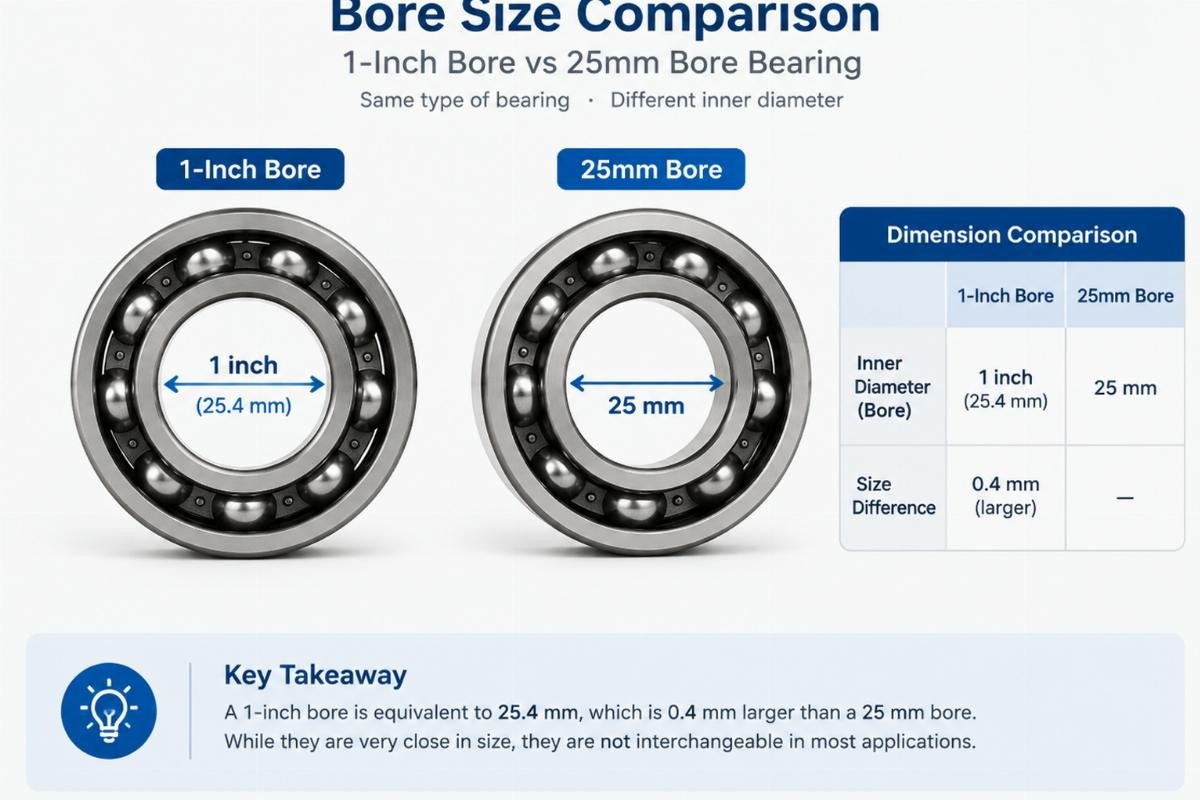
When sourcing Inch vs Metric Bearings, always confirm the design standard used in the original equipment manufacturer’s specifications. Do not assume compatibility based on visual similarity.
How Can You Identify the Measurement System from Part Numbers?
Part numbers are not universal; suffixes and prefixes vary by brand, making manual drawing verification essential.
Many buyers assume that a part number clearly indicates whether a bearing is inch or metric. This is a dangerous assumption. While some brands use specific prefixes to denote inch sizes, others rely on the numeric value itself or provide no clear indicator in the base code. For example, a leading global brand might use a specific prefix for inch-sized tapered roller bearings, while another brand might integrate the size into the numeric sequence without a distinct marker.
Consider a scenario where a distributor in the Middle East needed to replace a batch of spherical roller bearings. The part numbers looked similar across two different brands. One was metric, and the other was inch. Without checking the technical datasheets, the buyer ordered based on the part number alone. The result was a mixed batch that required extensive cross-referencing and delayed the maintenance schedule by weeks. Correct identification of the ID verification process could have saved significant lead time.
To avoid this, you must decode the part number rules for each specific brand. Look for clues such as:
- Fractional indicators: Some inch bearings include fractions in the description.
- Prefix codes: Certain manufacturers use specific letters to denote imperial sizes.
- Dimensional checks: If the bore size in the part number is not a multiple of 5mm, it is likely an inch bearing.
[NEED_CITE: bearing manufacturer part number decoding guidelines]
However, even these rules have exceptions. Custom or special-application bearings may not follow standard naming conventions. Therefore, relying solely on part numbers is risky. Always request the dimensional drawing from the supplier. Compare the bore, outside diameter, and width against known metric or inch standards. If the dimensions align with fractional inches, you are dealing with an inch bearing. If they align with whole or decimal millimeters, it is metric.
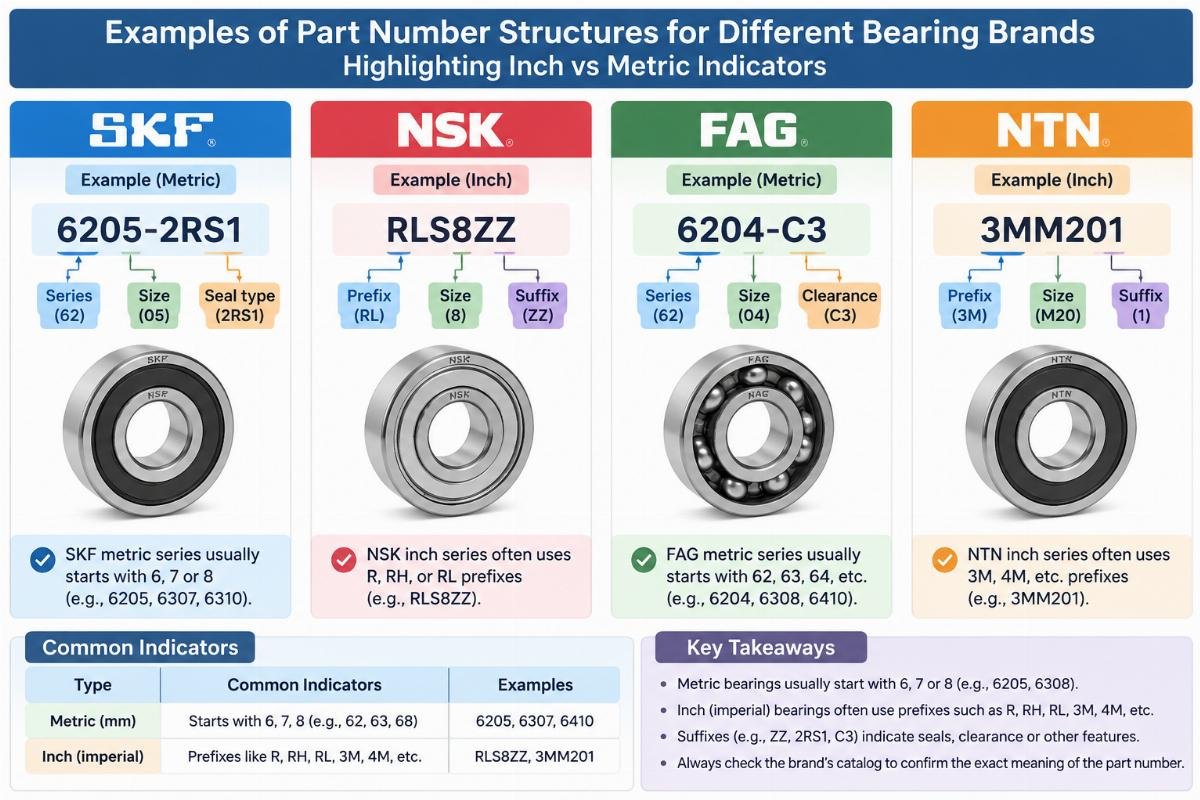
This diligence prevents the frustration of receiving incompatible parts. When evaluating Inch vs Metric Bearings, treat the part number as a reference, not a guarantee. Verify the physical dimensions to ensure accuracy.
Why Do Conversion Charts Fail in Real-World Installations?
Exact mathematical conversion ignores housing tolerances and interference fits, leading to installation failures.
Many engineers believe that converting inches to millimeters using a calculator is sufficient for substitution. This view overlooks the physical reality of bearing installation. Bearings are not isolated components; they interact with shafts and housings. The fit between the bearing and its mating parts is critical for performance. Inch and metric systems have different standard tolerance classes and fit recommendations.
For example, an inch bearing designed for a specific shaft fit may have a different clearance range than its metric counterpart, even if the nominal dimensions are converted accurately. Installing a metric bearing in an inch-designed housing can result in excessive looseness or tightness. Excessive looseness causes rotation and fretting corrosion, while excessive tightness leads to overheating and premature seizure.
A case in point involved an agricultural gearbox assembly in Southeast Asia. The OEM specified an inch-sized cylindrical roller bearing. The maintenance team substituted it with a metric bearing based on a conversion chart. The dimensional difference was minimal, but the tolerance deviation of 0.05mm caused significant vibration during operation. The gearbox failed within months, requiring a complete rebuild. [NEED_CITE: effect of fit clearance on bearing vibration and noise]
Conversion charts also fail to account for standard housing sizes. Inch housings are not simply metric housings scaled up. They have different bolt patterns, seal grooves, and lubrication paths. Substituting a bearing without considering the housing compatibility can compromise the entire assembly.

Therefore, do not rely on conversion charts for critical applications. Instead, consult the original equipment manufacturer’s specifications for fit and tolerance requirements. If a substitution is necessary, ensure that the new bearing meets the same functional criteria, including load capacity, speed rating, and fit class. Understanding Inch vs Metric Bearings involves more than math; it requires a holistic view of the mechanical system.
How to Verify Drawings Before Placing Bulk Orders?
Cross-checking critical dimensions with original CAD drawings prevents mismatched shipments and ensures traceability.
Before placing a bulk order, especially for mixed-brand or mixed-size packages, verify the dimensions against the original CAD drawings. This step is crucial for avoiding the pitfalls of misidentified Inch vs Metric Bearings. Request the full dimensional drawing from the supplier, including bore, outside diameter, width, and tolerance class.
Compare these dimensions with your equipment’s specifications. Pay attention to the tolerance class. Metric bearings typically use ISO tolerance classes (P0, P6, etc.), while inch bearings use ABMA classes (ABEC 1, 3, etc.). Ensure that the tolerance class of the supplied bearing matches the requirement of your application. A higher precision class may be necessary for high-speed or high-load applications, regardless of the measurement system.
Additionally, verify the material and heat treatment specifications. While most standard bearings use chrome steel, specialized applications may require stainless steel or ceramic materials. Ensure that the material specification matches your operational environment, such as corrosion resistance for marine applications or high-temperature stability for industrial ovens.
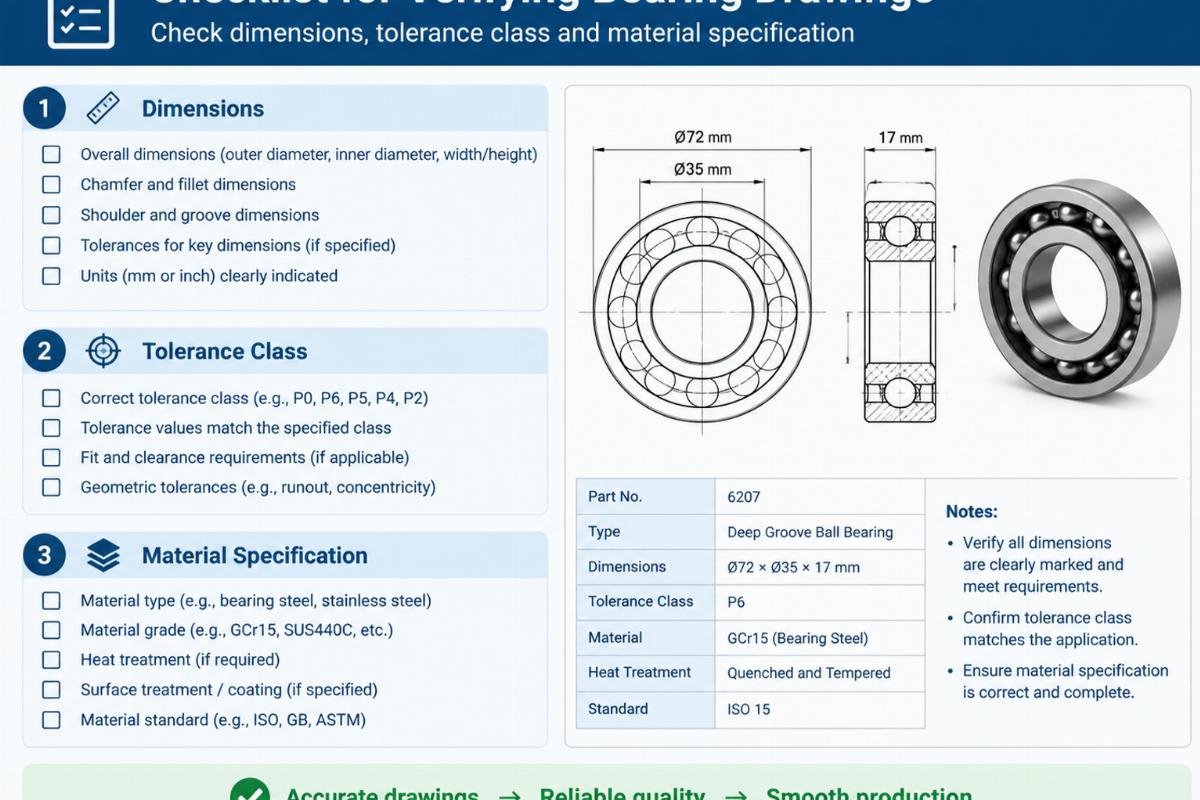
Our approach to sourcing involves strict drawing verification. We cross-reference every part number with its dimensional drawing to ensure accuracy. This process provides complete traceability and prevents sizing errors. For complex projects requiring mixed-brand solutions, we offer cross-brand equivalent consultation to identify suitable alternatives that meet the original specifications. This service helps clients avoid the risks associated with incorrect substitutions and ensures reliable performance.
By prioritizing drawing verification, you minimize the risk of receiving incompatible parts. This proactive step saves time, reduces costs, and ensures the longevity of your equipment. Whether you are sourcing for a new build or a maintenance replacement, accurate verification is the key to success.
Conclusion
Precision begins with correct identification.
Distinguishing between inch and metric bearings requires more than a quick glance at a part number. It demands a thorough understanding of dimensional standards, tolerance classes, and housing fits. By verifying drawings and consulting technical specifications, you can avoid costly installation errors and ensure optimal equipment performance. Always prioritize accuracy over convenience when selecting Inch vs Metric Bearings for your industrial needs.
Need a quote for the bearings in this article?
Send your part numbers and get price, stock and lead time within 4 hours.

Written by
authorEditor covering global sourcing, supplier verification, and industrial product knowledge. Content is compiled from manufacturer specifications, industry standards, and hands-on experience with international B2B buyers. Every article is fact-checked before publishing to help procurement professionals make informed decisions.
View all posts

