Bearing Greasing Interval Guide: Bulk Supply for Industrial MRO


Bearing Greasing Interval Guide: Bulk Supply for Industrial MRO
More grease is not better. In fact, over-greasing is a leading cause of premature bearing failure in industrial applications.
The correct bearing greasing interval is not a fixed calendar date but a calculated value derived from operating speed, temperature, and load conditions. Maintenance teams must determine the specific re-lubrication frequency using established engineering formulas rather than relying on generic monthly schedules to prevent heat buildup and seal damage.
Walking through the aisles of major industrial exhibitions in Chicago, I often hear maintenance managers lamenting short bearing life spans. They point to seized units as proof of poor manufacturing quality. However, upon closer inspection of these failed components, the root cause is rarely material defect. More often, it is a maintenance error. I have seen deep groove ball bearings in high-speed motors that*issipate heat. The grease churned, temperatures spiked, and the bearing locked up. This was not a product failure; it was a failure to calculate the proper bearing greasing interval.
Understanding the science behind lubrication schedules prevents these costly mistakes. It shifts the focus from arbitrary routines to condition-based maintenance.
Transitioning from fixed schedules to calculated intervals requires a shift in mindset. It demands attention to the specific variables affecting each asset.
Why Do Bearings Fail from “Improper” Lubrication?
Lubrication errors account for a significant portion of premature bearing failures. These errors generally fall into two categories: under-greasing and over-greasing. While under-greasing leads to metal-to-metal contact and wear, over-greasing is more insidious because it is often mistaken for thorough care.
When a bearing housing is completely filled with grease, the rolling elements have no room to move the lubricant. As the bearing rotates, the grease churns violently. This mechanical agitation generates excessive heat. In high-speed applications, this heat can rise rapidly, causing the grease base oil to separate or oxidize. The thickener may break down, losing its ability to hold the oil in place. Eventually, the pressure builds up enough to blow out seals, allowing contaminants to enter and lubricant to escape.
Conversely, under-greasing leaves surfaces unprotected. In harsh environments, such as vibrating screens in mining operations, the consumption rate of grease can be significantly higher than normal. If the bearing greasing interval is not adjusted to account for this accelerated loss, the film thickness drops below the critical level required to separate the races and rollers.
| Failure Mode | Primary Cause | Typical Symptom | Risk Level |
|---|---|---|---|
| Over-greasing | Excessive volume or frequency | High operating temperature, seal leakage | High |
| Under-greasing | Infrequent replenishment | Noise, vibration, surface wear | High |
| Contamination | Poor sealing during regreasing | Abrasive wear, pitting | Medium |
| Grease Incompatibility | Mixing different thickeners | Softening or hardening of lubricant | Critical |
[NEED_CITE: distribution of bearing failure modes related to lubrication per ISO 15243]
A case from a steel mill in the Middle East illustrates this clearly. A spherical roller bearing on a conveyor drive failed repeatedly every few months. The maintenance team assumed the load was too high and upgraded to a heavier series. The problem persisted. Only after reviewing the lubrication practice did we find they were adding grease weekly without purging old lubricant. The housing was packed solid. By recalculating the bearing greasing interval and reducing the quantity per session, the bearing life extended substantially.

Proper lubrication management is not just about adding oil; it is about maintaining the right balance within the system.
How to Calculate the Exact Greasing Interval?
Determining the correct bearing greasing interval requires moving beyond rule-of-thumb estimates. Industry standards and manufacturer guidelines provide formulas that consider the bearing type, size, speed, and operating temperature.
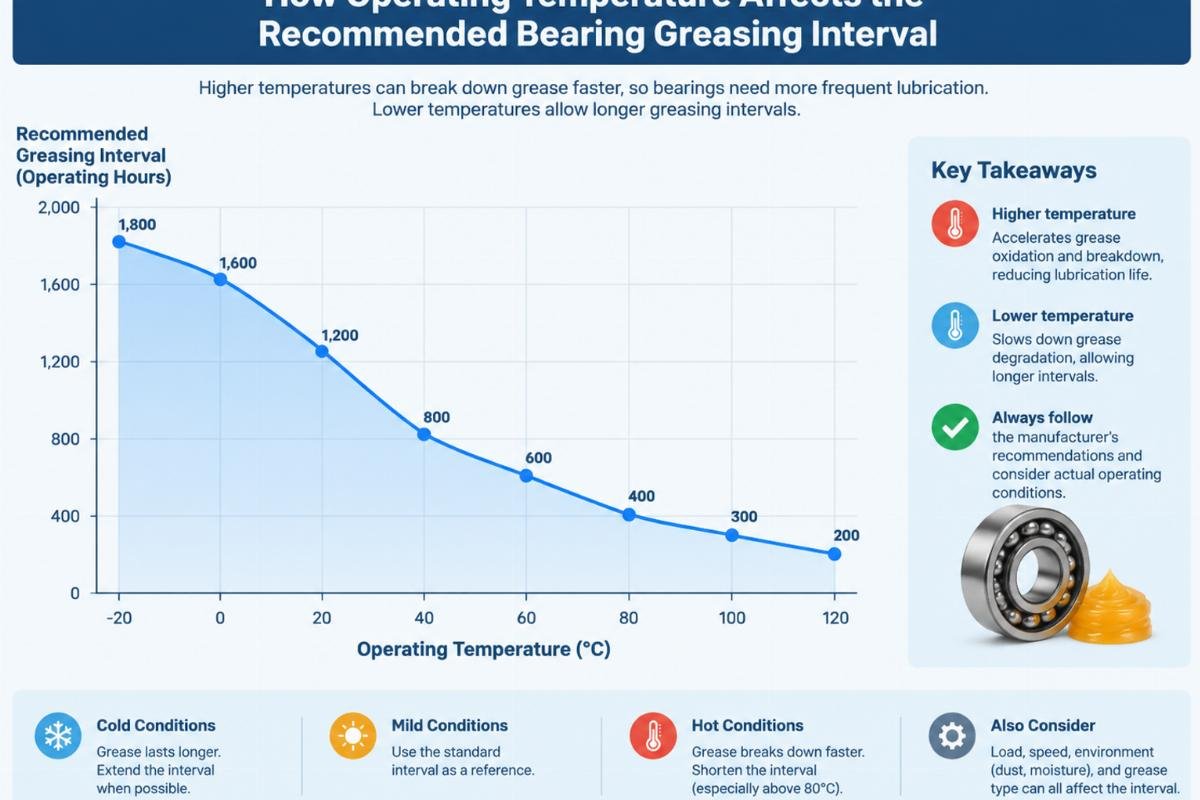
The fundamental principle is that grease degrades over time due to oxidation and mechanical stress. Higher speeds and temperatures accelerate this degradation. Therefore, the interval must shorten as these factors increase.
To calculate the interval, maintenance engineers typically use a baseline value provided by bearing manufacturers for standard conditions. This baseline is then adjusted using correction factors for speed and temperature. For instance, if a bearing operates at a temperature significantly above the standard reference, the interval may need to be halved. Similarly, if the speed is very low, the interval might be extended, but never indefinitely, as grease can still dry out or settle.
Steps to estimate the interval:
- Identify the bearing type and dimensions.
- Determine the operating speed (RPM) and mean diameter.
- Assess the average operating temperature.
- Apply the manufacturer’s formula or chart to find the base interval.
- Adjust for environmental factors such as vibration or contamination risk.
[NEED_CITE: standard methodology for calculating relubrication intervals based on speed and temperature]
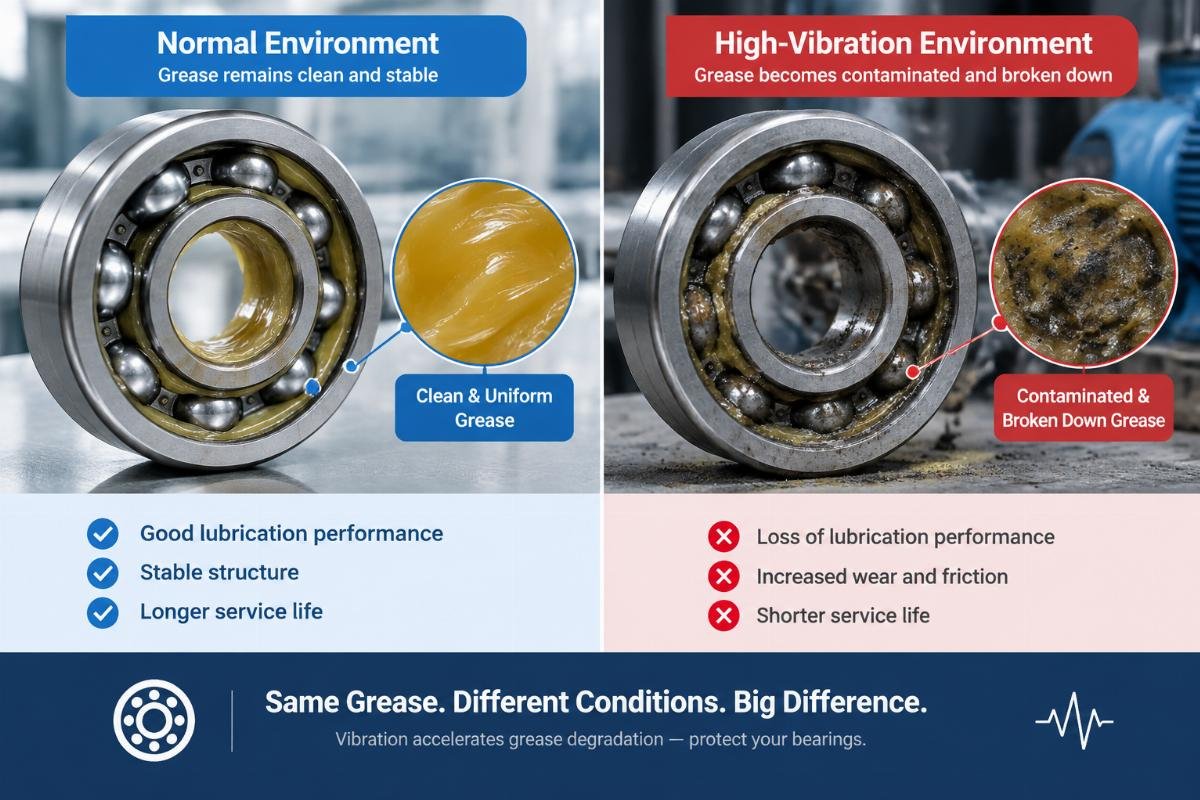
A common mistake is ignoring the impact of vibration. In a vibrating screen application, the grease is subjected to constant agitation, which can cause it to migrate away from the rolling contacts faster than in a static machine. In such cases, the calculated bearing greasing interval should be reduced noticeably compared to a standard motor application.
It is also crucial to document these calculations. Without a recorded bearing lubrication schedule, maintenance teams revert to guesswork. A documented schedule ensures consistency across shifts and personnel changes.
Precision in calculation prevents both waste and failure.
How Much Grease Should You Actually Add?
Knowing when to grease is only half the battle. Knowing how much to add is equally critical. Adding the wrong quantity can negate the benefits of a well-timed bearing greasing interval.
The general rule is to fill only a portion of the free space in the bearing housing. For standard bearings, this is often around one-third to one-half of the available void volume. Filling the housing completely leaves no room for the grease to expand as it heats up or for the rolling elements to displace it during rotation.
Calculating the exact quantity involves determining the free space. This can be estimated based on the bearing dimensions and the housing design. Some modern maintenance tools help technicians measure this volume accurately. However, even without precise tools, adhering to the principle of partial filling is safer than overfilling.
For sealed bearings, no additional grease should be added unless they are designed for relubrication. Attempting to force grease into a sealed unit can damage the seals and introduce contaminants.
In a recent project involving a large fan assembly, the maintenance team was instructed to add a specific weight of grease per session rath*ch prevented the seal blowouts they had experienced previously. The key was calculating the bearing grease quantity calculation based on the housing geometry, not just the bearing size.
| Bearing Type | Typical Fill Recommendation | Note |
|---|---|---|
| Deep Groove Ball | Partial fill of free space | Avoid churning at high speeds |
| Spherical Roller | Moderate fill | Ensure coverage of all rollers |
| Tapered Roller | Careful partial fill | Monitor for heat buildup |
| Thrust Bearing | Specific coverage pattern | Follow manufacturer guidance |
[NEED_CITE: guidelines for grease quantity in bearing housings from major manufacturers]
Over-greasing is a silent killer. It creates internal pressure that forces lubricant past seals, inviting dirt and moisture in. Once contamination enters, the bearing greasing interval becomes irrelevant because the lubricant is compromised.

Correct quantity ensures the lubricant performs its function without creating new problems.
What Factors Require Shortening the Interval?
Even with a calculated baseline, real-world conditions often demand adjustments. Several factors can accelerate grease degradation, requiring a shorter bearing greasing interval.
Temperature is the most significant factor. For every increase in operating temperature above the standard reference, the life of the grease decreases exponentially. If a bearing runs hot, the interval must be reduced noticeably.
Vibration and shock loads also play a role. In heavy machinery like crushers or vibratory screens, the mechanical action can cause grease to separate or migrate. This requires more frequent replenishment to maintain an adequate film thickness.
Contamination risk is another critical consideration. In dusty or wet environments, seals may allow small amounts of contaminants to enter. Frequent, small additions of fresh grease can help purge these contaminants, effectively shortening the bearing greasing interval to maintain cleanliness.
Load conditions matter too. Heavy loads increase the stress on the lubricant film. If a bearing is subjected to loads higher than its standard rating, the grease may break down faster. In such cases, the interval should be adjusted downward.
A European wind farm operator faced repeated gearbox bearing failures. The initial bearing lubrication schedule was based on standard land-based turbines. However, the offshore environment introduced higher humidity and salt spray risks. By shortening the interval and using a grease with better water resistance, they stabilized the equipment performance.
Our technical support team often assists clients in analyzing these specific conditions. When managing mixed-brand bearing packages, understanding the unique requirements of each component is vital. We provide cross-brand equivalent consultation to ensure that the lubrication strategy aligns with the actual operating environment, not just the catalog specifications.
Adapting to conditions is the hallmark of effective maintenance.
Conclusion
Effective lubrication is a calculated science, not a guessing game.
Mastering the bearing greasing interval prevents the dual pitfalls of over-greasing and under-greasing. By calculating intervals based on speed, temperature, and load, and by adding the correct quantity of grease, maintenance teams can significantly extend bearing life. Adjusting these parameters for specific environmental factors ensures reliability in even the harshest industrial settings.
Need a quote for the bearings in this article?
Send your part numbers and get price, stock and lead time within 4 hours.

Written by
authorEditor covering global sourcing, supplier verification, and industrial product knowledge. Content is compiled from manufacturer specifications, industry standards, and hands-on experience with international B2B buyers. Every article is fact-checked before publishing to help procurement professionals make informed decisions.
View all posts

