How to Remove a Bearing Without Damaging the Shaft: Wholesale Supplier

How to Remove a Bearing Without Damaging the Shaft: Wholesale Supplier
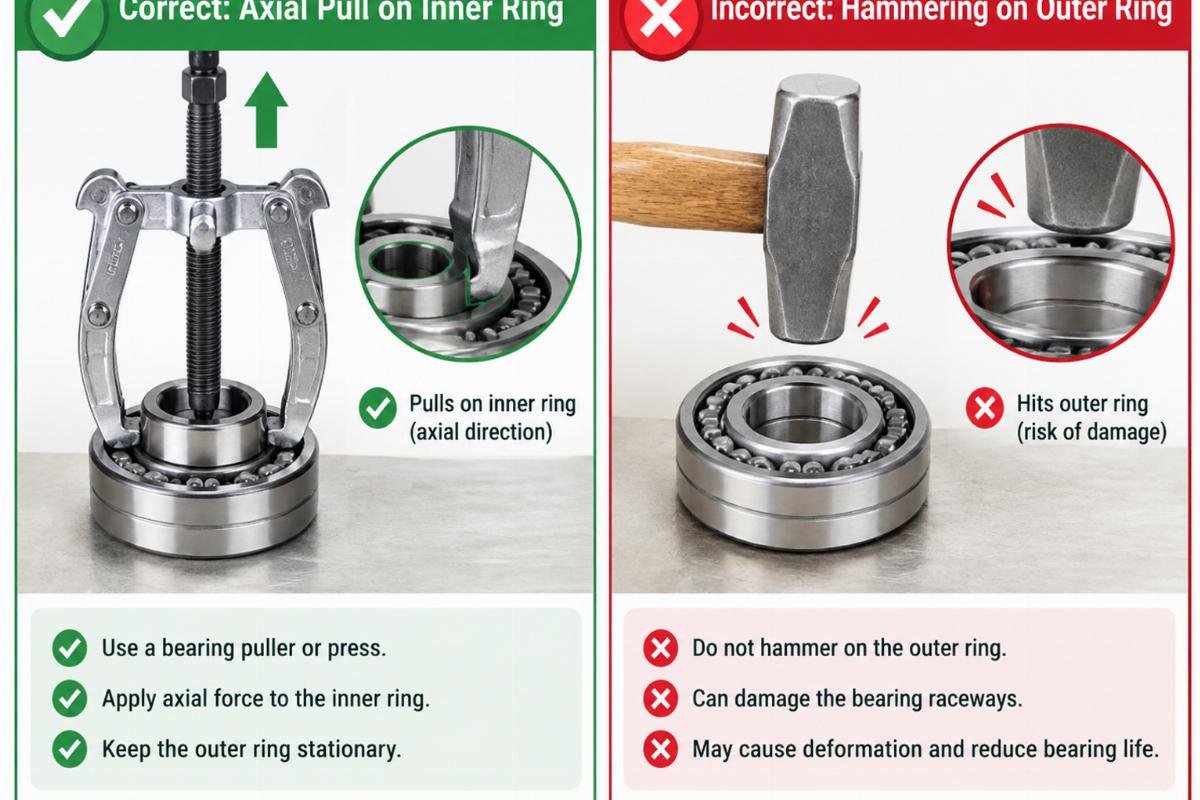
Hitting the outer ring is not a shortcut; it is a guarantee of shaft failure.
To remove a bearing without damaging the shaft, you must apply axial force exclusively to the inner ring while using controlled induction heating to expand the inner race. This method isolates the interference fit from the shaft journal, preventing scoring, micro-cracking, and costly spindle replacements. Pulling from the outer ring transfers destructive impact forces through the rolling elements directly onto the shaft surface, which is the primary cause of irreversible equipment damage in heavy industry maintenance.
I learned this lesson the hard way on a humid afternoon in Lagos, standing next to a crushed spherical roller bearing on a cement plant crusher. The local maintenance crew had used sledgehammers to drive the outer ring off, convinced it was the fastest route. The result was not speed, but a deeply scored shaft that scrapped the entire spindle. The project stalled for weeks while a new spindle was machined and shipped. That delay cost far more than the bearing itself. Since then, I have watched similar scenes play out in mining camps in Ethiopia and steel mills across Asia. The common thread is always the same: a misunderstanding of how interference fits work and how force transfers through bearing components. [NEED_CITE: mechanics of interference fit force transfer]
Understanding why standard practices fail is the first step toward reliable maintenance. When you grasp the physics of extraction, you stop viewing bearings as disposable items and start treating them as precision components that demand respect. This shift in perspective saves money, reduces downtime, and keeps your operations running smoothly.
Why Does Improper Removal Destroy the Shaft?
The rolling elements act as ball bearings for impact force, transferring hammer blows directly to the shaft journal.
Most technicians believe that hitting the outer ring is efficient because it is accessible. However, this approach ignores the internal structure of the bearing. When you strike the outer ring, the force travels through the balls or rollers, which press against the inner ring with concentrated high pressure. If the inner ring is tightly fitted on the shaft, this pressure creates indentations and scores on the shaft surface. These marks are not just cosmetic; they create stress concentration points that lead to fatigue cracks and eventual shaft failure under load. [NEED_CITE: ISO 15243 failure mode classification for mounting damage]
In one case at a Middle Eastern steel mill, a conveyor drive shaft failed prematurely after a routine bearing change. The investigation revealed micro-cracks originating from shallow dents on the journal. The previous team had used a cold chisel and hammer to pry the bearing off, damaging the shaft integrity. The replacement cost included not just the new shaft, but days of production loss. This is a preventable error. By understanding that the inner ring is the only safe point of contact for removal tools, you protect the most expensive part of the assembly: the shaft.
Another common mistake is heating the entire assembly. Some operators use open flames or broad heating methods to loosen the bearing. This expands both the shaft and the inner ring, often leaving the interference fit unchanged or even tightening it if the shaft heats up faster. More critically, uneven heating can alter the metallurgical properties of the shaft, reducing its hardness and load-carrying capacity. Localized heating of the inner ring is the only thermal method that safely breaks the fit without compromising the shaft’s structural integrity. [NEED_CITE: thermal expansion coefficients for bearing steel vs shaft steel]

What Are the Essential Tools for Safe Extraction?
Mechanical pullers and induction heaters are not luxuries; they are mandatory for preserving shaft tolerances.
You cannot remove a tight-fitting bearing safely with hammers and screwdrivers. The right tools ensure that force is applied axially and evenly. A mechanical puller with jaws designed to grip the inner ring is the baseline requirement. These pullers use a central screw or hydraulic ram to generate steady, controlled axial force. Unlike impact tools, pullers do not shock the bearing components, reducing the risk of cracking the races or damaging the cage. [NEED_CITE: mechanical puller force calculation standards]
For larger bearings or those with severe interference fits, an induction heater is indispensable. Induction heaters generate heat directly in the inner ring through electromagnetic induction, leaving the shaft relatively cool. This differential expansion creates a clearance gap that allows the bearing to slide off with minimal force. The key is precise temperature control. Overheating can anneal the bearing steel, destroying its hardness. Most manufacturers specify a maximum heating temperature, typically around 120°C to 150°C, depending on the bearing type and lubricant. Exceeding this limit risks permanent damage to the bearing if it is to be reused, and can affect the shaft if heat spreads. [NEED_CITE: bearing manufacturer technical manuals on heating limits]
| Tool Type | Application Scenario | Risk Level to Shaft | Effectiveness |
|---|---|---|---|
| Hammer & Chisel | Emergency field repair | High | Low |
| Mechanical Puller | Standard maintenance | Low | High |
| Induction Heater | Large/Tight fit bearings | Very Low | Very High |
| Hydraulic Press | Heavy industrial assemblies | Low | High |
In my experience supplying bearings to MRO clients, I often see teams trying to save money by skipping proper tools. They end up spending ten times more on shaft repairs. A quality puller set and a portable induction heater are small investments compared to the cost of a new spindle or the downtime of a major crusher. When I consult with buyers, I emphasize that tooling is part of the total cost of ownership. Using the wrong tool is not just inefficient; it is destructive.

How to Execute a Step-by-Step Damage-Free Removal?
Preparation and controlled heating are more critical than the pulling force itself.
Executing a clean removal requires discipline. Rushing the process leads to mistakes. Follow these steps to ensure the shaft remains untouched.
First, clean the area around the bearing. Remove any dirt, grease, or debris that could interfere with the puller jaws or contaminate the shaft surface during removal. Inspect the shaft for existing damage. If the shaft is already scored, document it before proceeding to avoid liability disputes later.
Second, select the correct puller. Ensure the jaws are sized to grip the inner ring firmly without slipping. If the inner ring is inaccessible, you may need to remove adjacent components first. Never grip the outer ring or the cage. The force must be axial, parallel to the shaft axis. Misaligned pulling can bend the shaft or crack the bearing.
Third, apply heat if necessary. For tight fits, use an induction heater to warm the inner ring. Monitor the temperature closely. Use a temperature stick or infrared thermometer to verify the heat distribution. The goal is uniform expansion. Once the target temperature is reached, act quickly but carefully. The clearance window is short as the heat dissipates.
Fourth, apply the pulling force. Tighten the puller slowly and steadily. Do not jerk the handle. If the bearing does not move, check for alignment issues or insufficient heat. Do not increase force arbitrarily. If it remains stuck, reapply heat. Forcing a stuck bearing can break the puller or the shaft.
Finally, allow the shaft to cool naturally. Do not quench it with water or compressed air, as rapid cooling can cause thermal shock and distortion. Once the bearing is removed, inspect the shaft again. Clean it thoroughly before installing the new bearing. [NEED_CITE: best practices for shaft preparation before bearing installation]
A mining operator in West Africa once called me in panic after a puller snapped during extraction. They had skipped the heating step on a large cylindrical roller bearing. The interference fit was too strong for mechanical force alone. After we supplied an induction heater and guided them through the heating process, the bearing slid off easily. The shaft was pristine. This case highlights that patience and the right method outweigh brute strength.

When Should You Call in Technical Support?
Severe corrosion or oversized interference fits require expert failure analysis, not guesswork.
Not every removal job is straightforward. If a bearing is seized due to corrosion, standard pulling methods may fail. Corrosion can weld the inner ring to the shaft, making removal impossible without damaging the shaft. In such cases, specialized techniques like ultrasonic vibration or cryogenic shrinking of the shaft may be required. These methods are complex and risky. Attempting them without expertise can lead to catastrophic failure.
Similarly, if the interference fit is unusually tight due to design errors or previous improper installation, standard tools may not suffice. Oversized fits require higher pulling forces and precise heating control. Misjudging the required force can snap the shaft or destroy the puller. In these scenarios, consulting with a technical expert is crucial. They can analyze the specific conditions and recommend a tailored removal strategy.
I have seen many distributors sell bearings without offering technical support. When problems arise, the buyer is left alone. As a supplier who understands field maintenance, I provide consultation for harsh-environment maintenance. We help clients select the right bearings and tools for their specific applications. This support prevents issues before they start and provides solutions when they do. For example, when a client in Southeast Asia faced repeated bearing seizures in a high-humidity environment, we analyzed their storage and installation practices. We recommended sealed bearings with corrosion-resistant coatings and provided training on proper handling. The seizure rate dropped noticeably.
If you encounter a stubborn bearing, do not force it. Stop and assess. Consider the history of the equipment. Has it been exposed to moisture or chemicals? Was the previous installation done correctly? These factors influence the removal strategy. Calling in technical support early can save time and money. It ensures that the removal process is safe and effective, protecting your equipment and your budget. [NEED_CITE: guidelines for handling corroded bearing assemblies]
Conclusion
Proper extraction is an investment in equipment longevity, not just a maintenance task.
Removing a bearing without damaging the shaft requires focusing on the inner ring, using controlled heat, and applying steady axial force. Avoid hammers and outer-ring pulling at all costs. These methods destroy shafts and cause expensive downtime. By adopting professional techniques and using the right tools, you protect your assets and ensure reliable operation. Whether you are managing a cement plant in Nigeria or a mine in Ethiopia, the principles remain the same. Respect the precision of the components, and they will serve you well.
Need a quote for the bearings in this article?
Send your part numbers and get price, stock and lead time within 4 hours.

Written by
authorEditor covering global sourcing, supplier verification, and industrial product knowledge. Content is compiled from manufacturer specifications, industry standards, and hands-on experience with international B2B buyers. Every article is fact-checked before publishing to help procurement professionals make informed decisions.
View all posts

