Bearing Heater Guide: Safe Mounting Temperatures for Wholesale


Bearing Heater Guide: Safe Mounting Temperatures for Wholesale
More heat does not mean a better fit.
The safe mounting temperature for most industrial bearings using an induction heater is between 80°C and 110°C. Never exceed 120°C, as this threshold risks annealing the cage retainer and carbonizing the lubricant, leading to immediate premature failure.
I still remember the smell of burnt grease in a pulp mill in Indonesia. A maintenance crew was rushing to replace a dryer roll bearing. Instead of using a controlled induction heater, they used an open flame torch. The surface temperature spiked well beyond two hundred degrees Celsius within minutes. The bearing slid onto the shaft easily, yes. But three days later, the line stopped. The cage had deformed from annealing, and the grease had turned into hard carbon deposits that seized the rollers. That downtime cost far more than the price of a proper heating tool. This experience shaped my approach to technical consultation. I do not just supply parts; I ensure the installation process respects the metallurgy of the component. [NEED_CITE: ISO standard guidelines for bearing mounting temperatures]
Understanding why temperature control matters is the first step in preventing costly errors. When you heat a bearing, you are expanding the inner ring to create a clearance over the shaft. However, the entire assembly reacts to heat, not just the steel ring. If the temperature climbs too high, the material properties change permanently. This guide breaks down the safe limits and methods to ensure your installation extends service life rather than shortening it.
What Happens When You Overheat a Bearing?
Exceeding safe thermal limits causes irreversible damage to the bearing’s internal components, specifically the cage and the lubricant.
Many technicians assume that hotter is faster. They believe that maximizing expansion reduces installation force. This is a dangerous misconception. The steel ring can withstand high temperatures, but the other components cannot. The primary victim of overheating is the cage retainer. Most cages are made from stamped steel or brass. When these materials are heated beyond their tempering temperature, they lose their hardness. This process, known as annealing, makes the cage soft and prone to deformation under load. [NEED_CITE: Metallurgical effects of overheating on bearing cage materials]
The second critical failure point is the lubricant. Grease has a dropping point, which is the temperature at which it transitions from a semi-solid to a liquid. If you exceed this point, the oil separates from the thickener. Upon cooling, the grease does not return to its original state. Instead, it often carbonizes, forming hard, abrasive particles inside the raceway. These particles act like grinding paste, accelerating wear and causing early seizure.
| Component | Vulnerability Level | Consequence of Overheating |
|---|---|---|
| Cage Retainer | High | Annealing, loss of hardness, deformation |
| Lubricant/Grease | High | Carbonization, separation, loss of lubricity |
| Seals (Rubber/Polymer) | Critical | Melting, hardening, loss of sealing ability |
| Inner Ring Steel | Low | Minimal change if below critical austenitizing temp |
In a mining conveyor application I consulted on, the maintenance team switched from uncontrolled heating to precise induction heating. The difference was not just in the ease of installation. The bearings lasted substantially longer because the internal integrity remained intact. The cage retained its strength, and the grease continued to protect the rolling elements as designed. [NEED_CITE: Case studies on bearing life extension via proper installation]

What is the Safe Temperature Range for Induction Heaters?
Maintain the bearing temperature between 80°C and 110°C for standard industrial applications, and never exceed 120°C.
This range is the sweet spot for thermal expansion. It provides sufficient clearance to slide the bearing onto a standard shaft with an interference fit without risking damage to the component. The exact temperature required depends on the amount of interference and the diameter of the shaft. Larger diameters and tighter fits require higher temperatures within this safe band to achieve the necessary expansion. [NEED_CITE: Thermal expansion formulas for interference fits]
It is crucial to note that sealed bearings have lower limits. If the bearing has rubber seals or shields, the temperature must be kept lower, typically below 80°C, to prevent the seal material from degrading. Rubber begins to harden and crack at relatively low temperatures compared to steel. Once a seal is compromised, contamination enters the bearing, leading to rapid failure regardless of how carefully it was mounted.
For open bearings or those with metal shields, the 110°C upper limit is a robust safety margin. Some guidelines suggest going up to 120°C for very large bearings with heavy interference, but this should only be done with strict monitoring. Going beyond 120°C enters the danger zone where the risk of damaging the cage and lubricant increases exponentially.
When sourcing bearings for wholesale distribution, it is important to communicate these limits to end-users. Many failures attributed to “bad quality” are actually installation errors. By providing clear guidance on safe mounting temperatures, distributors can reduce warranty claims and build trust with their clients. [NEED_CITE: OEM bearing manufacturer technical manuals for temperature limits]

How to Set Up and Monitor the Heater Correctly?
Use reliable temperature sensors and automated controls to ensure uniform heating and prevent hot spots.
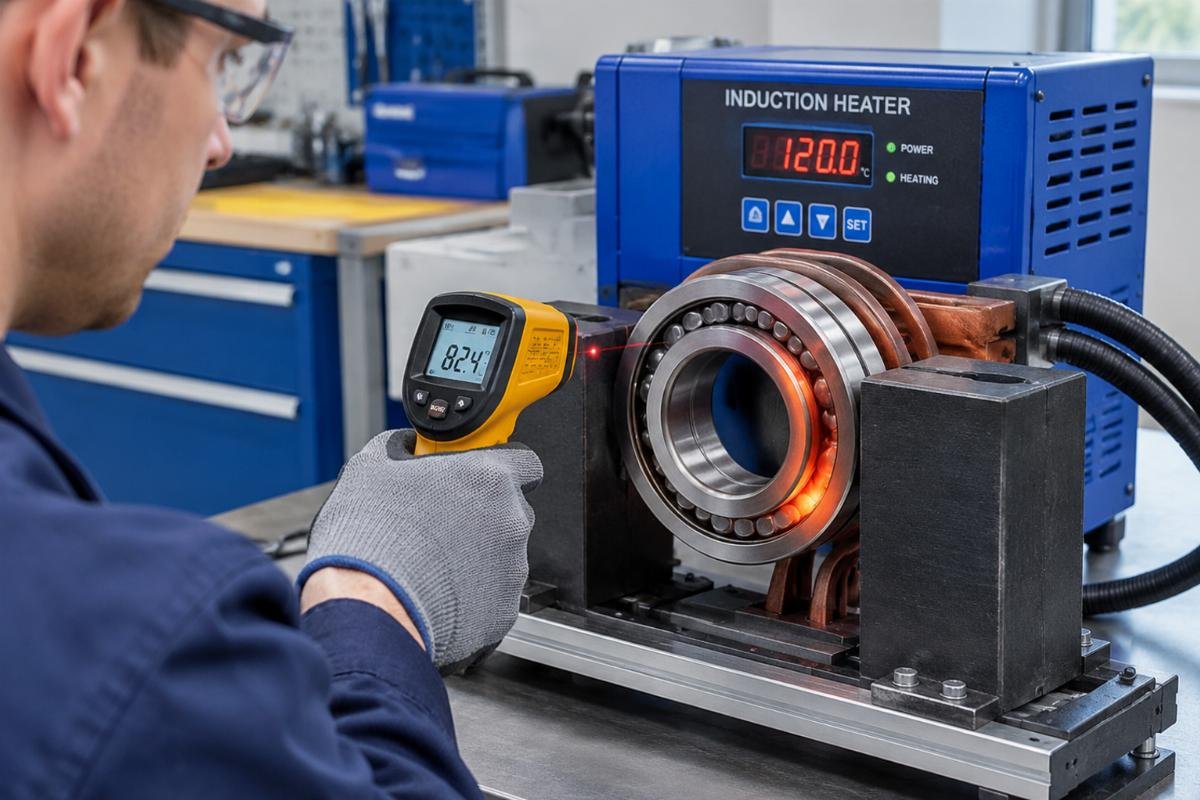
Setting up an induction heater correctly is about more than just turning it on. The goal is uniform heat distribution. Induction heaters work by creating a magnetic field that induces eddy currents in the bearing. If the bearing is not centered properly, or if the magnetic flux is uneven, some parts of the ring will heat faster than others. This creates internal stress and can lead to distortion.
Modern induction heaters use PID (Proportional-Integral-Derivative) control mechanisms to regulate power output. This technology allows the heater to adjust its energy delivery based on real-time feedback, ensuring the target temperature is reached smoothly without overshooting. [NEED_CITE: Principles of PID control in induction heating systems]
To monitor the temperature accurately, do not rely solely on the heater’s built-in display. Use a K-type thermocouple or an infrared thermometer to verify the actual temperature of the bearing. Place the sensor on the inner ring, as this is the part that needs to expand. Avoid measuring the outer ring or the cage, as these may not reflect the true temperature of the mounting surface.
A common mistake is heating the bearing for too long. Once the target temperature is reached, the bearing should be installed immediately. Delaying installation allows the bearing to cool, reducing the clearance and making installation difficult. In a heavy equipment assembly plant I visited, standardizing the heater settings and installation timing eliminated a significant number of batch defects. The technicians learned to work quickly and precisely, ensuring each bearing was seated correctly while still hot.
How to Verify the Installation After Heating?
Check for residual magnetism, verify smooth rotation, and inspect for thermal discoloration before final commissioning.
After the bearing is seated and cooled, the job is not finished. Verification is essential to confirm that the installation did not introduce new problems. First, check for residual magnetism. Induction heating can leave the bearing slightly magnetized. While small amounts of magnetism are usually harmless, strong magnetism can attract metallic particles from the lubricant or environment, leading to abrasion. Demagnetizing tools are available if high levels are detected. [NEED_CITE: Standards for residual magnetism in mounted bearings]
Next, rotate the bearing by hand. It should turn smoothly and quietly. Any roughness, noise, or binding indicates potential damage. This could be due to misalignment during installation, damage to the raceway, or debris trapped inside. If the bearing does not rotate freely, it must be removed and inspected. Do not attempt to run the machine with a binding bearing, as this will cause immediate failure.
Finally, inspect the bearing for signs of thermal damage. Look for discoloration on the steel, which indicates overheating. Blue or straw-colored tints suggest the steel was exposed to excessive heat. Check the seals for melting or cracking. If any signs of damage are present, replace the bearing. Installing a damaged bearing is a waste of time and resources, as it will fail prematurely.
In my experience, this verification step catches many errors before they become costly downtime events. It reinforces the importance of careful installation and provides immediate feedback to the maintenance team. For wholesalers supplying MRO clients, offering technical support on these verification steps adds significant value to the product offering.

Conclusion
Precise temperature control is the key to successful bearing installation.
By keeping induction heater temperatures between 80°C and 110°C, you protect the bearing’s structural integrity and lubrication. Avoiding overheating prevents cage annealing and grease carbonization, ensuring the bearing performs as designed. Proper setup, monitoring, and verification complete the process, minimizing the risk of premature failure. This approach saves time, money, and operational headaches in the long run.
Need a quote for the bearings in this article?
Send your part numbers and get price, stock and lead time within 4 hours.

Written by
authorEditor covering global sourcing, supplier verification, and industrial product knowledge. Content is compiled from manufacturer specifications, industry standards, and hands-on experience with international B2B buyers. Every article is fact-checked before publishing to help procurement professionals make informed decisions.
View all posts

