22210 Bearing: CC vs E vs CA Versions Wholesale Supplier

22210 Bearing: CC vs E vs CA Versions Wholesale Supplier
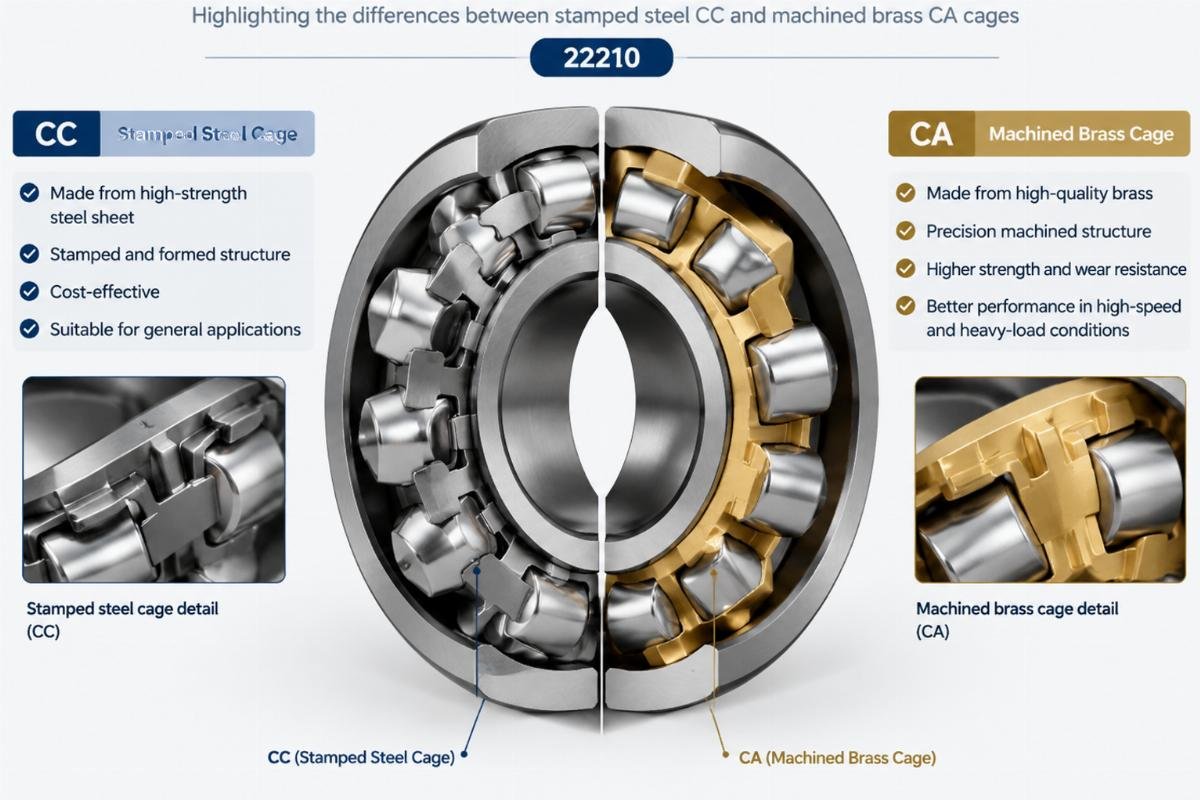
Most buyers order the wrong 22210 bearing because they match the dimensions but ignore the cage.
The core specification for a 22210 spherical roller bearing is not just its 50mm bore, 90mm outer diameter, and 23mm width. The critical differentiator lies in the internal design and cage material. Selecting between CC (stamped steel), CA (machined brass), or E (optimized roller profile) versions determines whether the bearing survives high shock loads or fails prematurely. For heavy-duty applications like mining crushers or vibrating screens, the CA or E variants often provide superior fatigue life and thermal stability compared to the standard CC version, despite the higher initial cost.
I still remember the humidity in Minas Gerais. The air was thick with iron dust and heat. I had shipped a batch of 22210 bearings to an iron ore processing plant, confident that the standard specifications would hold. I had matched the part number perfectly. But I had overlooked the cage type. The client was running a primary crusher under extreme shock loads and high ambient temperatures. I had supplied the CC version, which uses a stamped steel cage. Within weeks, the cage fractured. The rollers jammed, the shaft seized, and the entire production line halted. The cost of the downtime dwarfed the price difference between the CC and the CA version I should have recommended. That failure taught me that the part number is only the beginning of the story. [NEED_CITE: ISO 15243 failure mode classification for cage fractures]
Understanding these internal differences is essential for any procurement manager or distributor. Let’s break down exactly what makes each version distinct and how to choose the right one for your specific operational environment.
What Are the Core Specs of the 22210 Spherical Roller Bearing?
The 22210 bearing is defined by its self-aligning capability and double-row roller design, but its performance limits depend on internal clearance and cage construction.
At a basic level, the 22210 follows the ISO 15:2017 standard for boundary dimensions. It features a 50mm bore, a 90mm outside diameter, and a total width of 23mm. This compact size allows it to fit into tight spaces within gearboxes, pumps, and heavy machinery housings. However, the “222” series designation indicates a specific load capacity class and internal geometry that differs from the 223 or 230 series. [NEED_CITE: ISO 15:2017 rolling bearing dimensional standards]
The dynamic load rating (Cr) and static load rating (C0r) are often listed in catalogs, but these values assume ideal operating conditions. In reality, the effective load capacity is heavily influenced by the cage type. A stamped steel cage (CC) has lower strength and heat resistance than a machined brass cage (CA). Furthermore, the internal radial clearance, such as C3 or C4, plays a vital role in accommodating thermal expansion. Without adequate clearance, a bearing running at high speeds or in hot environments will expand, leading to preload and early failure.
Many buyers focus solely on the bore and OD, assuming all 22210 bearings are interchangeable. This is a dangerous assumption. While the external dimensions allow the bearing to fit into the housing, the internal architecture dictates its lifespan. A 22210 bearing designed for moderate speeds and clean environments will not survive in a vibrating screen application without the correct internal optimizations.
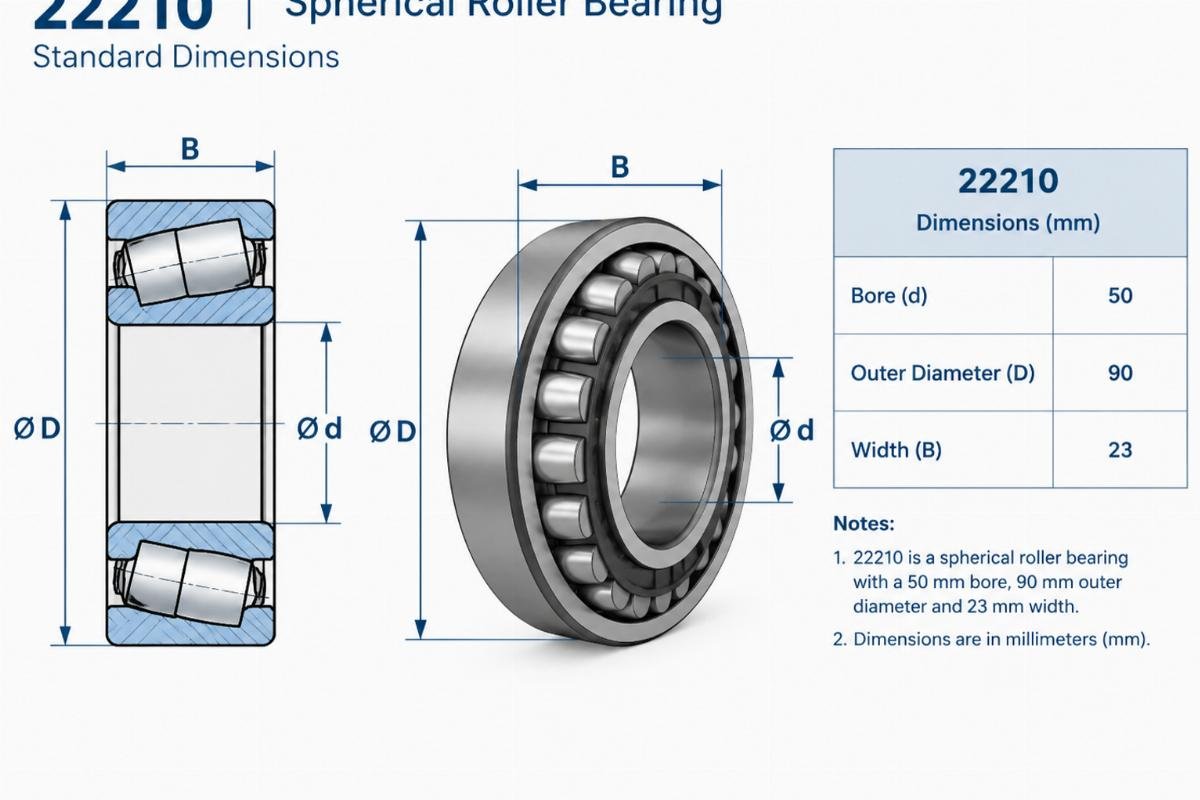
When sourcing these components, it is crucial to verify not just the part number, but the suffix codes that indicate cage material and clearance. This ensures that the physical fit translates into functional reliability.
CC vs. CA vs. E: How Do Cage Types and Internal Designs Differ?
The choice between CC, CA, and E designs is a trade-off between cost, shock resistance, and load capacity.
The suffixes attached to the 22210 part number are not arbitrary. They represent significant engineering differences in how the bearing handles stress, heat, and speed. Understanding these distinctions prevents the kind of catastrophic failure I witnessed in Brazil.
| Feature | CC Version (Stamped Steel) | CA Version (Machined Brass) | E Version (Optimized Design) |
|---|---|---|---|
| Cage Material | Stamped sheet steel | Machined solid brass | Varies (often steel or polyamide) |
| Shock Resistance | Low to Moderate | High | High |
| Thermal Stability | Limited | Excellent | Good |
| Load Capacity | Standard | Standard | Increased Radial Load |
| Speed Limit | Moderate | High | High |
| Cost | Lowest | Higher | Moderate to High |
The CC version uses a stamped steel cage. It is the most common and cost-effective option. The steel cage is lightweight and suitable for general industrial applications where shock loads are minimal and operating temperatures are stable. However, under high vibration or sudden impact, the thin steel can deform or crack. [NEED_CITE: ABMA/ANSI standards for bearing cage material properties]
The CA version features a machined brass cage. Brass is softer than steel but has excellent thermal conductivity and higher strength in solid form. This design is ideal for applications with high shock loads, such as crushers and mining equipment. The machined cage guides the rollers more precisely, reducing friction and heat generation. It is also more resistant to the thermal expansion that can cause jamming in high-temperature environments.
The E version represents an optimized internal design. It typically features larger or more numerous rollers, which increases the radial load capacity compared to the standard design. The cage material in E versions can vary, but the focus is on maximizing load carrying ability. This makes the E variant suitable for heavy-duty applications where space is limited but load requirements are high, such as in vibrating screens or continuous casters.
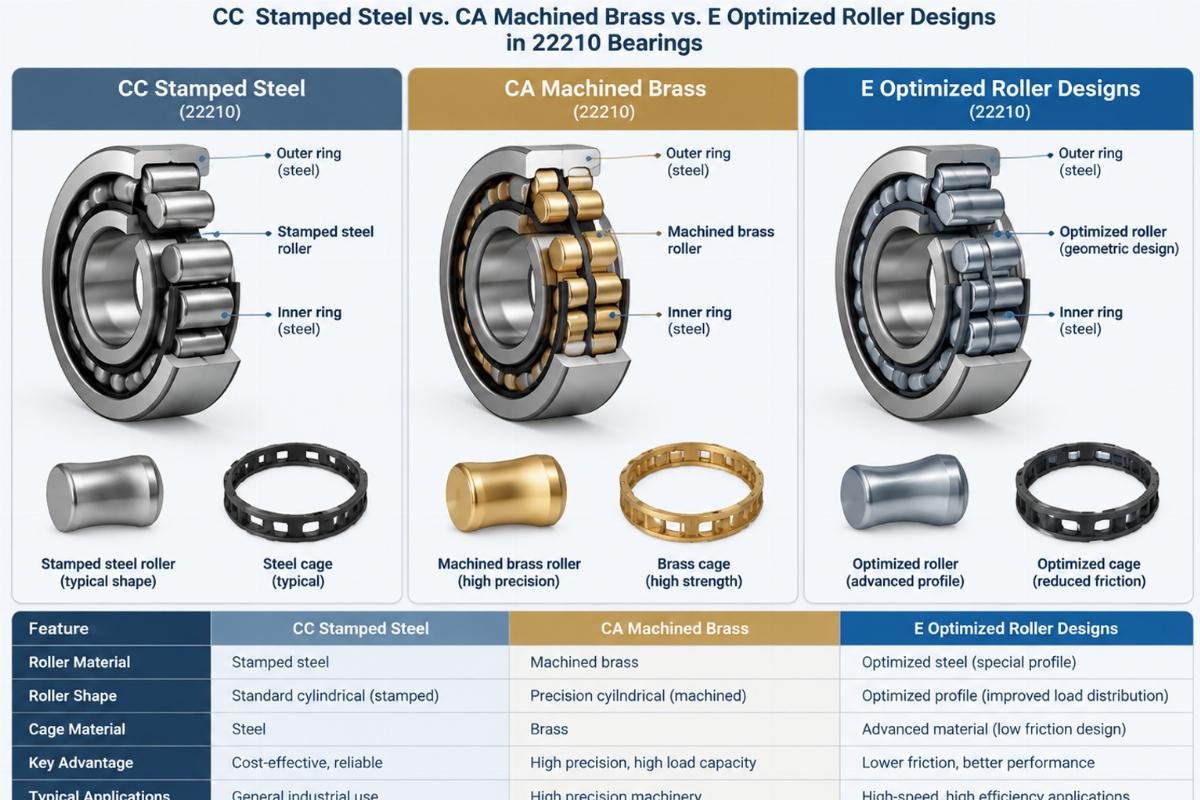
Choosing the wrong version can lead to premature failure. For instance, using a CC bearing in a high-shock application may result in cage fracture, while using a CA bearing in a high-speed, low-load application might be an unnecessary expense. The key is to match the internal design to the operational stresses.
How to Choose the Right 22210 Version for Your Application?
Match the cage material and internal design to the specific shock, speed, and thermal conditions of your machinery.
Selecting the correct 22210 variant requires a detailed analysis of the operating environment. It is not enough to know the load; you must understand the nature of the load. Is it constant? Is it shocking? Is there vibration?
For mining crushers and heavy-earth moving equipment, the environment is harsh. Shock loads are frequent and intense. In these cases, the CC version is rarely sufficient. The CA version, with its machined brass cage, offers the necessary robustness to withstand impact without fracturing. I have seen distributors in Latin America switch their standard stock from CC to CA for crusher applications, resulting in a noticeable extension of replacement cycles. The higher upfront cost is offset by reduced downtime and fewer emergency orders. [NEED_CITE: Case studies on bearing selection in mining industry]
Vibrating screens present a different challenge. The constant vibration can cause standard rollers to skid rather than roll, leading to flat spots and premature fatigue. The E version, with its optimized roller profile and higher load capacity, is better suited for this application. The increased load rating allows the bearing to handle the dynamic forces generated by the vibration. Additionally, the internal design of the E version often includes better lubrication pathways, which helps maintain film strength under oscillating conditions.
In steel mills, particularly in continuous casters, temperature is the primary enemy. Bearings operate in high-heat environments where thermal expansion can reduce internal clearance to zero. Here, the CA version is again preferred due to the thermal stability of brass. Furthermore, selecting the correct internal clearance, such as C3 or C4, is critical. A standard clearance bearing will likely seize in these conditions. [NEED_CITE: ISO 1132-1 tolerance classes for internal clearance]
When consulting with clients, I always ask about the specific failure modes they are experiencing. Are cages breaking? Are races spalling? Is there overheating? These symptoms point directly to the appropriate 22210 variant. A one-size-fits-all approach does not work in heavy industry.
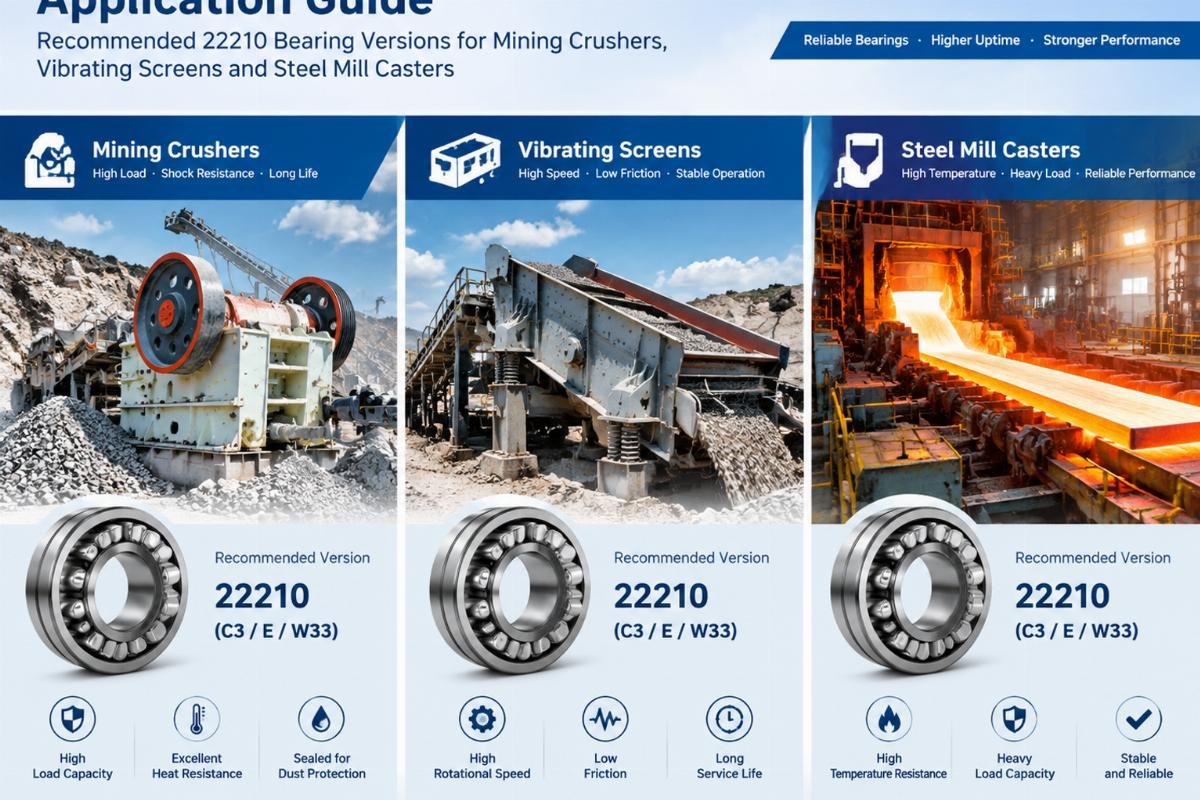
Proper selection minimizes the risk of unplanned downtime. It ensures that the bearing performs as intended throughout its design life, rather than failing due to a mismatch between component capabilities and operational demands.
What Are the Common Pitfalls in 22210 Bearing Selection?
Ignoring internal clearance and cage type leads to premature failure, even when dimensions are correct.
One of the most common mistakes buyers make is assuming that all 22210 bearings are identical if they share the same brand and part number base. They overlook the suffixes that denote cage type and clearance. This oversight can be costly.
Another pitfall is focusing solely on the initial purchase price. The CC version is cheaper than the CA or E versions. For light-duty applications, this cost saving is valid. However, in heavy-duty environments, the lower cost of the CC bearing often leads to higher total lifecycle costs. Frequent replacements, emergency shipping fees, and production losses quickly outweigh the initial savings. Buyers who prioritize upfront cost over technical suitability often find themselves paying more in the long run.
Incorrect lubrication is also a frequent issue. Different cage materials and internal designs may have specific lubrication requirements. For example, high-speed applications with CA cages may require oil lubrication to dissipate heat effectively, while grease may suffice for slower CC applications. Using the wrong lubricant can lead to overheating and cage degradation. [NEED_CITE: OEM technical manuals for lubrication guidelines]
Furthermore, improper installation can damage even the highest quality bearing. Misalignment during mounting can induce stresses that the bearing is not designed to handle. While spherical roller bearings are self-aligning, they have limits. Excessive misalignment can cause edge loading on the rollers, leading to rapid wear.
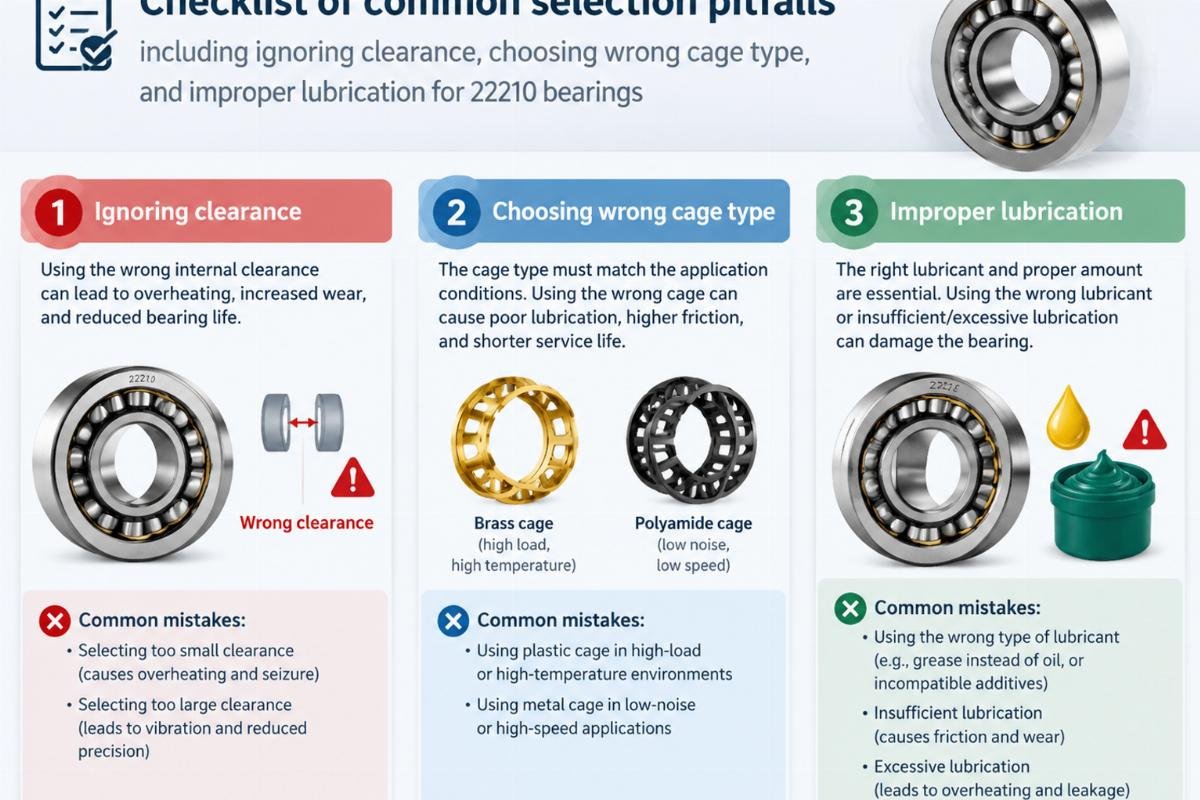
To avoid these pitfalls, it is essential to consult technical datasheets and, when possible, seek expert advice. Verifying the cage type and clearance before shipment can prevent many common failures. Our team provides cross-brand equivalent consultation to help buyers verify these critical parameters, ensuring that the selected 22210 bearing matches the specific demands of their application.
Conclusion
Selecting the right 22210 bearing requires looking beyond dimensions to cage material and internal design.
The difference between a CC, CA, and E version is not merely academic; it determines the reliability of your machinery in demanding environments. By matching the bearing’s internal architecture to the specific shock, thermal, and load conditions of your application, you can significantly extend service life and reduce downtime. Always verify the suffix codes and internal clearance specifications to ensure optimal performance.
Need a quote for the bearings in this article?
Send your part numbers and get price, stock and lead time within 4 hours.

Written by
authorEditor covering global sourcing, supplier verification, and industrial product knowledge. Content is compiled from manufacturer specifications, industry standards, and hands-on experience with international B2B buyers. Every article is fact-checked before publishing to help procurement professionals make informed decisions.
View all posts

