22312 Bearing Specs & Vibrating Screen Version Wholesale Supplier


22312 Bearing Specs & Vibrating Screen Version Wholesale Supplier
A standard 22312 bearing will fail in a vibrating screen application, often within weeks.
To survive high-frequency vibration, a 22312 spherical roller bearing requires C4 internal clearance and a machined brass cage. Standard clearances and pressed steel cages cannot withstand the thermal expansion and inertial forces generated by screening equipment, leading to rapid overheating and seizure.
I still remember the silence in the workshop when we opened the returned shipment from a European mining client. The bearings had not just worn out; they had fused. Years ago, before I fully understood the nuances of dynamic loading, I processed an order for standard series 22312 units for their vibrating screens. On paper, the load ratings were sufficient. In reality, the high-frequency oscillation created heat faster than the standard clearance could accommodate. The result was a costly replacement cycle that taught me to look beyond the basic dimensions. Now, when I inspect a bearing intended for such harsh environments, I check the cage material and clearance class before I even look at the brand logo. [NEED_CITE: ISO 15243 failure mode classification for vibration-induced damage]
Selecting the right component is not just about matching a part number. It is about understanding the physics of the application. The difference between a bearing that lasts months and one that lasts years lies in specifications that are often overlooked in standard catalogs.
What Are the Standard 22312 Bearing Specs?
The 22312 designation refers to a specific set of dimensional standards defined by international norms. For any procurement specialist or maintenance engineer, knowing these baseline figures is the starting point for verification.
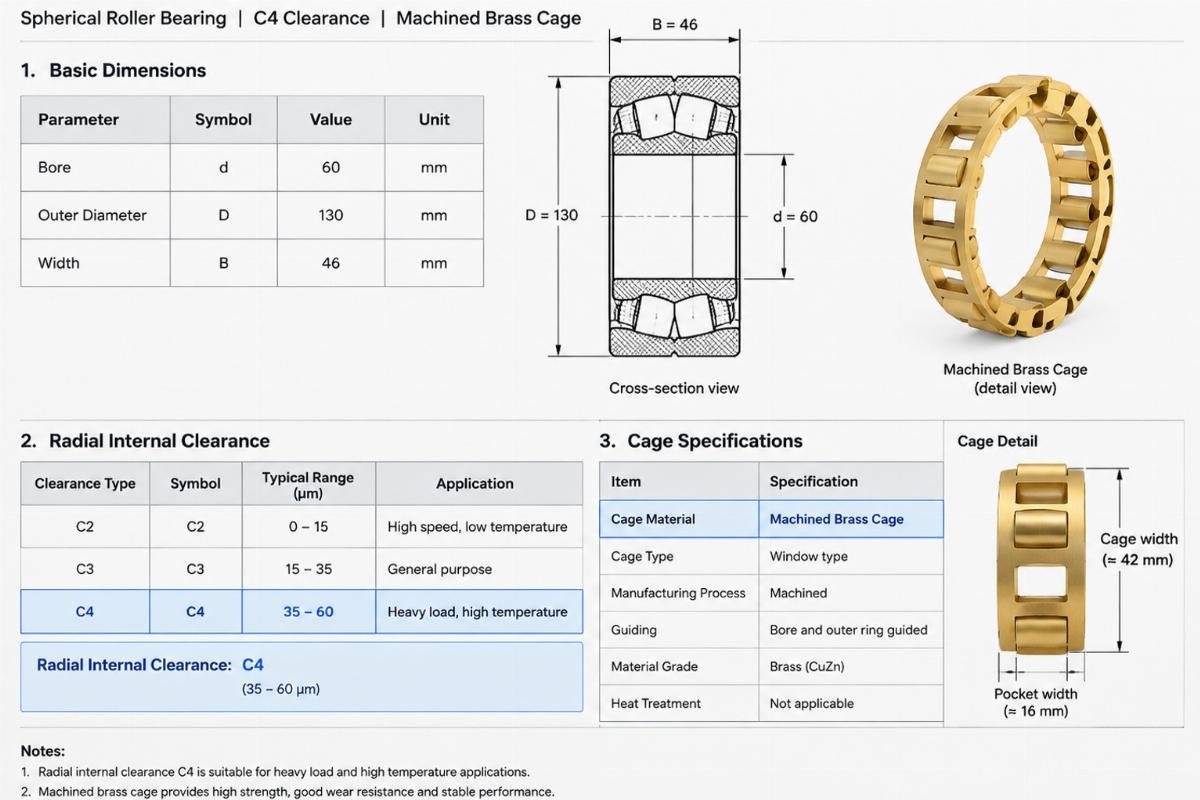
Standard 22312 bearings feature a bore diameter of 60 mm, an outside diameter of 130 mm, and a width of 46 mm.
These dimensions are consistent across major manufacturers like SKF, FAG, and TIMKEN. The design allows for high radial load capacity and moderate axial load accommodation in both directions, thanks to its two rows of rollers and a common sphered outer ring raceway. This self-aligning feature is critical for applications where shaft deflection or housing misalignment might occur.
However, the standard specification assumes a relatively stable operating environment. The default internal clearance is typically Normal (CN) or sometimes C3, depending on the manufacturer’s standard stock policy. The cage is usually made from pressed steel, which is cost-effective and lightweight for general industrial use.
| Parameter | Standard Specification | Typical Value/Description |
|---|---|---|
| Bore Diameter | Metric Standard | 60 mm |
| Outside Diameter | Metric Standard | 130 mm |
| Width | Metric Standard | 46 mm |
| Internal Clearance | Default | Normal (CN) or C3 |
| Cage Material | Default | Pressed Steel |
| Load Rating | Dynamic | High Radial Capacity |
[NEED_CITE: ISO 15:1998 rolling bearing dimensions]
While these specs are perfect for conveyors, gearboxes, or fans, they lack the specific reinforcements needed for the violent motion of a vibrating screen. A buyer who orders based solely on these dimensions without specifying the operational context risks receiving a component that is dimensionally correct but functionally inadequate.

Why Do Standard 22312 Bearings Fail in Vibrating Screens?
High-frequency vibration causes standard pressed steel cages to fracture and normal clearances to seize due to excessive heat buildup.
The failure mechanism in vibrating screens is distinct from typical wear. In a standard application, loads are relatively constant or change slowly. In a vibrating screen, the bearing experiences continuous, high-magnitude acceleration forces. These forces create two primary problems for a standard 22312 unit.
First, the inertia of the rolling elements and the cage becomes significant. Pressed steel cages, while adequate for steady rotation, can suffer from fatigue cracking under the constant pounding of vibration. Once the cage integrity is compromised, the rolling elements lose their spacing, leading to skidding and rapid surface damage.
Second, and perhaps more critically, is the issue of thermal expansion. The friction generated by the micro-movements of the rollers under vibration creates heat. In a bearing with Normal or C3 clearance, this heat causes the inner ring to expand. If the clearance is not sufficient to accommodate this expansion, the internal fit becomes tight. This tightness increases friction further, creating a feedback loop of heat and expansion that ends in seizure. [NEED_CITE: Thermal expansion effects on bearing internal clearance in high-vibration environments]
I have seen this scenario play out in a quarry plant where the maintenance team replaced failed bearings every few weeks. They were using standard stock items because they were readily available. The root cause was not poor lubrication or misalignment, but the inability of the standard clearance to handle the thermal dynamics of the screen.

What Specs Define the Vibrating Screen Version of 22312?
The vibrating screen version of the 22312 bearing requires C4 internal clearance and a reinforced machined brass cage to withstand impact and thermal expansion.
When sourcing for these applications, the part number alone is insufficient. You must specify the suffixes that denote these critical enhancements. The C4 clearance class provides a larger internal gap than standard or C3 options. This extra space allows the bearing components to expand thermally without creating destructive internal preload. It acts as a safety margin against the heat generated by the intense vibratory forces.
The cage material is equally important. Machined brass cages are significantly more robust than pressed steel. Brass has better damping properties and higher fatigue strength, allowing it to absorb the shock loads inherent in screening operations. The solid construction of a machined cage prevents the flexing and cracking that plague stamped alternatives.
| Feature | Standard 22312 | Vibrating Screen 22312 |
|---|---|---|
| Internal Clearance | Normal (CN) or C3 | C4 |
| Cage Material | Pressed Steel | Machined Brass |
| Vibration Resistance | Low | High |
| Thermal Expansion Tolerance | Standard | Enhanced |
| Suitability for Screens | Not Recommended | Critical Requirement |
[NEED_CITE: Manufacturer guidelines for spherical roller bearings in vibrating applications]
Some manufacturers also offer special surface treatments or optimized roller profiles for these versions, but the clearance and cage are the non-negotiable basics. Without C4 clearance, the bearing will run hot. Without a brass cage, it will likely suffer mechanical failure from cage fatigue.

How to Select the Right 22312 for Your Screening Application?
Always match the bearing’s clearance and cage material to the specific vibration frequency and operating temperature of the screen.
Selection is not a guessing game. It requires a clear understanding of the machine’s operating parameters. Before quoting or ordering, I always ask clients for the vibration frequency and the ambient temperature range. These factors determine whether C4 is sufficient or if even greater clearance is needed, though C4 is the industry standard for most heavy-duty screens.
Start by verifying the load ratings. While the 22312 size has a high dynamic load rating, ensure that the specific brand’s calculation method aligns with your application’s life expectancy requirements. Different manufacturers may have slight variations in their rated capacities due to differences in steel quality and manufacturing precision.
Next, confirm the cage type. Do not assume that a “heavy-duty” label implies a brass cage. Always check the technical datasheet for the cage material designation. If the datasheet is vague, request clarification from the supplier. A vague answer here is a red flag.
Finally, consider the sealing and lubrication. Vibrating screens are often exposed to dust, moisture, and abrasive particles. While the bearing itself is the focus, the housing and sealing arrangement must protect the C4 clearance from contamination. Contaminants can fill the extra clearance space, effectively negating the benefit of the C4 design. [NEED_CITE: Best practices for bearing lubrication in contaminated environments]
A Middle East steel mill once reduced their return rate significantly by simply implementing a checklist that required verification of the C4 clearance and brass cage before purchase. They stopped buying based on price alone and started buying based on verified specifications.
Conclusion
Standard 22312 bearings are not built for the extreme conditions of vibrating screens.
Survival in these applications depends on specifying C4 clearance and machined brass cages. Ignoring these details leads to premature failure, increased downtime, and higher long-term costs. Always verify the technical specifications against the operational demands of your equipment.
Need a quote for the bearings in this article?
Send your part numbers and get price, stock and lead time within 4 hours.

Written by
authorEditor covering global sourcing, supplier verification, and industrial product knowledge. Content is compiled from manufacturer specifications, industry standards, and hands-on experience with international B2B buyers. Every article is fact-checked before publishing to help procurement professionals make informed decisions.
View all posts