High Temp Kiln, Oven & Dryer Bearings Wholesale Supplier


High Temp Kiln, Oven & Dryer Bearings Wholesale Supplier
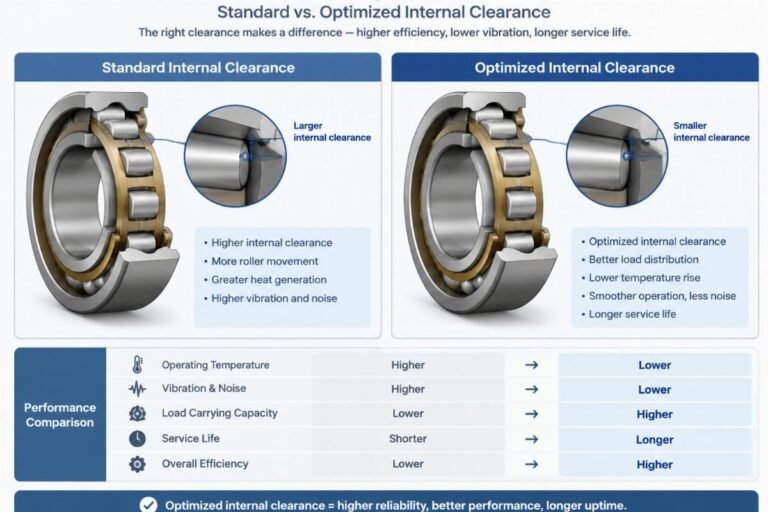
Standard steel with C3 clearance often outlasts special heat-treated steel with tight clearance in high-heat environments.
Selecting the right High Temperature Bearings for Kilns, Ovens and Dryers requires prioritizing C3 internal clearance and high-temperature grease over merely selecting high-temperature rated steel. Thermal expansion of the inner ring eliminates standard internal clearance, causing metal-to-metal contact and seizure, while improper grease carbonizes into a solid coke-like substance that locks the rolling elements. Preventing thermal lock-up is less about the alloy’s melting point and more about managing the dimensional changes caused by heat differentials between the inner and outer rings.
I still remember the silence in an Indonesian glass plant when their conveyor line halted. It wasn’t a motor failure or a power outage. The deep groove ball bearings had seized. The local maintenance team had specified “high-temperature” bearings based on the steel grade alone, ignoring the internal clearance. When the furnace temperature climbed past two hundred degrees Celsius, the inner ring expanded faster than the outer ring because it was directly mounted on the heated shaft. With standard C0 clearance, that expansion ate up every micron of play until the balls were crushed between the races. We replaced them with units featuring C3 clearance, and the line ran without incident for months. That failure wasn’t due to weak steel; it was due to physics. [NEED_CITE: thermal expansion coefficients of bearing steel vs housing materials]
Why Do Standard Bearings Seize in Kilns and Ovens?
Thermal expansion of the inner ring eliminates internal clearance, causing metal-to-metal contact.
In many industrial drying and baking applications, engineers focus heavily on the material composition of the bearing, assuming that a higher temperature rating guarantees survival. However, the primary mechanism of failure in these environments is not material degradation but geometric interference. When a bearing operates in a kiln or oven, the inner ring, which is press-fitted onto a rotating shaft, heats up significantly. Steel expands when heated. If the inner ring expands more than the outer ring—which is often housed in a cooler structure or has a larger mass that dissipates heat—the internal space available for the rolling elements shrinks.
In a standard bearing with normal (C0) clearance, this space is minimal at room temperature. As the temperature rises, the expansion consumes this clearance entirely. Once the clearance reaches zero, the rolling elements are forced against the raceways with immense pressure. This creates friction, which generates more heat, leading to further expansion and eventual seizure. This process can happen rapidly, often within hours of reaching operating temperature. [NEED_CITE: ISO standards for bearing internal clearance and thermal effects]
The misconception that “high-temp steel” solves this issue is dangerous. While specialized steels can resist softening at elevated temperatures, they still expand according to the same physical laws as standard bearing steel. Without adequate initial clearance, even the most advanced alloy will lock up. This is why specifying the correct internal clearance class is more critical than specifying a exotic material for most applications below three hundred degrees Celsius.

How Does C3 Clearance Prevent Thermal Lock-up?
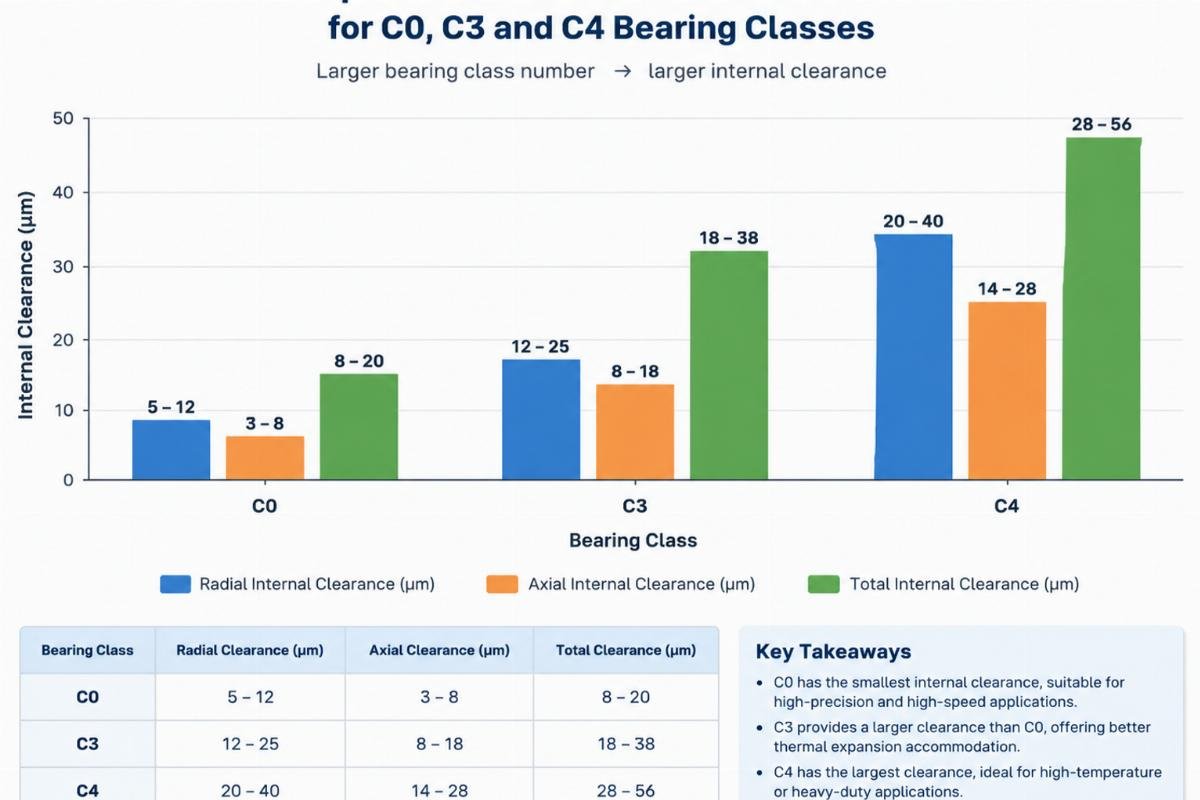
C3 or C4 clearance compensates for the temperature differential between the inner and outer rings.
Internal clearance is the amount of play between the rolling elements and the raceways when the bearing is unmounted. For high-temperature applications, standard clearance is insufficient. C3 clearance provides a larger initial gap, allowing the inner ring to expand without immediately contacting the rolling elements. In extreme cases, such as very high-temperature kilns or where the temperature differential between the shaft and housing is significant, C4 clearance may be required.
The selection of C3 versus C4 depends on the specific operating conditions, including the shaft diameter, the expected temperature rise, and the fit tolerances. A larger shaft diameter will result in greater absolute expansion for the same temperature increase, necessitating more initial clearance. [NEED_CITE: bearing manufacturer technical application guides for high-temp environments]
When sourcing High Temperature Bearings for Kilns, Ovens and Dryers, it is essential to verify that the supplier can provide genuine products with the specified clearance. Many standard stock items are supplied with C0 clearance by default. Substituting a C0 bearing for a C3 requirement is a common error that leads to premature failure. Our cross-brand sourcing capability allows us to secure genuine SKF, FAG, and NSK bearings with specific C3 or C4 clearances, ensuring that the dimensional specifications match the thermal demands of the application. We maintain a flexible MOQ for mixed-container MRO orders, enabling distributors to stock the correct variants without committing to excessive volumes of a single part number.
| Clearance Class | Typical Application | Thermal Compensation Capability |
|---|---|---|
| C0 (Normal) | Standard electric motors, general machinery | None |
| C2 | Quiet running applications, low temp | Minimal |
| C3 | High temp applications, tight fits | Moderate |
| C4 | Very high temp, large shafts | High |
What is the Role of High-Temperature Grease?
Synthetic or PFPE greases prevent carbonization and maintain lubrication film above 200°C.
Even with the correct clearance, a bearing will fail if the lubricant breaks down. Standard lithium-based greases have a dropping point—the temperature at which they turn from semi-solid to liquid—often below two hundred degrees Celsius. In a kiln or oven environment, exceeding this temperature causes the grease to separate, leak out, or worse, carbonize. Carbonized grease turns into a hard, black solid that acts like glue, locking the bearing in place. This is distinct from thermal seizure caused by clearance issues, but the result is the same: a stopped production line.
High-temperature greases, such as those based on synthetic hydrocarbons or perfluoropolyether (PFPE), have much higher dropping points and thermal stability. They maintain their viscosity and lubricating film even at elevated temperatures. However, these greases are often more expensive and may have different compatibility requirements with seals and other materials. [NEED_CITE: high-temp grease dropping point and base oil viscosity specs]
Relubrication cycles also change in high-heat environments. The grease degrades faster, requiring more frequent replenishment. In some sealed-for-life bearings designed for high temperatures, the grease volume and type are carefully calculated to last the intended service life without relubrication. For open or shielded bearings in continuous operation, establishing a rigorous relubrication schedule is critical. Failure to do so leads to dry running and rapid wear.
A European food processing plant once experienced repeated failures in their dryer conveyor bearings. The issue was not the bearing type but the grease. They were using a standard multi-purpose grease that carbonized after a few weeks at operating temperature. Switching to a high-temperature synthetic grease extended the service life meaningfully. This highlights that lubrication is as critical as mechanical design in high-heat applications. When advising clients on High Temperature Bearings for Kilns, Ovens and Dryers, we emphasize the need to match the grease specification to the maximum operating temperature, not just the average.

Which Bearing Types Suit Dryers and Ovens Best?
Deep groove and spherical roller bearings with specific suffixes for high-temp stability are preferred.
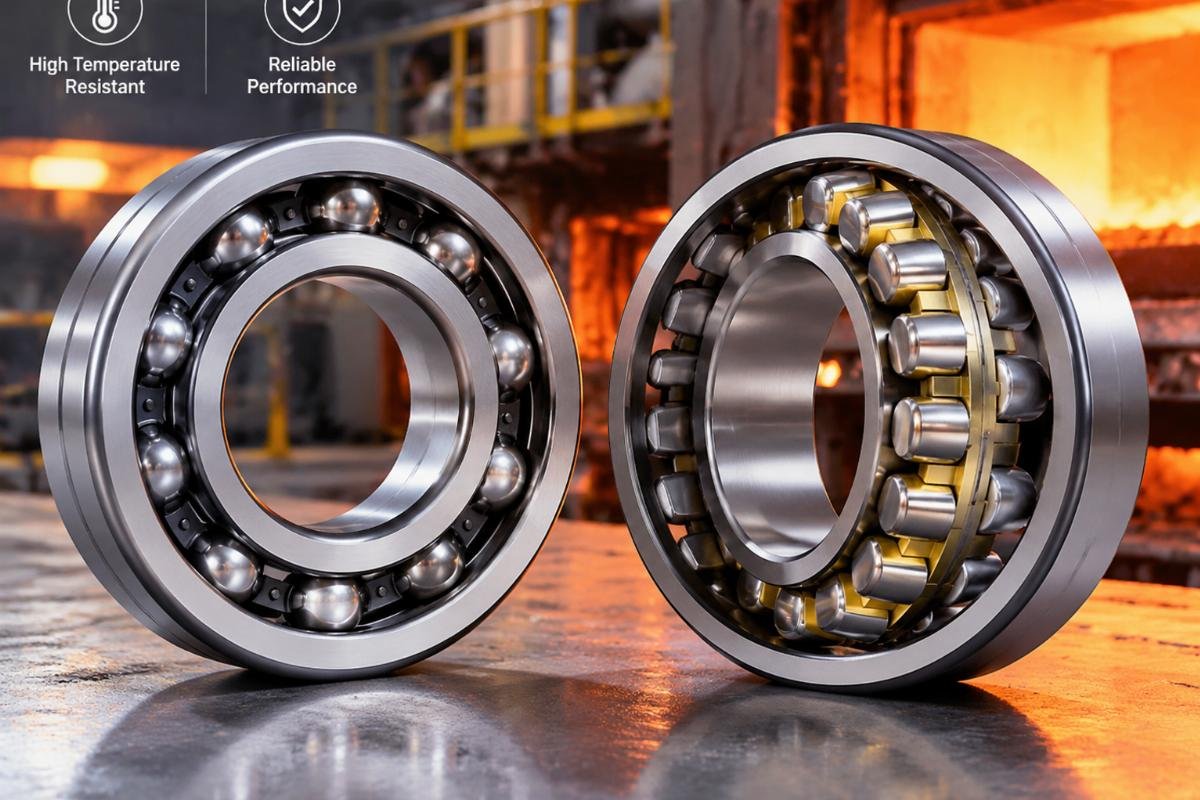
Not all bearing types are equally suited for high-temperature environments. Deep groove ball bearings are common due to their versatility and ability to handle both radial and axial loads. However, in applications with significant misalignment or heavy loads, spherical roller bearings may be a better choice. These bearings can accommodate shaft deflection and misalignment, which can occur due to thermal distortion of the housing or shaft.
The choice of cage material is also important. Standard steel cages may perform adequately, but in very high temperatures, brass or polyamide cages might degrade. Some high-temperature bearings use machined brass cages or even steel cages with specific heat treatments to maintain integrity. Shields and seals must also be selected carefully. Standard rubber seals will melt or harden and crack at high temperatures. Metal shields (ZZ or 2Z suffixes) are often preferred as they can withstand higher temperatures, although they offer less protection against contamination than rubber seals. In dusty kiln environments, this trade-off must be managed through external sealing solutions or frequent maintenance. [NEED_CITE: ISO standards for bearing seal materials and temperature limits]
For distributors and MRO managers sourcing High Temperature Bearings for Kilns, Ovens and Dryers, understanding these nuances is key to providing reliable solutions. Our portfolio covers full-spectrum bearing types, including deep-groove ball bearings and spherical roller bearings from premium global brands like SKF, FAG, INA, NSK, and NTN. We provide technical selection support to help clients choose the right combination of bearing type, clearance, and sealing for their specific application. This ensures that the bearings not only survive the heat but also perform reliably under load.
Conclusion
Preventing thermal seizure requires managing expansion and lubrication, not just selecting heat-resistant steel.
Success in high-temperature applications hinges on specifying C3 or C4 clearance to accommodate thermal growth and using high-temperature grease to prevent carbonization. These factors are often overlooked in favor of material ratings, leading to avoidable downtime. By focusing on these critical parameters, operators can ensure reliable performance in kilns, ovens, and dryers. Sourcing genuine components with the correct specifications from a reliable High Temperature Bearings for Kilns, Ovens and Dryers supplier is the final step in securing operational continuity.
Need a quote for the bearings in this article?
Send your part numbers and get price, stock and lead time within 4 hours.

Written by
authorEditor covering global sourcing, supplier verification, and industrial product knowledge. Content is compiled from manufacturer specifications, industry standards, and hands-on experience with international B2B buyers. Every article is fact-checked before publishing to help procurement professionals make informed decisions.
View all posts