Conveyor Idler, Pulley & Drive Bearings: Wholesale Supplier for Bulk Orders


Conveyor Idler, Pulley & Drive Bearings: Wholesale Supplier for Bulk Orders
Tighter clearance is not better for mining conveyors. It causes thermal seizure. Selecting the right conveyor bearings requires matching internal clearance grades like C3 or C4 to specific operating temperatures and load conditions, rather than defaulting to standard clearances or premium brand names alone.
I still remember the silence in the control room of a large open-pit mine in Western Australia. It was not the peaceful kind. The main overland conveyor had stopped because the idler rollers seized up. The maintenance team had replaced a batch of bearings just weeks prior. They assumed that since the new parts were from a top-tier global brand, they would outperform the previous ones. They did not account for the ambient heat combined with the friction heat generated by the heavy coal load. The bearings had standard internal clearance. As the temperature rose, the inner rings expanded faster than the outer rings could accommodate. The rolling elements locked. That shutdown cost more in lost production than the entire annual bearing budget for that site. I learned then that specifications on paper mean nothing if they do not match the thermal reality of the field. [NEED_CITE: relationship between operating temperature and internal clearance selection]
This mismatch is common when buyers focus solely on brand reputation or price per unit. As a conveyor bearings selection guide, this article breaks down how to choose idler, pulley, and drive bearings correctly. We will look at why clearance matters more than brand in hot environments, how seal types dictate survival in wet plants, and the hidden risks of mixing brands in consolidated shipments.
How Do Idler, Pulley, and Drive Bearings Differ in Load Requirements?
Each position on a conveyor system faces distinct mechanical stresses that demand specific bearing geometries. You cannot use the same bearing for a high-speed drive pulley and a slow-moving idler roller.
Idler bearings primarily support radial loads. They rotate at relatively low speeds but must endure constant vibration and misalignment from the belt structure. Spherical roller bearings are often preferred here because they can accommodate angular misalignment without inducing excessive internal stress. [NEED_CITE: load capacity comparison between spherical roller and deep groove ball bearings]
Pulley bearings, especially at the head and tail ends, handle higher radial loads due to belt tension. They also face some axial load during startup and shutdown. These positions require robust housings and bearings with high dynamic load ratings. If the load rating is too low, premature spalling occurs on the raceways.
Drive bearings are the most critical. They transmit torque and face combined radial and axial loads. They operate at higher speeds than idlers, generating more heat. Cylindrical roller bearings or tapered roller bearings are common here due to their ability to handle heavy loads and precise positioning. Using an undersized bearing in the drive position leads to rapid fatigue failure.
| Bearing Position | Primary Load Type | Speed Range | Common Bearing Type | Key Failure Mode |
|---|---|---|---|---|
| Idler Roller | Radial | Low | Spherical Roller | Seal failure, grease washout |
| Pulley (Head/Tail) | Radial + Moderate Axial | Medium | Spherical Roller / Tapered | Raceway spalling, housing crack |
| Drive Unit | Combined Radial/Axial | High | Cylindrical / Tapered | Thermal seizure, cage fracture |
A client in Southeast Asia once ordered a full container of spherical roller bearings for both idlers and drive units to simplify inventory. Within months, the drive units failed. The spherical bearings could not handle the precise axial positioning required by the gearbox coupling, leading to uneven load distribution. Switching to cylindrical roller bearings for the drive end resolved the issue. This highlights why understanding the specific role of each component is vital in conveyor bearings selection.

Why is Internal Clearance Critical for Conveyor Roller Bearings?
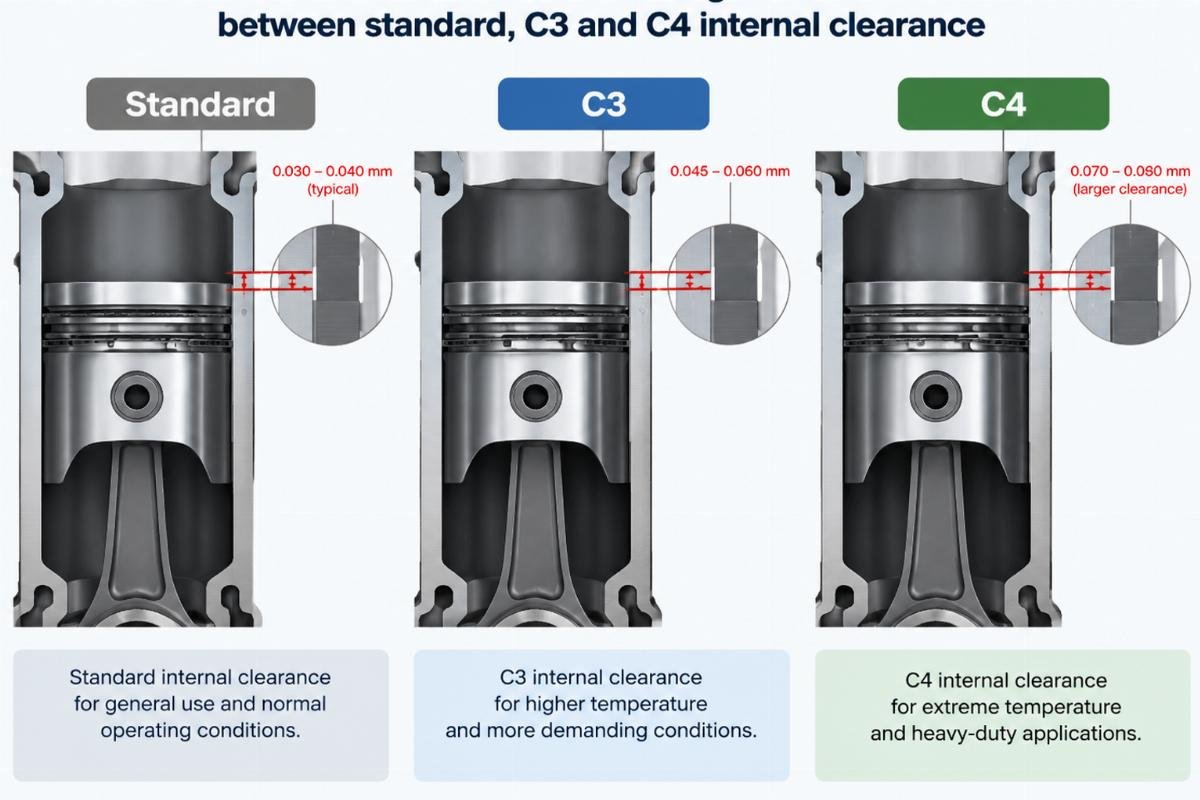
Standard clearance bearings will seize in high-temperature mining applications. You must specify C3 or C4 clearance based on operating conditions.
Internal clearance is the space between the rolling elements and the raceways. In a stationary state, this gap seems insignificant. However, during operation, two things happen: the bearing generates heat from friction, and the environment adds ambient heat. Steel expands when heated. If the initial clearance is too tight, the expansion eliminates the gap entirely. The rolling elements then press against the raceways with immense force, causing friction to spike, heat to rise further, and eventually, the bearing to lock up.
In mining conveyors, ambient temperatures can exceed forty degrees Celsius. Add the heat from heavy loads and poor ventilation in underground tunnels, and the operating temperature of the bearing can rise significantly. A standard clearance bearing might have only a few microns of play. A C3 clearance bearing has more, allowing for thermal expansion without contact. [NEED_CITE: ISO standards for bearing internal clearance groups]
I once inspected a batch of returned bearings from a cement plant in the Middle East. The outer rings showed blue discoloration, a sign of extreme overheating. The maintenance team had installed standard clearance bearings because they were “what we always use.” They did not realize that the new conveyor design ran hotter due to increased throughput. By switching to C4 clearance bearings, they eliminated the seizure issues. The key is to calculate the expected temperature rise and select the clearance group that accommodates it.
Many buyers assume tighter is better for precision. In conveyors, loose is often safer. This counter-intuitive fact is a major cause of downtime. When sourcing as a conveyor bearings selection partner, we verify the operating temperature range before recommending the clearance grade.
How to Choose the Right Seals for Harsh Mining Environments?
Standard rubber seals fail quickly in wet wash plants and dusty mines. Multi-labyrinth seals with steel covers are essential for longevity.
Seals keep lubricant in and contaminants out. In a clean factory, a simple rubber seal works fine. In a mining environment, you face abrasive dust, high-pressure water jets, and chemical slurries. Standard seals wear out rapidly. Once the seal lip degrades, water enters the bearing. Water mixes with grease, forming an emulsion that loses its lubricating properties. The bearing then runs dry, leading to rapid corrosion and failure.
Labyrinth seals offer superior protection. They use a series of narrow passages that create resistance to contaminant ingress. Even if water reaches the outer edge, it cannot easily penetrate the inner chambers where the rolling elements sit. Some advanced designs combine labyrinth structures with high-grade nitrile or viton rubber lips for added security. [NEED_CITE: IP rating standards for bearing seals in harsh environments]
A coal processing plant in Indonesia struggled with frequent idler failures in their wash plant area. The water spray used to clean the coal was washing out the grease from standard sealed bearings. We recommended switching to bearings with triple-labyrinth seals and stainless steel outer covers. The replacement cycle extended from three months to over a year. The initial cost was higher, but the total cost of ownership dropped noticeably because labor and downtime costs were reduced.
When evaluating seals, look for the material compatibility with your specific contaminants. Acidic slurry requires different elastomers than alkaline water. Do not just ask for “sealed bearings.” Specify the type of seal and the expected environmental challenges. This precision is a core part of effective conveyor bearings selection.

What Risks Come from Mixing Brands in Consolidated Shipments?
Mixed-brand batches often have inconsistent tolerances that cause premature failure. Strict verification is required when consolidating orders.
Buyers often consolidate orders from multiple brands to save on shipping and meet minimum order quantities. This is a smart financial move, but it carries technical risk. Different manufacturers have slightly different interpretations of ISO tolerance classes. One brand’s P6 class might be at the upper limit of the tolerance band, while another’s is at the lower limit. When these bearings are installed in the same conveyor system, the fit and clearance can vary unexpectedly.
Furthermore, grease formulations differ between brands. Mixing greases can lead to chemical incompatibility, causing the lubricant to harden or separate. I once handled a claim where a buyer mixed two well-known European brands in one container. The bearings looked identical, but the internal clearance distribution varied enough that some idlers ran hot while others ran cool. The inconsistency made troubleshooting difficult for the site engineers.
To mitigate this, we perform strict incoming inspections on consolidated shipments. We check the clearance and dimensional tolerances of each brand batch to ensure they fall within a compatible range. We also verify that the grease types are similar or compatible if the bearings are pre-greased. This level of scrutiny prevents the “mixed batch” problem that plagues many general traders.
Our approach to conveyor bearings selection includes this verification step. We do not just ship boxes; we ensure that the technical parameters align across the entire shipment, regardless of the brand mix. This protects your operation from the hidden risks of consolidation.

Conclusion
Correct bearing selection prevents catastrophic conveyor downtime. Match clearance, seals, and load ratings to your specific operating conditions.
Choosing the right bearings involves more than picking a brand. It requires understanding the thermal, mechanical, and environmental stresses of your application. By focusing on internal clearance, seal integrity, and load compatibility, you ensure reliable performance. Whether you are sourcing idlers, pulleys, or drive units, technical precision matters more than price alone. Proper conveyor bearings selection is the foundation of efficient mining and heavy industry operations.
Need a quote for the bearings in this article?
Send your part numbers and get price, stock and lead time within 4 hours.

Written by
authorEditor covering global sourcing, supplier verification, and industrial product knowledge. Content is compiled from manufacturer specifications, industry standards, and hands-on experience with international B2B buyers. Every article is fact-checked before publishing to help procurement professionals make informed decisions.
View all posts

