Machine Tool Spindle Bearings: Selection & Arrangement Wholesale Supplier


Machine Tool Spindle Bearings: Selection & Arrangement Wholesale Supplier
Higher preload does not always mean higher precision. In fact, excessive preloading is a primary cause of thermal displacement that ruins machining accuracy.
The optimal configuration for machine tool spindle bearings depends on balancing rigidity against thermal stability. For high-speed milling, face-to-face arrangements with light preload minimize heat generation. For heavy-cutting lathes, back-to-back setups with moderate preload provide necessary stiffness. Selecting the correct precision grade, such as P4 or P2, must align with specific tolerance requirements rather than assuming higher is always better.
I still remember the smell of burnt oil in a Dongguan workshop years ago. We were assembling spindles for a batch of CNC milling machines. The design called for a specific angular contact arrangement, but during assembly, we switched to a face-to-face configuration without adjusting the preload correctly. The result was immediate and costly. During the test run, the spindle heated up rapidly, vibration levels spiked, and the entire batch was rejected by the client. That failure taught me that details in selection dictate survival. Since then, every time I handle machine tool spindle bearings, I focus intensely on the match between bearing type, arrangement, and operating conditions. A wrong suffix code or a miscalculated preload can turn a high-precision asset into scrap metal.
Understanding these technical nuances is critical for buyers who need reliable performance. This guide breaks down the selection process to help you avoid common pitfalls.
How to Choose the Right Bearing Type?
Match the bearing geometry to the dominant load direction and speed profile of your application.
Selecting the right type involves analyzing whether the spindle faces primarily radial loads, axial loads, or a combination. Angular contact ball bearings are the standard for high-speed applications due to their ability to handle combined loads with low friction. Tapered roller bearings, while robust, generate more heat and are typically reserved for heavy-duty, lower-speed operations where rigidity is paramount.
| Bearing Type | Load Capacity | Speed Limit | Thermal Stability | Typical Application |
|---|---|---|---|---|
| Angular Contact Ball | High Axial/Radial | Very High | Excellent | High-speed Milling |
| Tapered Roller | Very High Radial/Axial | Moderate | Moderate | Heavy Turning |
| Cylindrical Roller | High Radial Only | High | Good | Support Roles |
[NEED_CITE: load capacity and speed limits per ABMA standards]
A European machinery OEM once sourced tapered rollers for a high-speed grinder, assuming higher load capacity would extend life. Instead, the increased friction caused thermal growth that exceeded tolerance limits within hours. Switching to precision angular contact units resolved the issue. When evaluating options, consider the stiffness curves and thermal expansion coefficients. [NEED_CITE: thermal expansion coefficients for bearing steels]
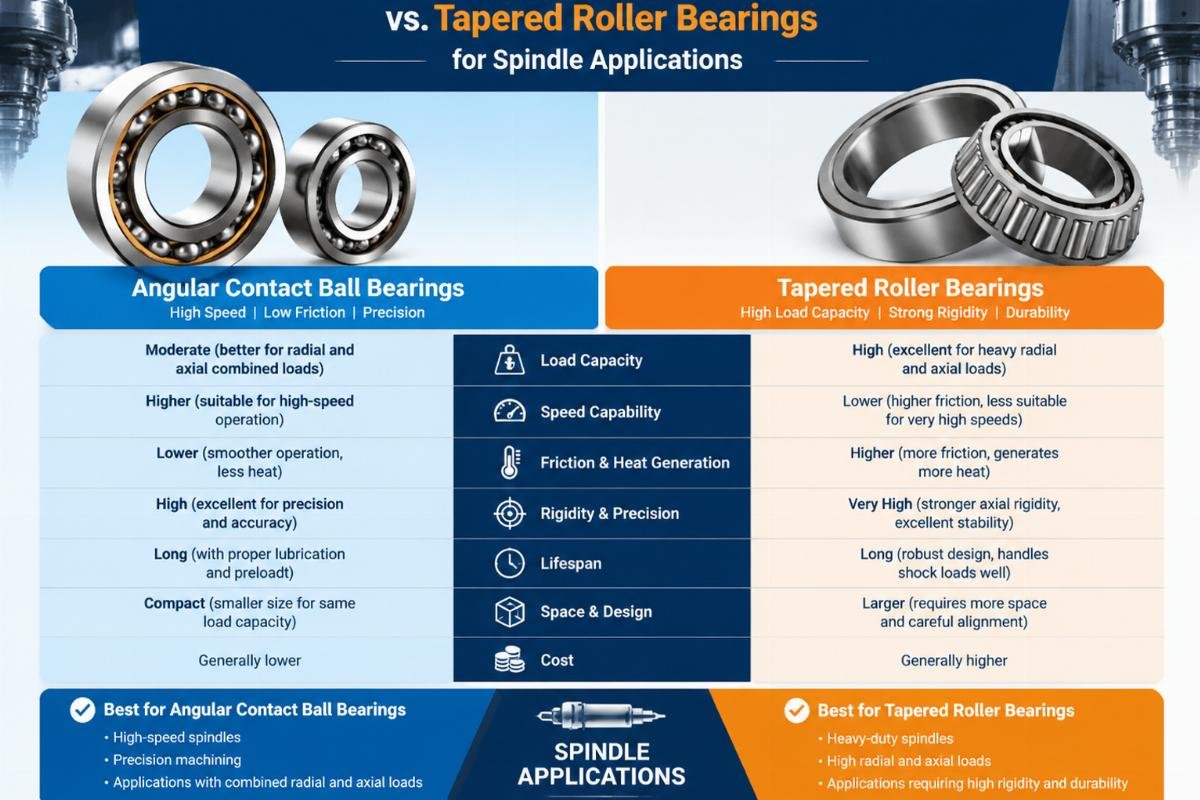
For distributors and OEMs, stocking the correct type prevents field failures. Our inventory includes genuine angular contact spindle bearings from brands like SKF, FAG, and NSK, ensuring you have access to units that meet strict ISO specifications for high-speed performance.
What is the Best Arrangement Configuration?
No single arrangement is universally superior; each configuration offers distinct trade-offs between rigidity and misalignment tolerance.
The arrangement of machine tool spindle bearings determines how the system handles forces and heat. The three common setups are back-to-back (DB), face-to-face (DF), and tandem (DT).
Back-to-back arrangements provide high rigidity and resist moment loads effectively, making them ideal for heavy cutting. However, they are sensitive to thermal expansion. If the spindle heats up, the inner ring expands more than the outer, increasing preload unintentionally and causing overheating. Face-to-face configurations allow for slight misalignment and handle thermal growth better because the contact lines converge inside the bearing set. This makes them suitable for high-speed applications where thermal stability is critical. Tandem arrangements are used when extreme axial load capacity in one direction is required.
| Configuration | Rigidity | Misalignment Tolerance | Thermal Sensitivity | Best Use Case |
|---|---|---|---|---|
| Back-to-Back (DB) | High | Low | High | Heavy Cutting |
| Face-to-Face (DF) | Moderate | High | Low | High-Speed Milling |
| Tandem (DT) | High (One Direction) | Low | Moderate | Specific Axial Loads |
[NEED_CITE: rigidity and misalignment characteristics per ISO technical papers]
A Middle East steel plant experienced repeated spindle failures in their lathe operations. They were using face-to-face arrangements for heavy roughing cuts. The lack of rigidity caused deflection under load. Switching to a back-to-back setup with appropriate preload solved the deflection issue. Understanding these differences helps in selecting the right spindle bearing selection arrangement for your specific machining environment.

When sourcing these configurations, ensure the supplier can provide matched sets. Mismatched bearings in a set can lead to uneven load distribution. We offer technical selection support to verify that the arranged sets meet your rigidity and thermal requirements, preventing assembly failures before they occur.
How to Determine the Optimal Preload?
Balance stiffness requirements against heat generation limits based on operating RPM and cutting force.
Preload eliminates internal clearance to increase stiffness, but it also increases friction and heat. The optimal preload is not the maximum possible preload. It is the minimum preload required to maintain stiffness under the expected load without causing excessive temperature rise.
Light preload is suitable for high-speed, low-load applications like precision grinding. Medium preload works well for general milling and turning. Heavy preload is reserved for slow-speed, high-load operations where rigidity is the primary concern. Determining the right level requires analyzing the stiffness curves relative to the operating speed. [NEED_CITE: stiffness curves vs preload data]
- Identify Operating Speed: High RPM requires lighter preload to manage heat.
- Assess Cutting Forces: Heavy cuts demand higher stiffness, implying heavier preload.
- Check Thermal Limits: Monitor temperature rise during testing. If temperatures exceed safe limits, reduce preload.
- Verify Stiffness: Ensure deflection remains within tolerance under load.
A common mistake is applying uniform preload across different spindle types. A case involving a precision grinder showed that switching from heavy to light preload reduced thermal displacement significantly, improving surface finish quality. The key is to tailor the preload to the specific duty cycle.
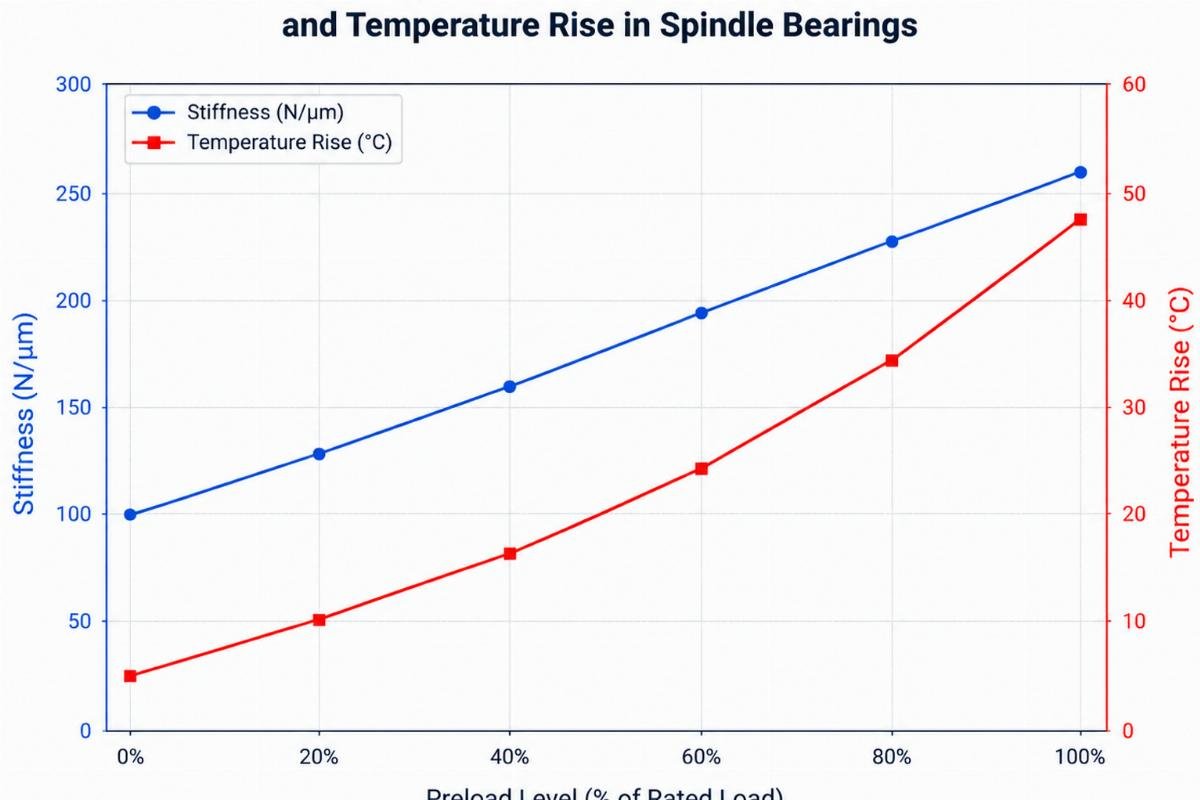
Proper preload setting is critical for longevity. Our team provides guidance on preload classes for various brands, helping you select units that match your operational parameters. This ensures that the machine tool spindle bearings perform optimally without premature wear due to thermal stress.
Which Precision Grade is Required?
Analyze the cost-performance ratio of P4 versus P2 grades based on your specific machining tolerances.
Precision grades define the dimensional and running accuracy of the bearing. Common grades include P0 (normal), P6, P5, P4, and P2. For most machine tool applications, P4 is the standard choice, offering a good balance of performance and cost. P2 grade provides ultra-high precision but comes at a significantly higher price and may not yield noticeable benefits for all applications.
| Precision Grade | Running Accuracy | Cost Level | Typical Application |
|---|---|---|---|
| P4 | High | Moderate | Standard CNC Mills |
| P2 | Ultra-High | High | Precision Grinders |
| P5 | Medium | Low | General Machinery |
[NEED_CITE: precision grade definitions per ISO standards]
Choosing P2 for a standard milling machine might inflate costs without improving output quality. Conversely, using P4 for a ultra-precision grinder could lead to unacceptable vibration levels. A Southeast Asian equipment manufacturer learned this when they upgraded to P2 grades for a new line of lathes. The cost increased substantially, but the machining precision did not improve noticeably because the spindle housing and shaft tolerances were not matched to P2 specifications.
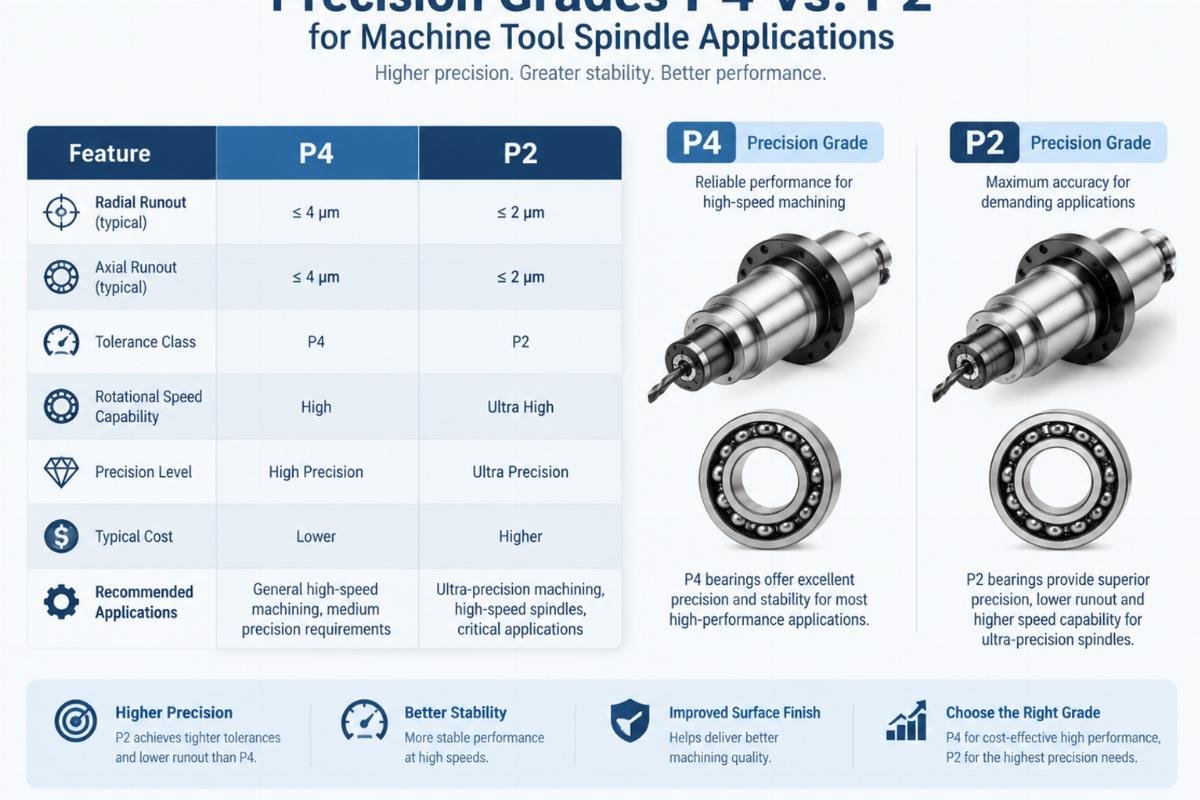
It is essential to match the bearing grade with the rest of the spindle system. We stock genuine precision grade bearings from leading brands, allowing you to source the exact grade needed for your application. This avoids over-engineering and ensures cost-effective performance.
Conclusion
Correct selection prevents thermal failure and ensures precision.
Matching the bearing type, arrangement, and preload to your specific machining conditions is essential for optimal performance. Avoid assuming that higher preload or higher precision grades always yield better results. Focus on the balance between rigidity and thermal stability. By understanding these technical details, you can select machine tool spindle bearings that deliver reliability and longevity for your equipment.
Need a quote for the bearings in this article?
Send your part numbers and get price, stock and lead time within 4 hours.

Written by
authorEditor covering global sourcing, supplier verification, and industrial product knowledge. Content is compiled from manufacturer specifications, industry standards, and hands-on experience with international B2B buyers. Every article is fact-checked before publishing to help procurement professionals make informed decisions.
View all posts

