Crossed Roller Bearing for Robots: Wholesale Supplier

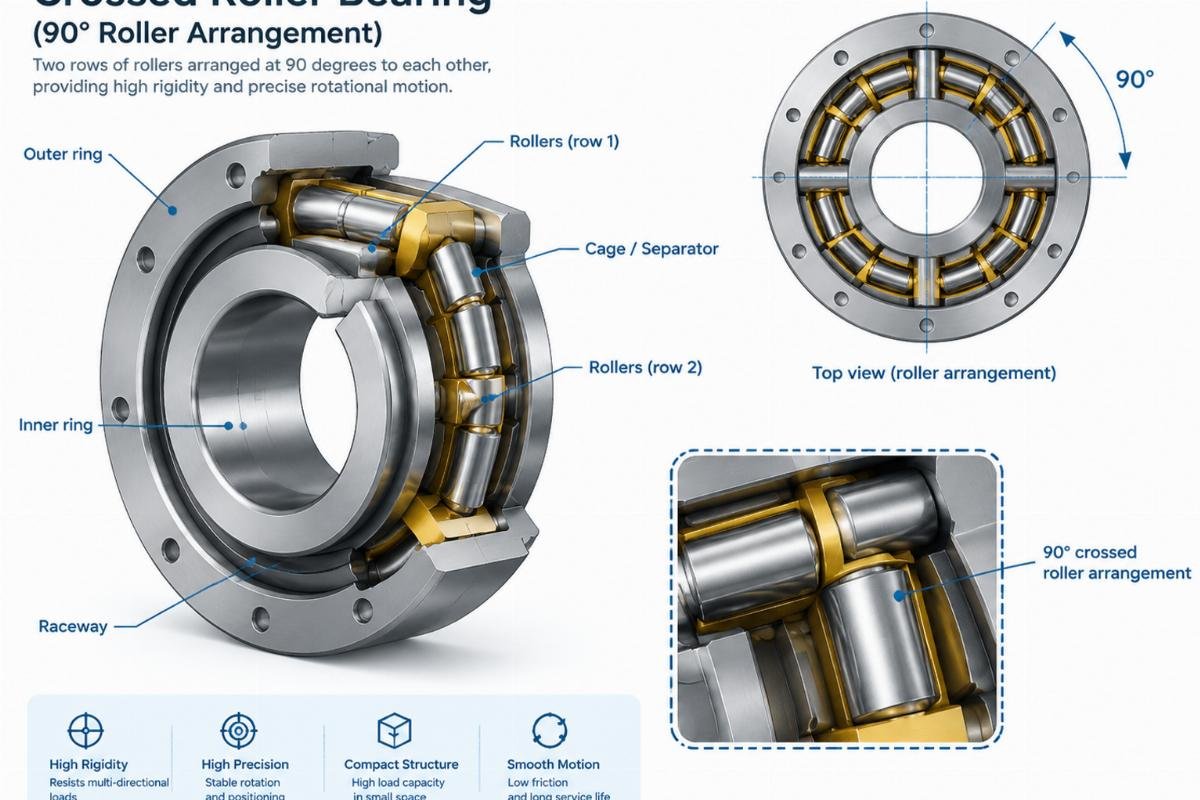
Crossed Roller Bearing for Robots: Wholesale Supplier
Tighter preload does not guarantee better precision; it often guarantees premature failure.
Selecting the right crossed roller bearing for robot joints requires matching internal clearance and preload to specific dynamic load profiles, rather than simply choosing the highest precision grade or the lowest unit price. A mismatch here leads to joint stiffness, heat generation, and rapid loss of repeatability, causing costly production downtime. The correct approach involves verifying load ratings against moment forces, selecting appropriate sealing for the environment, and sourcing from a supplier who provides full traceability and technical validation for mixed-brand requirements.
I still remember the smell of burnt grease in a Suzhou assembly workshop years ago. A six-axis industrial robot had been running smoothly during acceptance tests, but within months, the third joint began to exhibit noticeable stiffness and lost its positional accuracy. The maintenance team blamed the servo motor. I suspected the bearing. When we disassembled the joint, the crossed roller bearing showed signs of micro-spalling and excessive heat damage. The root cause was not a material defect, but a selection error: the replacement bearing had a clearance class that did not match the original design specifications, leading to improper preload under operational loads. This experience shaped my approach to sourcing. Now, when I evaluate a crossed roller bearing for robots, I look past the brand label and focus on the mechanical harmony between the bearing’s internal geometry and the robot’s kinematic demands. [NEED_CITE: ISO 15243 failure mode classification for rolling bearings]
Why Do Robot Joints Fail Prematurely?
Most joint failures stem from incorrect clearance and preload matching, not from material defects.
In high-precision robotics, the crossed roller bearing is the heart of the joint. It supports radial, axial, and moment loads simultaneously. However, many buyers treat these components as interchangeable commodities. They assume that if the outer dimensions fit, the bearing will perform. This is a dangerous misconception. The internal clearance—the space between the rollers and the raceways—determines how the bearing behaves under load. If the clearance is too loose, the joint will have play, leading to vibration and reduced positioning accuracy. If it is too tight, the preload becomes excessive, generating friction heat that degrades the lubricant and causes early fatigue.
Consider a case involving a heavy-payload palletizing robot. The OEM initially specified standard industrial bearings to cut costs. Under the high moment loads generated by extended arm movements, these bearings failed repeatedly. The issue was not that the bearings were “weak,” but that their roller diameter and internal geometry were not optimized for the specific moment load profile of that axis. By switching to a crossed roller bearing with a larger roller diameter and optimized contact angles, the lifespan extended significantly. [NEED_CITE: Relationship between roller diameter and moment load capacity in crossed roller bearings]
The lesson is clear: failure analysis must start with the application parameters. You cannot select a bearing in isolation. You must understand the dynamic loads, the speed, and the environmental conditions. A supplier who only quotes part numbers without asking about these factors is not helping you solve the problem; they are just moving inventory.

How to Match Bearing Specs to Robot Axes?
Base and axis load profiles dictate the required crossed roller geometry and internal clearance.
Selecting a crossed roller bearing for robots is not a one-size-fits-all process. Each axis of a robot has different mechanical requirements. The base axis typically handles the highest moment loads and requires robust structural support. The wrist axes, on the other hand, prioritize compactness and high rotational speed. Matching the bearing specs to these distinct roles is critical.
To make this decision systematically, engineers should evaluate the following parameters:
| Parameter | Base Axis Requirements | Wrist Axis Requirements | Verification Method |
|---|---|---|---|
| Load Type | High Moment & Axial | Moderate Radial & Axial | [NEED_CITE: Dynamic load rating calculation methods] |
| Precision Grade | P4 or P2 | P4 or P2 | Visual inspection of certification docs |
| Internal Clearance | Controlled Preload | Light Preload/Clearance | Measurement with dial indicator |
| Sealing | Robust, Dust-proof | Compact, Low-friction | IP rating verification |
| Lubrication | High-viscosity Grease | Low-viscosity Oil/Grease | Compatibility check with operating temp |
A common mistake is ignoring the effect of temperature on clearance. As the robot operates, friction generates heat, causing the inner ring to expand. If the initial clearance is not accounted for this thermal expansion, the bearing can seize. In one instance, a cleanroom assembly arm suffered from increased noise and vibration. The investigation revealed that the standard open-type bearing allowed particulate contamination into the raceway. Switching to a sealed variant with integrated labyrinth seals solved the issue, resulting in zero unplanned stops. [NEED_CITE: Impact of sealing types on bearing life in contaminated environments]
When reviewing specifications, do not just look at the static load rating. Calculate the equivalent dynamic load based on your actual motion profile. If your supplier cannot provide the technical data to support this calculation, they are not a true partner in your engineering process.

What Are the Hidden Costs of Cheap Alternatives?
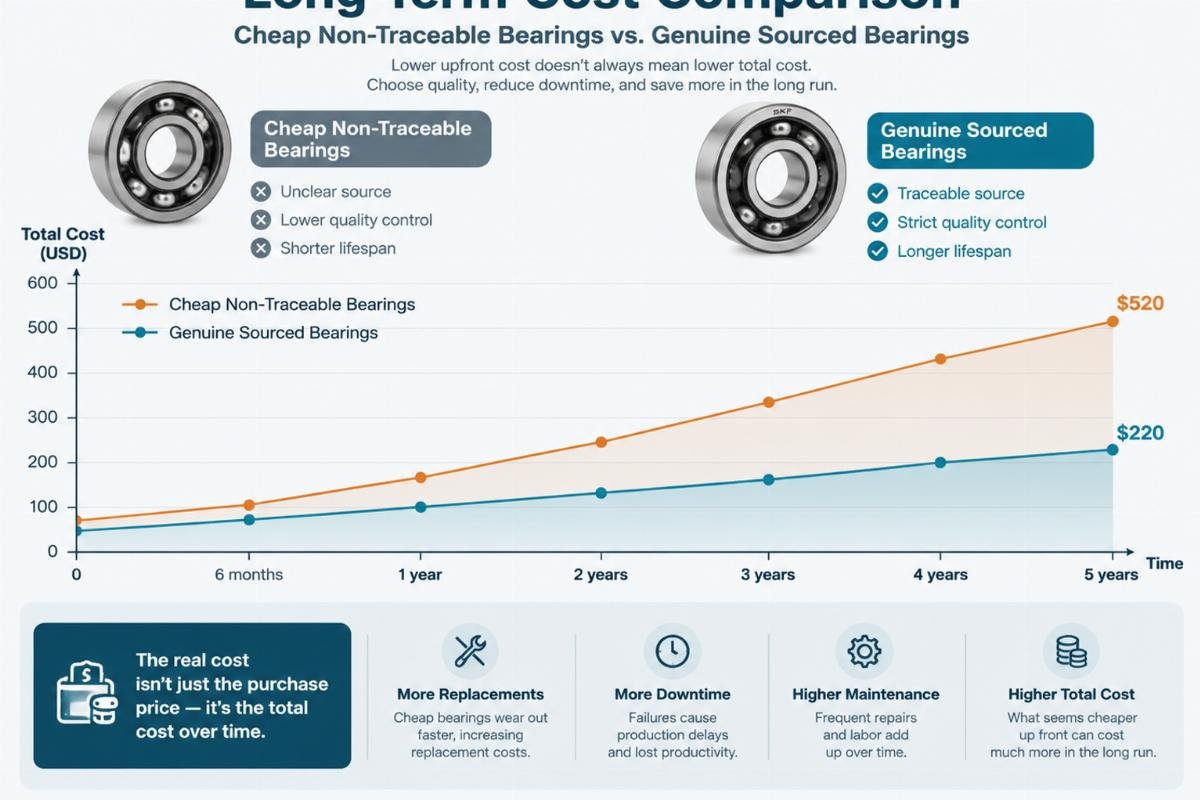
Unplanned downtime and warranty claims far exceed the initial savings on unit price.
It is tempting to choose the lowest-priced option, especially when purchasing in bulk. However, in robotics, the cost of the bearing is a tiny fraction of the total system cost. The real expense lies in reliability. A failed bearing can halt an entire production line, leading to missed deadlines, penalty clauses, and reputational damage.
Many low-cost alternatives lack consistent quality control. They may use lower-grade steel or have inconsistent heat treatment, leading to variable hardness across the batch. While one bearing might perform adequately, the next one from the same batch could fail prematurely. This inconsistency makes it impossible to predict maintenance schedules, forcing operators into reactive rather than proactive maintenance.
Furthermore, cheap bearings often lack proper documentation. Without traceability, it is difficult to verify the origin of the materials or the manufacturing process. In regulated industries, this can lead to compliance issues. A mid-six-figure loss due to a single line stoppage is not uncommon when a critical component fails unexpectedly. By contrast, investing in genuine, traceable components from a reliable source ensures batch-to-batch consistency and reduces the risk of catastrophic failure. [NEED_CITE: Total Cost of Ownership models for industrial maintenance]
How to Verify Supplier Reliability and Authenticity?
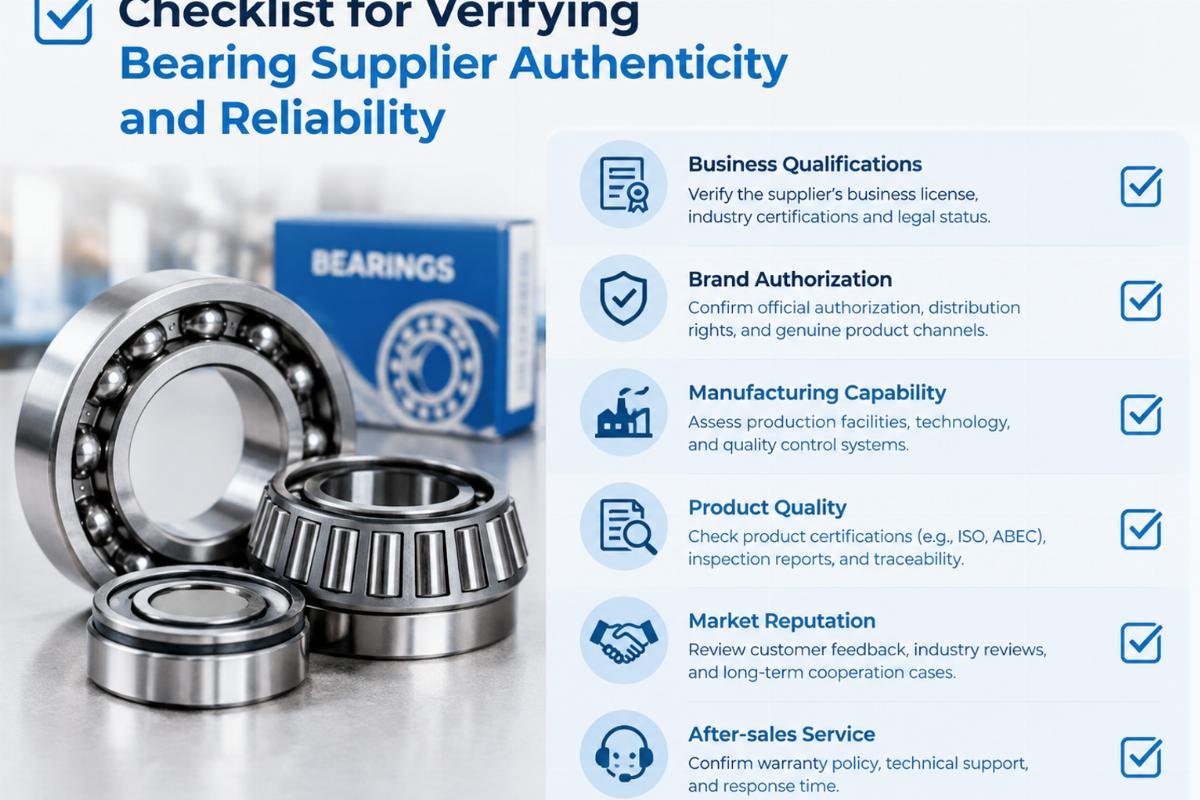
Demand traceability documents, ISO certifications, and mixed-brand consolidation capabilities.
Finding a trustworthy crossed roller bearing for robots supplier is as important as selecting the right technical specification. The market is flooded with counterfeit products and refurbished items sold as new. To protect your investment, you must vet your supplier rigorously.
First, ask for proof of authenticity. Genuine bearings come with original packaging, serial numbers, and certificates of conformity. A reliable supplier will provide these documents without hesitation. They should be able to trace each batch back to the manufacturer’s production facilities. If a supplier cannot provide this level of transparency, walk away.
Second, check for technical competence. A good supplier does not just sell boxes; they offer engineering support. They should be able to discuss preload options, clearance classes, and lubrication recommendations. They should understand the difference between a P4 and a P2 precision grade and explain why one might be better for your application. [NEED_CITE: Importance of supplier technical support in bearing selection]
Third, consider logistics flexibility. Robotics projects often require a mix of brands and sizes. A supplier who can consolidate orders from multiple manufacturers into a single shipment saves time and reduces shipping costs. This is particularly valuable for MRO operations where urgent spare parts are needed for different types of equipment.
In our own operations, we have seen how a streamlined sourcing process can prevent delays. By maintaining a large spot inventory and offering flexible minimum order quantities, we help clients avoid the trap of overstocking while ensuring they have access to genuine parts when needed. This approach allows engineers to focus on design and performance, rather than worrying about supply chain disruptions.
Conclusion
Precision in robotics starts with precision in sourcing.
Choosing the right crossed roller bearing for robots is a technical decision that impacts the entire lifecycle of your machine. By focusing on load matching, verifying supplier authenticity, and understanding the hidden costs of poor quality, you can ensure reliable performance and minimize downtime. Do not let short-term savings compromise long-term stability. Partner with a supplier who values transparency and technical expertise, and your robots will reward you with consistent, precise operation.
Need a quote for the bearings in this article?
Send your part numbers and get price, stock and lead time within 4 hours.

Written by
authorEditor covering global sourcing, supplier verification, and industrial product knowledge. Content is compiled from manufacturer specifications, industry standards, and hands-on experience with international B2B buyers. Every article is fact-checked before publishing to help procurement professionals make informed decisions.
View all posts

