LM11949/LM11910 Bearing Set: Trailer Hub Specs Wholesale Supplier

LM11949/LM11910 Bearing Set: Trailer Hub Specs Wholesale Supplier
Hub burnouts are rarely just bearing defects; they stem from long-term uneven loading and wrong clearance.
The LM11949/LM11910 bearing set is a standard tapered roller assembly defined by specific boundary dimensions and load ratings that must match the trailer hub’s machined pockets exactly. Mismatched clearances or incorrect press-fit tolerances cause immediate heat generation and premature failure, regardless of the brand quality. Selecting the correct LM11949/LM11910 dimensions ensures proper load distribution across the rollers, preventing the edge-loading that destroys hubs under heavy payloads.
I still remember the smell of scorched grease in a warehouse in Dongguan. A batch of LM11949/LM11910 bearing sets destined for the Middle East had returned after only a few thousand kilometers. The customer insisted the bearings were defective because the cones were blue from overheating. I dismantled the failed hubs and found the issue wasn’t the steel quality or the manufacturing precision. The trailers had been consistently overloaded on one side, causing the tapered rollers to skew within the cup. The clearance was technically within spec, but the application demanded a tighter initial setting to handle the lateral forces. That incident changed how I approach every inquiry for trailer hub components. I no longer just quote part numbers; I ask about the axle load and the hub machining standards. [NEED_CITE: common causes of tapered roller bearing failure in trailer applications]
Understanding these mechanical realities is essential for distributors and fleet managers who need to avoid costly returns and downtime. Let’s break down the exact specifications and operational limits that define this critical component.
What Are the Exact Dimensions of LM11949/LM11910?
Precise boundary dimensions are the non-negotiable foundation of any successful bearing installation.
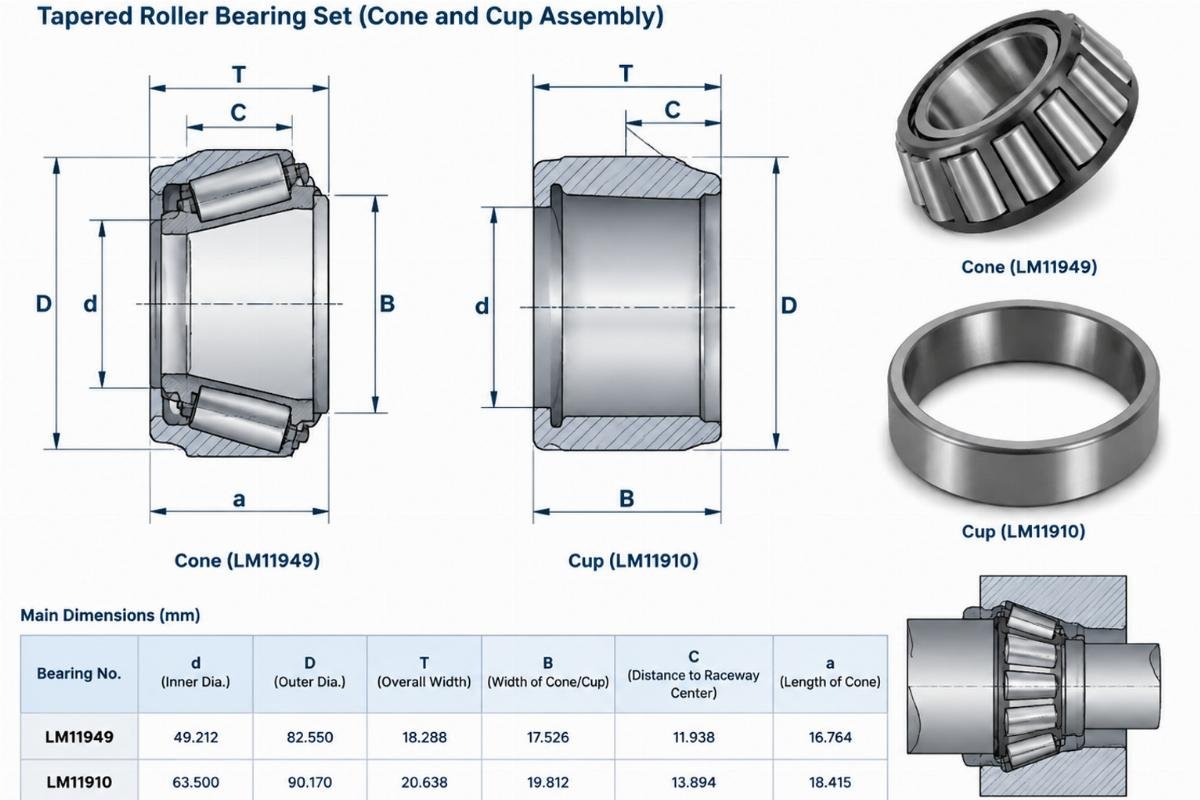
The LM11949/LM11910 combination consists of a cone (inner ring) and a cup (outer ring). The interchangeability of these parts relies entirely on adherence to international dimension standards. If the outer diameter of the cup does not match the hub bore, or if the cone width is off by even a fraction, the bearing will not seat correctly. This misalignment creates point loads that destroy the raceways.
| Dimension Parameter | Specification Detail | Tolerance Class |
|---|---|---|
| Bore Diameter (d) | Standard inch-based size | ABMA/ISO Standard |
| Outer Diameter (D) | Matches hub cup pocket | ABMA/ISO Standard |
| Cone Width (B) | Critical for preload setup | ABMA/ISO Standard |
| Cup Width (C) | Determines axial position | ABMA/ISO Standard |
| Assembly Width (T) | Total installed height | ABMA/ISO Standard |
[NEED_CITE: ABMA standard dimensional tables for inch-series tapered roller bearings]
When sourcing an LM11949/LM11910 bearing set, verify that the supplier provides certification tracing back to these standard dimensions. In my experience, bulk orders from mixed-brand consolidators often contain units with varying tolerance classes. A P0 class bearing might fit loosely in a hub machined for a tighter tolerance, leading to fretting corrosion on the outer ring. Conversely, a bearing with excessive preload due to width variations will generate heat rapidly.
A European repair group once reported that their replacement hubs were failing faster than the originals. Upon inspection, we found that the aftermarket cups had a slightly larger outer diameter variance than the OEM parts. They were being forced into the hub with excessive pressure, distorting the raceway geometry before the trailer even moved. Switching to a supplier who guaranteed strict dimensional compliance for the LM11949/LM11910 dimensions resolved the issue. The physical fit is just as important as the internal clearance.
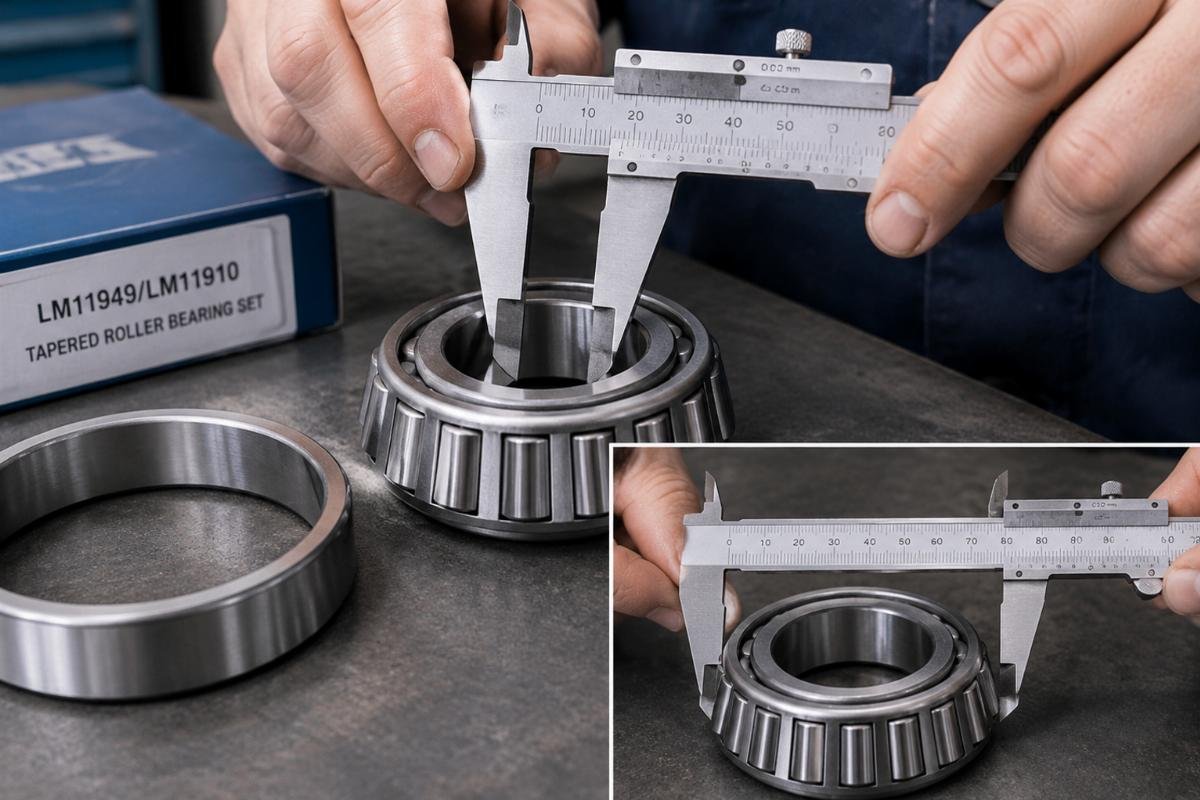
Always request dimensional inspection reports for large batches. For critical applications, such as off-road trailers carrying heavy machinery, even minor deviations can lead to catastrophic hub failure. The goal is to ensure that the bearing sits naturally in its pocket without requiring excessive force or leaving gaps that allow movement.
How Do Load Ratings Dictate Trailer Hub Lifespan?
Dynamic and static load ratings determine whether a bearing survives the journey or fails under stress.
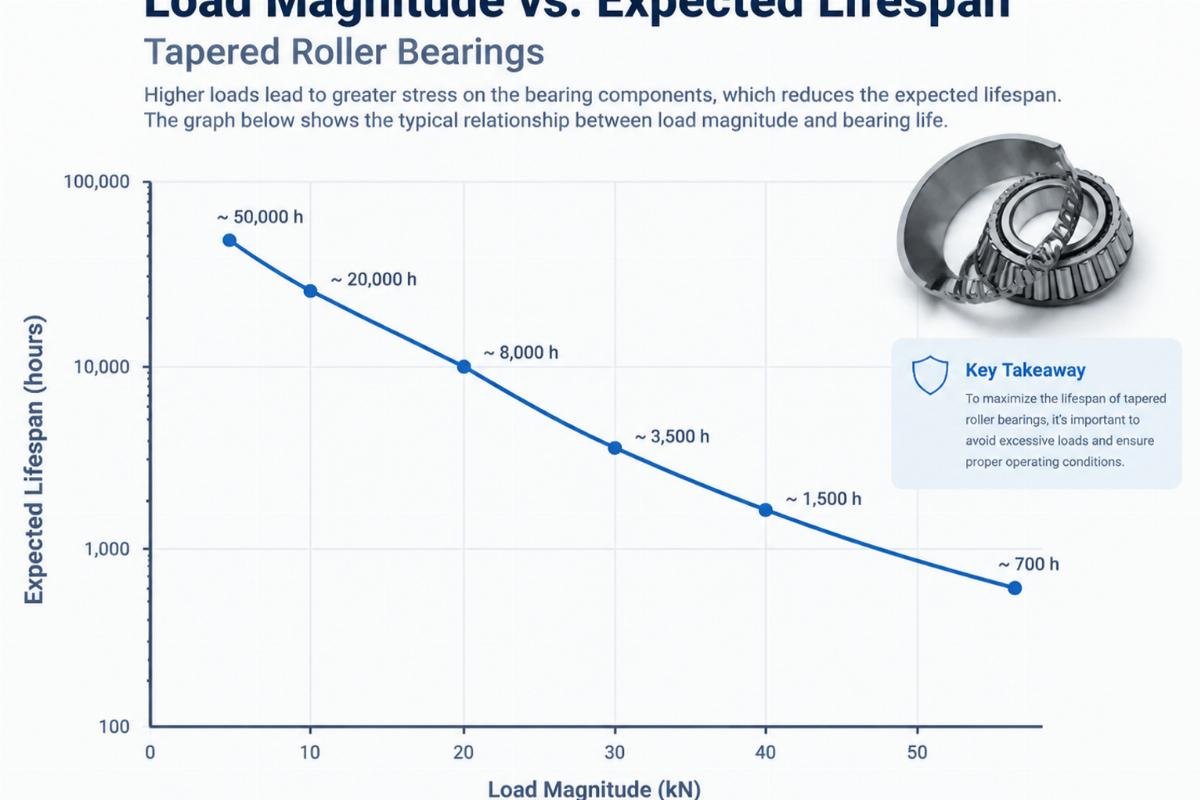
The LM11949/LM11910 bearing set is designed to handle combined radial and axial loads. However, its lifespan is directly tied to how these loads are applied. The dynamic load rating indicates the capacity for rotating applications, while the static load rating applies when the trailer is stationary or moving very slowly. Exceeding these ratings, even briefly, can cause permanent deformation of the rollers and raceways.
Trailer hubs often face unpredictable stress patterns. Potholes, sharp turns, and uneven cargo distribution create shock loads that far exceed the nominal weight of the trailer. If the LM11949/LM11910 bearing set is selected based solely on static weight calculations, it may fail under dynamic conditions. The limit speed parameter also plays a role, though trailers typically operate well below the maximum rated speed of these bearings. The real danger is sustained high-load operation at moderate speeds, which generates significant heat.
An off-road trailer OEM recently upgraded their hubs to handle heavier payloads. They initially chose a bearing with a higher static load rating but ignored the dynamic fatigue life. After a few months of field testing, the bearings showed signs of spalling. We recommended switching to an LM11949/LM11910 bearing set with a verified high dynamic load capacity. The change extended the service life meaningfully, as the new bearings could better absorb the shock loads from rough terrain. [NEED_CITE: relationship between dynamic load rating and bearing fatigue life]
| Load Type | Impact on Bearing | Mitigation Strategy |
|---|---|---|
| Radial Load | Primary stress source | Ensure proper seating |
| Axial Load | Caused by cornering | Correct preload adjustment |
| Shock Load | Risk of brinelling | Higher dynamic rating |
| Static Load | Deformation risk | Verify static capacity |
When evaluating suppliers, ask for the specific load rating data for their LM11949/LM11910 bearing set. Generic claims of “heavy-duty” are insufficient. You need verifiable data that matches your application’s demands. For fleet operators, this means calculating the maximum expected load per wheel and adding a safety margin for dynamic stresses.
Proper lubrication also affects how load ratings translate to real-world performance. Grease that breaks down under heat cannot protect the rollers from metal-to-metal contact, effectively lowering the bearing’s load capacity. Therefore, selecting the right bearing is only half the battle; maintaining the correct lubrication regime is equally critical.
Why Do Trailer Hubs Burn Out Prematurely?
Improper press-fit clearance causes more heat than slight undersizing.
Many technicians assume that a tight fit is always better. However, if the cone is pressed onto the spindle with too much interference, it expands the inner ring, reducing the internal clearance of the LM11949/LM11910 bearing set. This preloads the rollers, causing them to generate excessive heat during rotation. The heat thins the lubricant, leading to metal-to-metal contact and eventual seizure.
Conversely, a loose fit allows the cone to creep on the spindle. This movement wears away the metal, creating debris that contaminates the lubricant and damages the raceways. The key is finding the precise press-fit tolerance specified by the hub manufacturer. This requires accurate measurement of both the spindle journal and the bearing bore.
I once visited a maintenance facility where technicians were using hammers to install bearings. The impact distorted the cages and rollers, compromising the integrity of the LM11949/LM11910 bearing set before it was even in service. They switched to hydraulic presses with controlled force settings, and the failure rate dropped noticeably. The method of installation is just as important as the part itself. [NEED_CITE: best practices for installing tapered roller bearings]
Another common cause of burnout is uneven loading. If the trailer’s axles are not aligned, one wheel bears more weight than the other. This forces the rollers in the LM11949/LM11910 bearing set to carry an disproportionate share of the load, leading to rapid fatigue. Regular alignment checks can prevent this issue, but the bearing must be robust enough to handle minor misalignments without failing immediately.
| Installation Error | Consequence | Solution |
|---|---|---|
| Excessive Press-Fit | Reduced clearance, overheating | Use calibrated press |
| Loose Fit | Creeping, wear debris | Verify spindle dimensions |
| Hammer Installation | Cage distortion | Use hydraulic tools |
| Misaligned Axle | Uneven load distribution | Check alignment regularly |
When sourcing replacements, consider suppliers who offer technical support for installation procedures. A simple guide on proper press-fit techniques can save thousands in warranty claims. For the LM11949/LM11910 bearing set, ensuring the correct fit is the first step toward long-term reliability.

Heat generation is the enemy of bearing life. By controlling the installation process and ensuring proper alignment, you can maximize the performance of your LM11949/LM11910 bearing set. It is not just about the part; it is about the entire system working together.
How to Verify Bearing Quality Before Bulk Purchase?
Traceability and material verification are the only safeguards against counterfeit parts.
The market is flooded with look-alike bearings that mimic the packaging of premium brands but lack the metallurgical quality. These counterfeits may pass initial visual inspections but fail quickly under load. To protect your inventory, you must verify the origin and material composition of every LM11949/LM11910 bearing set you purchase.
Start by requesting traceability documentation. Genuine bearings come with batch numbers that can be traced back to the manufacturing facility. This documentation should include material certificates confirming the use of high-quality bearing steel. Without this paper trail, you are gambling on the quality of the product. [NEED_CITE: importance of supply chain traceability for industrial bearings]
Next, perform visual and tactile inspections. Check the surface finish of the rollers and raceways. They should be smooth and free of scratches or discoloration. The cage should be securely attached and move freely. Any signs of roughness or irregularity are red flags. For large orders, consider sending samples to an independent lab for hardness testing. The steel should meet standard hardness ranges for bearing applications.
A distributor in Southeast Asia once received a container of bearings that looked perfect but failed within weeks. Lab tests revealed that the steel had inconsistent hardness, leading to premature wear. They switched to a supplier who provided full traceability and regular quality audits. The new LM11949/LM11910 bearing sets performed reliably, restoring confidence in their supply chain.
| Verification Step | Purpose | Method |
|---|---|---|
| Traceability Docs | Confirm origin | Request batch certificates |
| Visual Inspection | Detect surface flaws | Check rollers and raceways |
| Hardness Testing | Verify material quality | Lab analysis of samples |
| Brand Equivalents | Ensure compatibility | Cross-reference part numbers |
When dealing with mixed-brand orders, ensure that the supplier can provide consistent quality across all lines. Whether you are buying premium global brands or reliable domestic alternatives, the standard for quality should remain high. For the LM11949/LM11910 bearing set, this means insisting on proof of quality before committing to large volumes.

Reliable suppliers will welcome these requests. They understand that quality verification is part of doing business in the industrial sector. By making these checks standard practice, you protect your reputation and your customers’ operations.
Conclusion
Precision in specs and installation prevents the majority of trailer hub failures.
Mastering the details of the LM11949/LM11910 bearing set goes beyond memorizing part numbers. It requires understanding how dimensions, load ratings, and installation practices interact in the real world. From verifying exact boundary dimensions to ensuring proper press-fit clearances, every step influences the lifespan of the hub. Distributors and fleet managers who prioritize these technical details see fewer returns and happier customers. Always demand traceability and verify quality before bulk purchasing to avoid the pitfalls of counterfeit components.
Need a quote for the bearings in this article?
Send your part numbers and get price, stock and lead time within 4 hours.

Written by
authorEditor covering global sourcing, supplier verification, and industrial product knowledge. Content is compiled from manufacturer specifications, industry standards, and hands-on experience with international B2B buyers. Every article is fact-checked before publishing to help procurement professionals make informed decisions.
View all posts

