Grease Lubrication Failure Signs: Bulk Bearing Supplier

Grease Lubrication Failure Signs: Bulk Bearing Supplier
More grease does not mean better protection. In fact, excessive lubrication is a leading cause of premature bearing failure in heavy industry.
The primary signs of bearing lubrication failure include abnormal temperature spikes, seal extrusion or blowouts, and distinct acoustic changes such as high-pitched whining or dry grinding noises. Over-lubrication typically manifests as churning-induced heat and seal damage, while under-lubrication presents as metal-to-metal contact wear and cage deformation. Accurate diagnosis requires distinguishing between these two opposing conditions to prevent unplanned downtime.
I still recall the oppressive heat of a cement plant on the outskirts of Riyadh during a mid-summer afternoon. The ambient temperature hovered near fifty degrees Celsius, but the real issue was inside the conveyor drive housing. We had supplied spherical roller bearings for their main material handling line, yet the units seized within weeks of installation. When we opened the housing, the grease had baked into a hard, dark block. The maintenance team had been following a “more is better” philosophy, pumping grease until it overflowed. This over-lubrication caused severe churning, generating enough heat to degr* had forced the seals outwards, allowing fine desert dust to ingress and mix with the degraded grease. Standing by that smoking housing, I realized that selling the right bearing is only half the job; understanding how it fails in the field due to improper maintenance is the other. This experience underscores why identifying bearing lubrication failure signs is critical for any operation relying on continuous machinery performance.
Transitioning from this field observation to systematic analysis, we must break down the specific indicators that differentiate between too much and too little grease.
What Are the Classic Signs of Over-Lubrication?
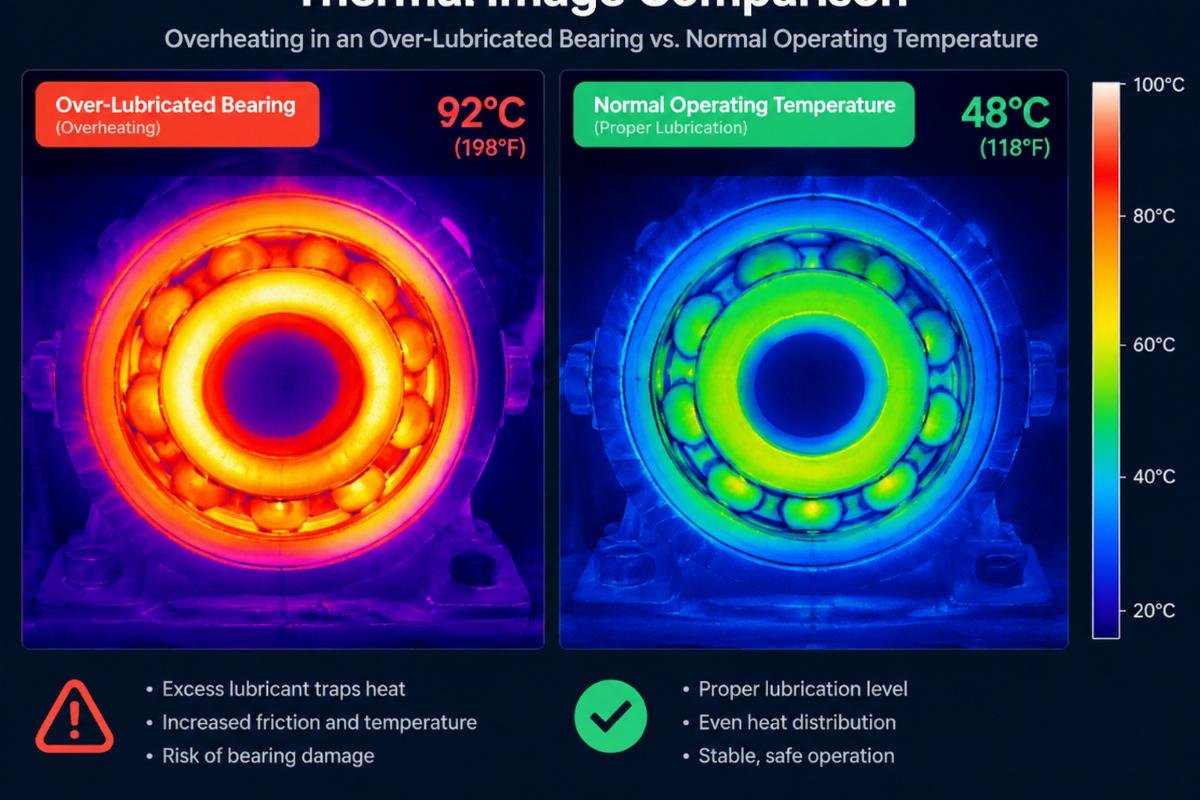
Over-lubrication creates internal pressure and thermal runaway, often mistaken for external load issues. Many technicians assume that if a bearing is running hot, it needs more grease to cool it down. This is a dangerous misconception. When a bearing cavity is completely filled, the rolling elements have no space to move the grease aside. Instead, they churn through it, creating significant fluid friction. This churning generates heat far faster than the grease can dissipate it, leading to a thermal spike that can rise by tens of degrees above normal operating levels. [NEED_CITE: thermal effects of grease churning in rolling bearings]
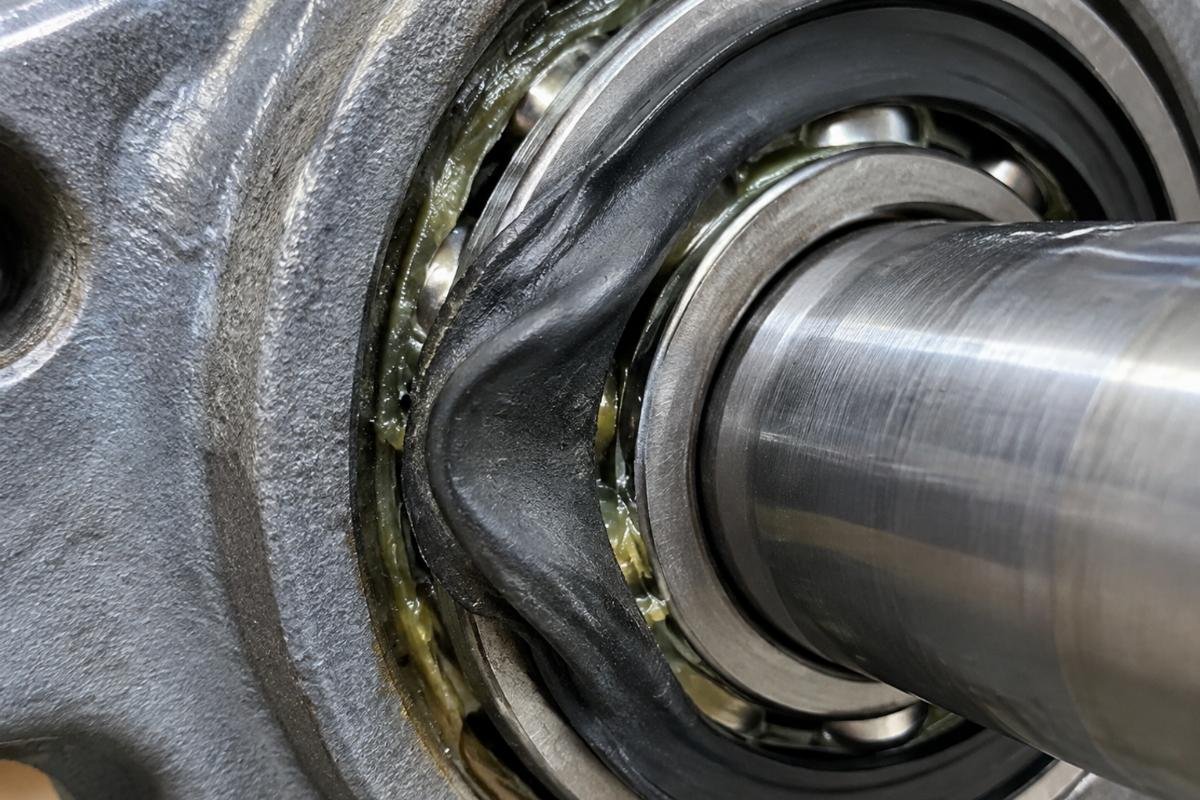
One of the most visible bearing lubrication failure signs in this scenario is seal damage. As the grease heats up, it expands. In a fully packed housing, this expansion has nowhere to go but out. The pressure builds until it extrudes the seal lips or blows them out entirely. Once the seal is compromised, the bearing is open to contamination. In dusty environments like mining or cement production, this allows abrasive particles to enter the raceway, accelerating wear exponentially.
Another subtle indicator is the change in grease consistency. Fresh grease should remain pliable. However, in over-lubricated conditions, the combination of high shear stress from churning and elevated temperatures causes the oil to separate from the thickener. This process, known as oil bleeding, leaves behind a dry, hardened soap block that offers no lubrication. The bearing then runs effectively dry, despite being surrounded by grease.
| Indicator | Visual/Physical Sign | Operational Impact |
|---|---|---|
| Temperature | Significant rise above baseline | Thermal degradation of grease and steel |
| Seals | Extruded, distorted, or blown out | Loss of contamination protection |
| Grease Texture | Hardened, dark, or separated oil | Loss of lubricating film strength |
| Noise | Low-frequency rumbling or churning sound | Increased vibration and energy consumption |
Recognizing these bearing lubrication failure signs early can save a bearing from catastrophic failure. If you see grease leaking excessively from seals, do not assume the seal is faulty; check if the housing is overfilled.
How to Identify Under-Lubrication Failures?
Under-lubrication leads to direct metal-to-metal contact, resulting in rapid surface distress and fatigue. While over-lubrication is a problem of excess, under-lubrication is a problem of absence. The symptoms here are often more aggressive and lead to quicker destruction of the bearing components.
The most common bearing lubrication failure signs associated with insufficient grease are acoustic emissions. A well-lubricated bearing hums quietly. An under-lubricated one may emit a high-pitched whining or squealing noise, indicating that the rolling elements are sliding rather than rolling. In severe cases, this progresses to a dry grinding sound as the protective film breaks down completely. [NEED_CITE: acoustic emission patterns in starved bearings]
Visually, under-lubrication manifests as distinctive wear patterns. You will often see discoloration on the raceways and rolling elements, ranging from blue to black, caused by localized overheating. This is known as tempering. Additionally, because there is no cushion of grease to absorb shocks, the cage (the component holding the rollers or balls) takes a beating. Cage deformation or fracture is a hallmark of starvation. In vibrating screens or crushers, where loads are dynamic and heavy, even intermittent grease starvation can cause localized overheating and rapid cage failure.
A counter-intuitive aspect of under-lubrication is that it does not always present as immediate seizure. It can begin as early cage fatigue. The cage rubs against the rolling elements due to lack of lubrication, wearing down the pockets. This increases clearance and vibration, which further destabilizes the bearing. By the time the noise becomes obvious, the structural integrity of the bearing is already compromised.
For MRO managers, identifying these bearing lubrication failure signs requires regular inspection routines. Vibration analysis can detect the early stages of cage wear before audible noise becomes prominent. Thermal imaging can also spot hot spots on the bearing outer ring, indicating friction where there should be smooth rotation.

Step-by-Step: How to Calculate the Right Grease Volume?
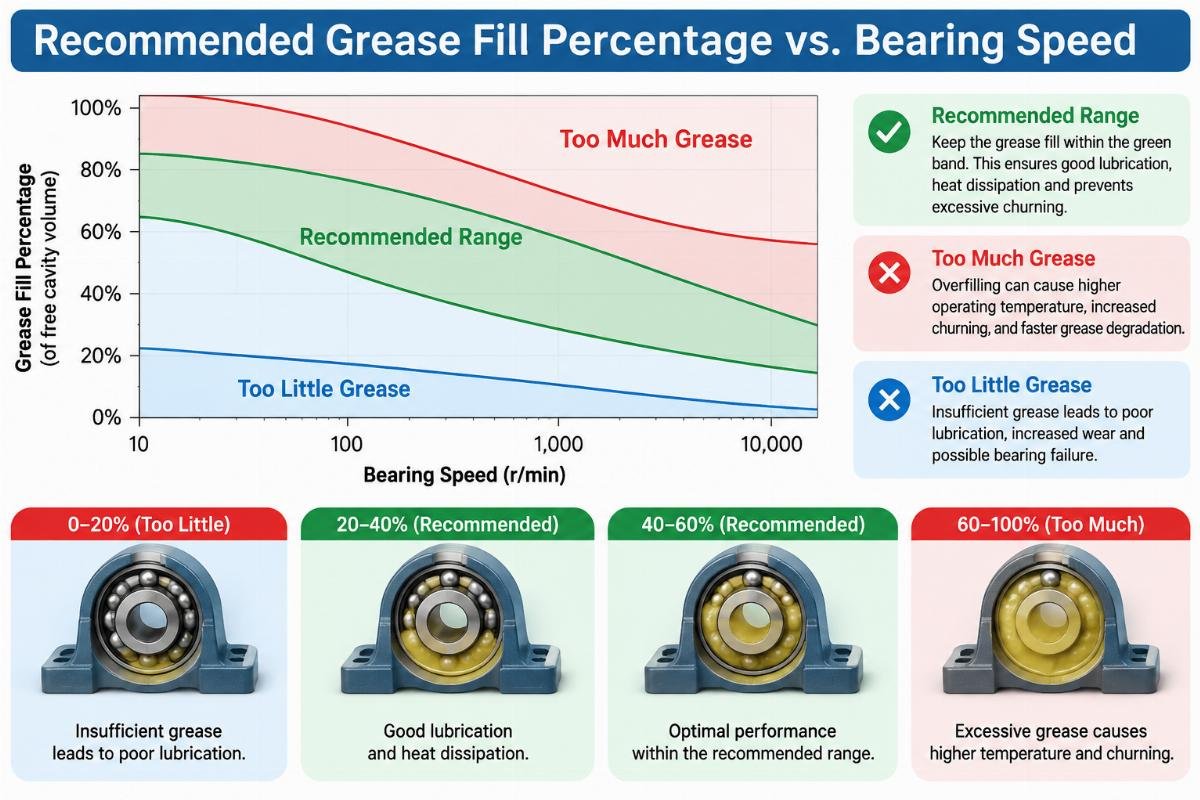
Precision in grease volume is determined by bearing speed, size, and type, not by visual estimation. To avoid both over- and under-lubrication, maintenance teams must move away from guesswork and adopt calculated relubrication strategies. The goal is to maintain a sufficient film thickness without filling the free space in the housing.
The first step is determining the initial fill volume. For standard applications, the general rule is to fill thirty to fifty percent of the free space in the bearing housing. High-speed applications require less grease to minimize churning, while low-speed, heavy-load applications may tolerate slightly more. [NEED_CITE: ISO guidelines for bearing grease fill volumes]
Next, calculate the relubrication interval. This depends on the bearing type, operating temperature, and environmental conditions. A common methodology involves using the manufacturer’s base interval and adjusting it for temperature. For every fifteen degrees Celsius increase above seventy degrees Celsius, the relubrication interval is typically halved. Conversely, cleaner environments allow for longer intervals.
- Identify Bearing Type and Speed: Check the bearing designation and operating RPM. High-speed bearings need lighter grease and smaller volumes.
- Calculate Free Space: Estimate the empty volume in the housing. Do not fill the entire cavity.
- Determine Base Interval: Use standard charts provided by bearing manufacturers for your specific bearing series.
- Adjust for Conditions: Apply correction factors for temperature, vibration, and contamination. Harsh environments like those faced by our clients in mining or steel mills require more frequent, smaller top-ups rather than large, infrequent fills.
- Verify Relief Path: Ensure the relief plug is open. If old grease cannot escape, new grease will cause pressure buildup.
This methodical approach helps prevent the bearing lubrication failure signs discussed earlier. It ensures that the bearing receives just enough fresh lubricant to replenish the film without causing churning. Our technical selection support often involves helping clients refine these calculations for their specific machinery, ensuring that the genuine bearings they source from us perform optimally in their unique operating conditions.
Field Maintenance Checklist to Avoid Lubrication Errors
Consistency in maintenance procedures is the best defense against lubrication-related failures. Even with the right calculations, human error can undermine the best plans. A standardized checklist ensures that every technician follows the same rigorous protocol, reducing variability and risk.
- Cleanliness First: Always clean the grease nipple and surrounding area before attaching the gun. Contaminants introduced during greasing are a major cause of failure.
- Check Relief Plugs: Before pumping, ensure the relief plug is open. Watch for old grease exiting. If no old grease comes out, stop immediately. The path may be blocked, or the bearing may already be overfilled.
- Use the Right Grease: Never mix different grease types unless compatibility is confirmed. Incompatible thickeners can react to form a solid mass, blocking lubrication paths. [NEED_CITE: grease compatibility chart standards]
- Monitor Temperature: After relubrication, monitor the bearing temperature. A temporary rise is normal, but it should stabilize. If it continues to rise, you may have over-lubricated.
- Record Data: Log the amount of grease added, the date, and any observations. This data helps refine future intervals and identifies trends.
Implementing this checklist helps teams spot bearing lubrication failure signs before they lead to downtime. It transforms maintenance from a reactive task to a proactive strategy. For distributors and end-users alike, having access to genuine bearings with consistent quality ensures that when lubrication is done correctly, the hardware holds up. Our global supply network supports this by providing traceable, authentic products that meet the strict tolerances required for these precise maintenance routines.

Conclusion
Correct lubrication is a balance, not a quantity. Recognizing bearing lubrication failure signs such as seal extrusion, thermal spikes, and acoustic changes allows for timely intervention. By calculating grease volumes based on speed and load, and adhering to strict maintenance checklists, operators can significantly extend bearing life. Preventing these failures requires not just quality components, but a deep understanding of how they interact with their environment.
Need a quote for the bearings in this article?
Send your part numbers and get price, stock and lead time within 4 hours.

Written by
authorEditor covering global sourcing, supplier verification, and industrial product knowledge. Content is compiled from manufacturer specifications, industry standards, and hands-on experience with international B2B buyers. Every article is fact-checked before publishing to help procurement professionals make informed decisions.
View all posts

