Bearing Suffix Codes Decoder: Cross-Brand Wholesale Supplier Guide


Bearing Suffix Codes Decoder: Cross-Brand Wholesale Supplier Guide
Matching basic numbers is not enough for cross-brand substitution.
Accurate cross-brand bearing substitution requires decoding suffix codes for internal design, clearance, and cages, not just matching basic numbers. A mismatch in a single letter can lead to equipment failure, regardless of the brand prestige.
I still remember the silence in the control room of a Latin American mining operation. It was not the quiet of efficiency, but the heavy, expensive silence of a stopped crusher. I had shipped what I thought was a perfect equivalent: a spherical roller bearing to replace an SKF unit with a FAG model. The basic number matched perfectly. The dimensions were identical. But I had missed the suffix. The client needed a C3 clearance with a stamped steel cage, but I had supplied an M1 suffix, indicating a machined brass cage. The thermal expansion in that high-load environment caused the inner ring to expand faster than the outer, and the tighter fit of the brass cage led to immediate jamming. That incident cost me half a year’s profit in air freight and compensation. Since then, I have learned that the basic number only tells you where the bearing fits, but the suffix tells you how it survives. [NEED_CITE: importance of suffix codes in bearing interchangeability]
This guide is built on those hard lessons. It is designed for global distributors and MRO buyers who need to navigate the complex world of Bearing Suffix Codes without risking downtime. We will decode the sequence, expose the hidden traps, and provide a method to build a reliable cross-brand matrix.
Why Basic Numbers Aren’t Enough for Cross-Brand Substitution?
The basic number of a bearing, such as 22220, defines its boundary dimensions: bore, outside diameter, and width. It is the universal language of size. However, it says nothing about the internal geometry, the material of the cage, or the amount of internal clearance. Two bearings with the same basic number from different manufacturers can behave like completely different components if their suffixes are ignored.
In the global supply chain, buyers often assume that a “standard” bearing is interchangeable across brands. This is a dangerous misconception. The suffix codes dictate the real-world fit and performance. For instance, a deep-groove ball bearing with a standard clearance might work fine in a motor, but if replaced with a unit having a C3 clearance without verifying the load conditions, it could lead to premature fatigue due to excessive vibration. [NEED_CITE: effect of internal clearance on bearing life]
Consider the case of a Middle East MRO team. They were replacing sealed bearings in a dusty cement plant environment. The original specification called for a 2Z suffix, which indicates non-contact metal shields on both sides. The replacement part, however, had a 2RS suffix, meaning contact rubber seals. While both offer protection, the 2RS creates higher friction and heat generation. In high-speed applications, this subtle difference led to a noticeably shorter lifespan and premature dust ingress because the rubber degraded faster under the thermal stress. Understanding these nuances is critical when using a Bearing Suffix Codes decoder.
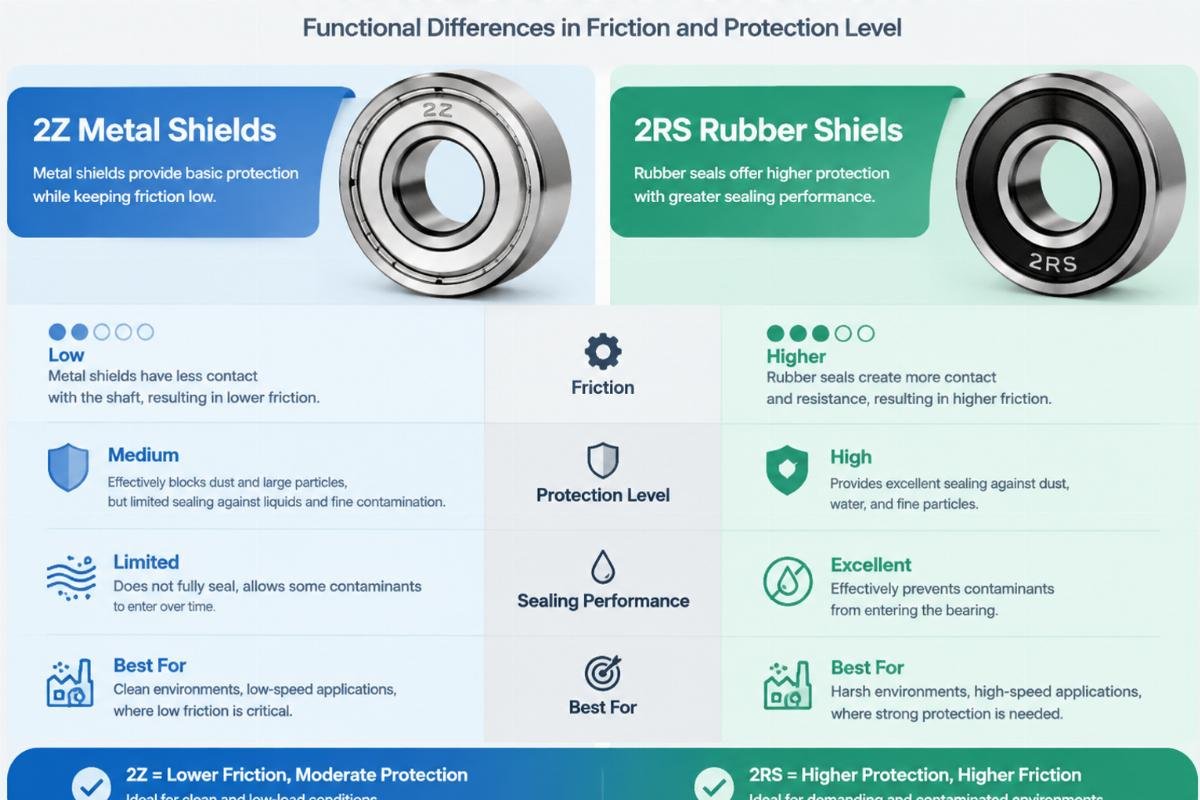
The key takeaway is that the basic number gets the bearing into the housing, but the suffix keeps it running. Ignoring the suffix is akin to buying a tire based only on its diameter while ignoring the load index and speed rating. For professional buyers, mastering the Bearing Suffix Codes is not optional; it is a requirement for risk management.
How to Decode the Suffix Sequence Step-by-Step?
Decoding a bearing suffix is not a random guess; it follows a strict logical sequence. Manufacturers generally arrange suffixes from left to right based on their impact on the bearing’s internal structure and external interface. Misreading this order can lead to selecting a component that physically fits but functionally fails.
The standard decoding sequence is: Internal Design > External Design > Cage > Tolerance > Clearance. [NEED_CITE: standard order of bearing suffix interpretation]
- Internal Design: This often appears first and indicates modifications to the rolling elements or raceways. For example, some brands use specific letters to denote optimized internal geometry for higher load capacity.
- External Design: This includes seals and shields. As seen in the previous example, distinguishing between Z (metal shield), RS (rubber seal), and DDU (double rubber seal) is vital for contamination control.
- Cage Material: The cage holds the rolling elements in place. Common suffixes include M for machined brass, TN for polyamide, and J for pressed steel. The choice affects speed limits and temperature resistance.
- Tolerance Class: This defines the precision of the bearing. Standard bearings are usually P0 (or Normal). Higher precision classes like P6, P5, or P4 are used in machine tools and spindles. [NEED_CITE: ISO tolerance classes for rolling bearings]
- Clearance: This is the most critical for thermal management. C2 is tighter than normal, C3 is looser, and C4 is even looser. Selecting the wrong clearance can cause overheating or excessive play.

When evaluating a Bearing Suffix Codes chart, always start from the left. If you see a code like “22220 CC/W33,” the “CC” refers to the internal design and cage, while “W33” indicates a specific lubrication groove pattern. Skipping to the end might make you miss the cage material, which could be incompatible with high-temperature environments. A systematic approach ensures that no detail is overlooked.
What Are the Hidden Traps in Cage and Seal Suffixes?
Cage and seal suffixes are where most cross-brand errors occur. Different manufacturers use different letters to describe similar features, and sometimes the same letter means different things across brands. This inconsistency is a major trap for unwary buyers.
For example, in the Asian OEM sector, confusion over cage material suffixes has led to significant cost overruns. A gearbox manufacturer specified a bearing with a polyamide cage for its lightweight and low-friction properties. The supplier substituted it with a brass cage, assuming it was a premium upgrade. However, in high-temperature operations, the polyamide cage was chosen specifically for its ability to withstand certain chemical exposures that brass could not handle, or vice versa depending on the specific polymer grade. The result was a cage failure that required a full gearbox teardown. [NEED_CITE: cage material compatibility with operating temperatures]
Seal suffixes also vary widely. While 2Z and 2RS are common, some brands use V for non-contact rubber seals, or L for low-friction seals. A buyer might request a low-friction seal for a high-speed motor, but receive a standard contact seal because the suffix was misinterpreted. This increases drag and energy consumption, defeating the purpose of the upgrade.
| Feature | Common Suffix (Brand A) | Common Suffix (Brand B) | Risk of Mismatch |
|---|---|---|---|
| Machined Brass Cage | M | M | Low (often consistent) |
| Polyamide Cage | TN9 | TVH | Medium (material grade may differ) |
| Pressed Steel Cage | J | Y | Low (generally interchangeable) |
| Non-contact Seal | Z | V | High (friction and protection levels differ) |
| Contact Rubber Seal | RS | RSH | Medium (lip design may vary) |
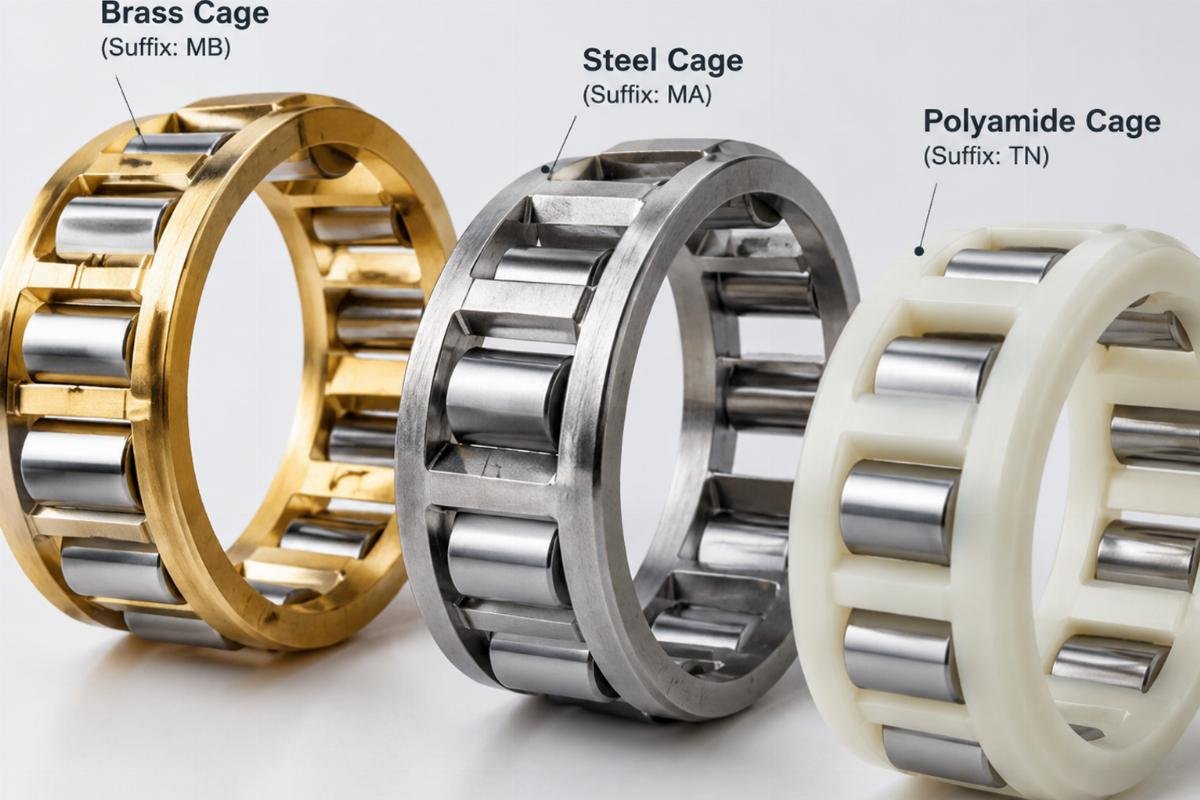
To avoid these traps, never assume that a suffix from one brand translates directly to another without verification. A reliable Bearing Suffix Codes comparison must account for these brand-specific variations. Always check the technical datasheet for the specific material composition and design details, not just the letter code.
How to Build a Reliable Cross-Brand Suffix Matrix?
Building a cross-brand suffix matrix is the best way to ensure consistent quality in multi-brand sourcing. This matrix serves as a reference tool that maps equivalent suffixes across major manufacturers like SKF, FAG, NSK, and others. It transforms ambiguous letter codes into clear, actionable specifications.
Start by listing the critical parameters: Clearance, Cage, Seals, and Tolerance. For each parameter, identify the standard suffixes used by your primary brands. Then, map them based on functional equivalence, not just letter similarity. For instance, map SKF’s C3 clearance to FAG’s C3, but verify if there are any brand-specific nuances in the actual micron values. [NEED_CITE: comparison of internal clearance values across major bearing manufacturers]
Next, include a column for “Verification Status.” Mark entries as “Verified” if you have tested the equivalence in real-world applications, or “Theoretical” if based only on catalog data. This distinction helps prioritize which substitutions are safe for critical applications.
A practical example involves a European wind farm operator. They maintained a fleet of turbines using bearings from multiple brands. By creating a detailed suffix matrix, they were able to standardize their spare parts inventory. When a specific SKF bearing was unavailable, they could confidently substitute it with an FAG equivalent because the matrix confirmed that the cage material and clearance class were functionally identical. This reduced their downtime significantly and simplified their procurement process.

Our approach to cross-brand substitution relies on such rigorous verification. We do not just match numbers; we validate the suffixes. Our strict suffix-verification shipping policy ensures that every bearing sent out matches the required internal design, clearance, and cage specifications. This guarantees 100% genuine, mismatch-free replacements, protecting your operations from the costly errors that I once made. When you consult with us for cross-brand equivalents, you are getting more than a part number; you are getting a verified solution backed by technical expertise.
Mastering Bearing Suffix Codes is the key to unlocking reliable global sourcing. It turns a potential liability into a strategic advantage, allowing you to leverage the best availability and pricing across brands without compromising on performance.
Conclusion
Suffixes define the bearing’s reality, not just its size.
Ignoring them invites failure, while decoding them ensures reliability. Use a structured approach to interpret internal design, cages, and clearance, and always verify cross-brand equivalents through a trusted matrix. This diligence protects your equipment and your bottom line.
Need a quote for the bearings in this article?
Send your part numbers and get price, stock and lead time within 4 hours.

Written by
authorEditor covering global sourcing, supplier verification, and industrial product knowledge. Content is compiled from manufacturer specifications, industry standards, and hands-on experience with international B2B buyers. Every article is fact-checked before publishing to help procurement professionals make informed decisions.
View all posts

