






71811c/P5 Angular Contact Ball Bearings for Automotive & Machinery [WARN] draft identifier mismatch
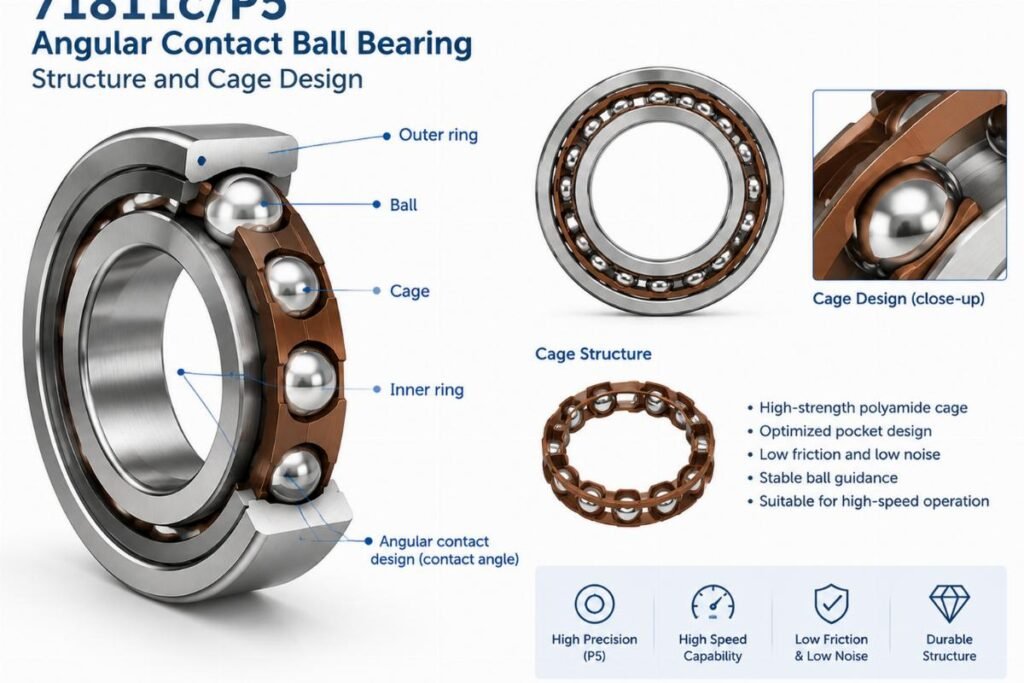
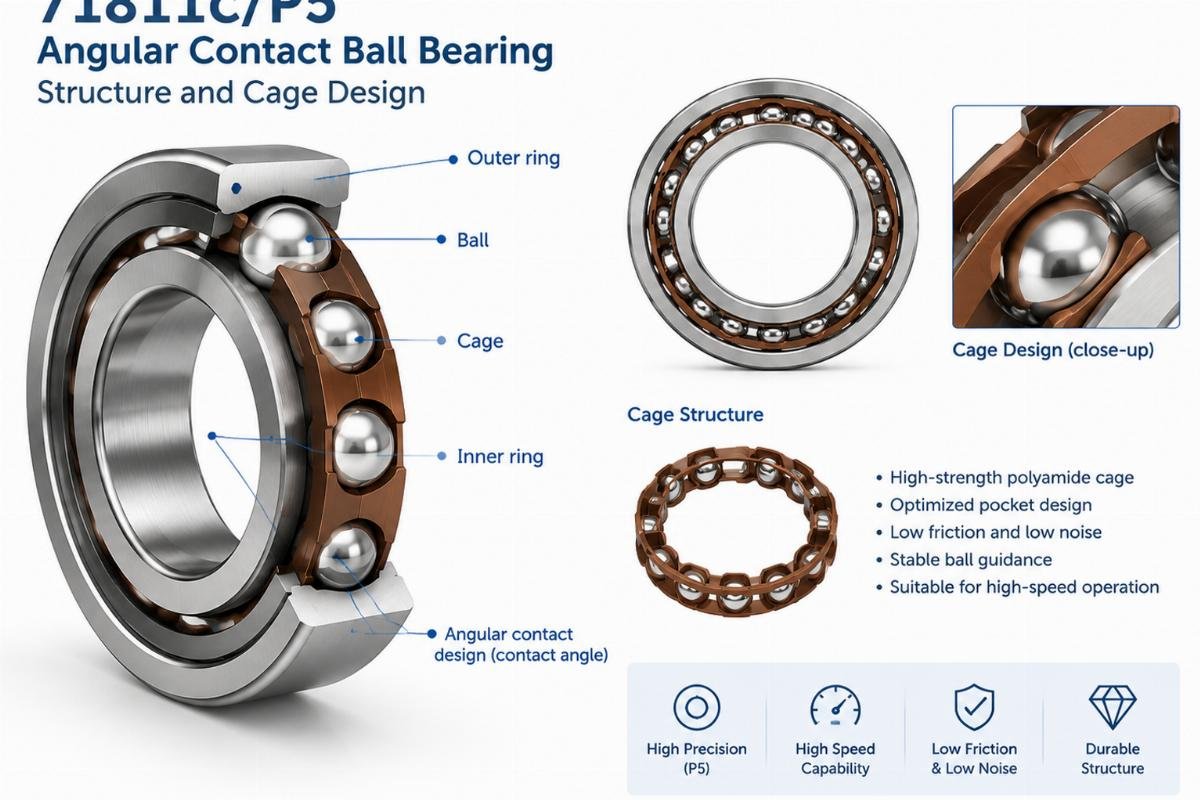
<p><strong>71811c/P5 Angular Contact Ball Bearing</strong> — featuring a 15° contact angle for optimized high-speed performance and P5 precision class ensuring tight dimensional and running accuracy.</p> <ul> <li>The lightweight polyamide cage minimizes friction heat, making it highly suitable for machine tool spindles, automotive components, and industrial pumps.</li> <li>Verify batch authenticity instantly via our official app QR verification channel before installation.</li> </ul>
Updated Daily
Within 4 Hours
No Minimum
Traceable
Specifications
| Parameter | Value |
|---|---|
| Brand | SKF |
| Type | Uncategorized |
| Model / Part Number | 71811c/P5 Angular Contact Ball Bearings for Automotive & Machinery [WARN] draft identifier mismatch |
| Bore Diameter (d) | Contact for specs |
| Outside Diameter (D) | Contact for specs |
| Width (B) | Contact for specs |
| Dynamic Load Rating (C) | Contact for specs |
| Static Load Rating (C₀) | Contact for specs |
| Reference Speed | Contact for specs |
| Limiting Speed | Contact for specs |
| Weight | Contact for specs |
Specifications shown are typical values. Contact us for confirmed dimensional and tolerance data for this specific model.
Technical Documents
Need help identifying this bearing?
Send us a part number, a drawing, or a photo. We'll confirm the exact SKF equivalent.
Product Description
Traceable Batch Origins — Every 71811c/P5 angular contact ball bearing ships with verifiable manufacturer lot records to ensure material integrity.
Technical Specifications
| Parameter | Value |
|---|---|
| Designation | 71811c/P5 |
| Bearing Type | Angular Contact Ball Bearing |
| Contact Angle | 15° |
| Precision Class | P5 |
| Cage Material | Nylon (Polyamide) |
| Material | Available in Gcr15 bearing steel and other variants |
| Seal or Shield Type | Open |
| Clearance Class | C0 to C5 available |
| Vibration Level | V1, V2, V3 |
| Rows Number | Single Row / Double Row |
| Aligning | Non-Aligning |
| Separated | Unseparated |
| Origin | Shandong, China |
Application Suitability
| Industry | Typical Applications |
|---|---|
| Automotive | Transmission shafts and steering column supports |
| Machinery | High-speed machine tool spindles and precision rotary tables |
| Fluid Handling | Centrifugal pump impeller shafts and compressor rotors |
Why Spindle Vibration Spikes When Ignoring the 71811c/P5 Angular Contact Ball Bearing Clearance
Thermal expansion at high speeds rapidly eliminates internal clearance if the initial fit is not matched to the operating temperature.
I once sourced spindle bearings for a Middle Eastern client where a minor oversight in preload and clearance tolerances led to catastrophic seizure under high-temperature machining conditions. The ambient heat combined with friction completely wiped out the internal gap. When deploying a 71811c/P5 angular contact ball bearing, ignoring the thermal growth of the shaft and housing turns precision equipment into scrap metal. Engineers often focus solely on the static load rating, forgetting that dynamic thermal displacement alters the actual operating geometry. This oversight causes the rolling elements to skid, generating excessive heat and ultimately destroying the raceway. [NEED_CITE: thermal displacement effects on bearing internal clearance]
Aligning the 71811c/P5 Angular Contact Ball Bearing with High-Speed Demands
High-speed machine tools and automotive powertrains demand components that minimize friction heat while maintaining absolute rigidity under load. The 15° contact angle inherent in this 71811c/P5 angular contact ball bearing optimizes the load distribution for predominantly axial forces combined with moderate radial loads. Our engineering team cross-references your specific spindle RPM and axial thrust to confirm this geometry prevents premature raceway fatigue. By matching the contact angle to the actual force vectors, we ensure the bearing operates within its optimal stress zone, significantly extending the operational lifespan of the assembly.
Managing Thermal and Lubrication Challenges in Precision Assemblies
Precision spindles and compressors generate significant friction heat, which directly impacts lubricant viscosity and internal clearance during continuous operation. An open bearing design requires a carefully managed external oil-air or oil-mist lubrication system to prevent starvation at elevated rotational speeds. Without a continuous supply of fresh lubricant, the polyamide cage can overheat and degrade rapidly. Furthermore, any contamination ingress in these high-speed environments accelerates surface fatigue, making cleanroom assembly protocols mandatory. The absence of integrated seals means the housing design must provide adequate labyrinth or contact seals to protect the internal components. [NEED_CITE: lubrication starvation failure modes in high-speed spindles]
Decoding the Polyamide Cage and P5 Tolerance Class
The polyamide cage significantly reduces weight and inertia, allowing faster acceleration and lower operating temperatures compared to machined brass alternatives. Achieving P5 precision ensures tighter dimensional and running accuracy, which is critical for minimizing vibration and noise in high-speed machine tool spindles. The 15° contact angle provides the optimal balance between axial rigidity and speed capability, preventing the balls from sliding under heavy thrust loads. Additionally, standard material options like Gcr15 bearing steel offer reliable hardness and wear resistance for typical industrial environments, ensuring the raceways can withstand repetitive contact stress. Selecting the correct clearance class, ranging from C0 to C5, compensates for the interference fit and thermal expansion during operation, preventing the bearing from locking up when the spindle reaches its maximum temperature.

The Operational Toll of Mismatched Precision and Clearance
Selecting an incorrect clearance class or ignoring precision requirements leads to unplanned downtime and catastrophic damage to the spindle housing. When internal clearance is completely eliminated by thermal expansion, the rolling elements skid rather than roll, causing rapid surface degradation and severe vibration. Such premature failure not only voids equipment warranties but also halts entire production lines for emergency repairs and component replacements. The financial impact extends far beyond the cost of the bearing itself, encompassing lost production time and potential damage to adjacent precision gears and motors. [NEED_CITE: rolling bearing failure mode classification per ISO 15243]
Securing Traceability and Technical Verification for Precision Components
Sourcing mixed-brand precision components often results in mismatched tolerances if suppliers lack rigorous technical oversight and verification processes. We verify the exact P5 running accuracy and 15° contact angle against OEM specifications before dispatch to ensure precise integration into your spindle assembly. Our inventory supports flexible consolidation, allowing you to combine single-unit emergency spares with bulk project shipments without compromising on quality control. We provide complete traceability documentation to guarantee the authenticity of premium brands like KOYO, NTN, and NSK, protecting your equipment from counterfeit risks. Furthermore, our cross-brand equivalent model consultation ensures you receive the correct replacement even during global supply chain disruptions, keeping your maintenance schedules on track.
Documentation & Authenticity
- Certificate of Conformity validating the P5 precision class and material grade.
- Original manufacturer batch traceability records linked to the specific lot number.
- Dimensional and running accuracy inspection reports confirming tight P5 tolerances.
- Material test certificates verifying the specific steel composition and hardness.
Storage, Handling & Mounting
- Keep the open bearing in original moisture-barrier packaging until mounting to prevent raceway corrosion.
- Use cleanroom-grade gloves during handling to avoid transferring oils that degrade high-speed spindle lubricants.
- Employ induction heating for inner ring mounting to preserve the precise P5 dimensional tolerances.
- Verify shaft shoulder runout before installation to maintain the exact 15° contact angle alignment.
Engineering Data Required for Technical Validation
To ensure optimal performance and prevent thermal seizure, please share your spindle's maximum RPM, axial and radial load profiles, and expected operating temperature range. Providing the OEM equipment model number allows our team to perform a precise cross-reference and verify the required clearance class and preload arrangement. This technical review guarantees the selected configuration aligns perfectly with your specific machining or automotive application, mitigating the risk of early failure. Supplying details about your lubrication system and housing seal design also helps us confirm that the open bearing format is suitable for your environmental conditions.
Frequently Asked Questions
Q: What does the 'c' suffix indicate in this bearing designation?
A: The lowercase 'c' suffix specifies a 15° contact angle, which is optimized for high-speed applications where axial loads are present but minimizing friction heat is critical. This geometry allows the bearing to sustain higher rotational speeds compared to larger contact angle variants.
Q: How does P5 precision compare to standard P0 class?
A: P5 precision dictates significantly tighter tolerances for both dimensional accuracy and running precision. This enhanced accuracy minimizes vibration and heat generation, making it essential for high-speed machine tool spindles and precision automotive components where standard P0 bearings would cause unacceptable runout.
Q: Can this open bearing be used in contaminated environments?
A: An open design is intended for clean environments with external lubrication systems, such as oil-air or oil-mist setups in machine tools. If your application involves dust or coolant ingress, you must rely on external housing seals, as the bearing itself lacks integrated contact seals to block contaminants.
Q: Why is cage material critical for high-speed spindles?
A: The polyamide cage is substantially lighter than brass, reducing centrifugal forces and friction heat at high RPMs. This lightweight construction allows for faster acceleration and better lubricant flow around the rolling elements, which is vital for maintaining thermal stability in precision machining equipment.
Cross-Brand Interchange
Find the equivalent part number from other major bearing manufacturers. Free cross-reference service -- contact us to confirm exact interchange.
| Brand | Equivalent Model | Status | Action |
|---|---|---|---|
| SKF ORIGINAL | 71811c/P5 Angular Contact Ball Bearings for Automotive & Machinery [WARN] draft identifier mismatch | Confirmed | -- |
| FAG | Request interchange | Pending | Get Equivalent → |
| NSK | Request interchange | Pending | Get Equivalent → |
| NTN | Request interchange | Pending | Get Equivalent → |
| TIMKEN | Request interchange | Pending | Get Equivalent → |
| INA | Request interchange | Pending | Get Equivalent → |
| IKO | Request interchange | Pending | Get Equivalent → |
| Koyo | Request interchange | Pending | Get Equivalent → |
| Nachi | Request interchange | Pending | Get Equivalent → |
Free cross-reference service: Send us any competitor part number and we'll identify the exact SKF equivalent with confirmed boundary dimensions.
Same Series Products
Other bearings in the same category you may need.


Ready to order 71811c/P5 Angular Contact Ball Bearings for Automotive & Machinery [WARN] draft identifier mismatch?
Send us the part number and quantity. We'll reply with price, stock availability and lead time within 4 working hours.